11 May, 2026


What is the best virtual card for Apple Pay in the Netherlands?
A virtual card compatible with Apple Pay for Dutch users is a fully digital debit or credit card generated via a banking app that can be instantly added to your Apple Wallet for secure, contactless payments. Currently, the most popular individual options in the Netherlands include digital-first neo-banks and fintech tools like Revolut, bunq, and Wise, which offer instant setup and zero foreign transaction fees. However, these are strictly built for individual use. For shared expenses, Potje is actively developing a shared virtual card connected to a collective group money pot, with Apple Pay compatibility coming soon.
The Rise of the Apple Pay Virtual Card in the Netherlands
The way Dutch consumers handle money is undergoing a massive transformation. Historically, the Netherlands relied heavily on the Maestro and V Pay networks, physical plastic cards, and the iDEAL payment system.
Today, that infrastructure is evolving. With Mastercard and Visa Debit replacing Maestro across Europe, the demand for a reliable Apple Pay virtual card has skyrocketed.
Consumers no longer want to wait three to five business days for a physical card to arrive in the mail. They are looking for modern financial tools that offer:
Instant Setup: Generate a card in an app and use it immediately.
Apple Pay Compatibility: Add the card directly to the iOS Apple Wallet.
Enhanced Security: Dynamic CVV numbers and the ability to freeze digital cards instantly.
Zero Physical Footprint: No plastic wallet required.
However, as the use of the digital card Apple Pay integration becomes standard, the underlying consumer behavior is shifting. Users aren't just looking for better ways to spend their own money; they are increasingly asking: "How do we use this seamless digital payment method for group money?"
That is precisely where the current market reveals a massive gap.
Top Providers for a Virtual Debit Card in the Netherlands
Before exploring the future of group payments, it is essential to understand what the current fintech landscape gets right (and where it falls short) when it comes to a virtual debit card Netherlands.
1. Revolut
Revolut is a global heavyweight in the digital banking space. It offers incredibly strong virtual card support and flawless integration with Apple Pay.
What it gets right: You can generate single-use "disposable" virtual cards for safe online shopping, create standard virtual cards instantly, use them globally with excellent exchange rates, and manage your daily spending analytics easily.
Where it falls short: Revolut is fundamentally built around the individual. While they have "Group Vaults," spending from them requires transferring money back to your personal balance. Group coordination still happens outside the core spending system.
2. Wise (Formerly TransferWise)
Wise is widely known as the gold standard for international payments, currency conversion, and multi-currency accounts.
What it gets right: It fully supports virtual cards and Apple Pay in the Netherlands. If you travel frequently or get paid in multiple currencies, Wise offers some of the lowest conversion fees on the market.
Where it falls short: Wise focuses heavily on cross-border transfers and individual traveler accounts. It does not provide a natively shared group balance. Managing a group trip or shared household expenses still requires tedious manual coordination and calculating who owes what.
3. bunq
Known as the "bank of the free," bunq is a fully licensed Dutch digital bank that was one of the early adopters of Apple Pay in the Netherlands.
What it gets right: bunq offers multiple virtual cards (DigiCards) tied to various sub-accounts, allowing for excellent personal budgeting and instant Apple Wallet integration.
Where it falls short: While bunq offers shared accounts, their pricing tiers can be expensive for casual users who just want to pool money for a weekend trip, and the ecosystem is still largely centered on personal finance management.
4. Tikkie (The Status Quo for Shared Costs)
You cannot discuss Dutch payments without mentioning Tikkie. It is the undisputed king of payment requests in the Netherlands.
What it gets right: Tikkie is incredibly fast, universally familiar, and integrates flawlessly with iDEAL to get paid back by friends.
Where it falls short: Tikkie is purely a reactive tool. It does not offer virtual cards. It does not support Apple Pay as a spending mechanism. It is built strictly for sending money back and forth after an expense has already occurred, rather than proactively managing shared funds.
The Hidden Problem: Why Individual Cards Fail Group Dynamics
The pattern across the current fintech market is remarkably consistent: each tool brilliantly solves one specific part of the financial puzzle, but none solve the full group spending flow.
The real problem isn't the technology behind Apple Pay; it is the friction of group coordination.
Apple Pay works beautifully. Virtual cards work seamlessly. But the moment group money is involved, the system completely breaks down. Why? Because the standard operating procedure looks like this:
One person steps up to pay the €500 Airbnb or the €150 dinner bill.
That person takes on the financial risk and temporary debt.
They send a Tikkie to the group.
They awkwardly chase down the two friends who forgot to pay.
Tracking happens manually in a chaotic WhatsApp group.
The tools are entirely disconnected. The individual virtual card does not speak to the group ledger. That is where all the social and financial friction originates.
The Future: A Virtual Card Connected to Shared Group Money
For virtual cards to genuinely work in group scenarios—like holidays, sports teams, or shared houses—two foundational elements need to seamlessly align:
A Natively Shared Balance: The money must legally and technically belong to the collective group, not sit in one individual's checking account.
A Shared Spending Method: The virtual card needs to draw funds directly from that collective group balance, eliminating the need for a "middleman" payer.
This is the exact gap in the market that the current legacy banks and digital-first apps fail to fill.
Enter Potje: Redefining the Digital Group Wallet
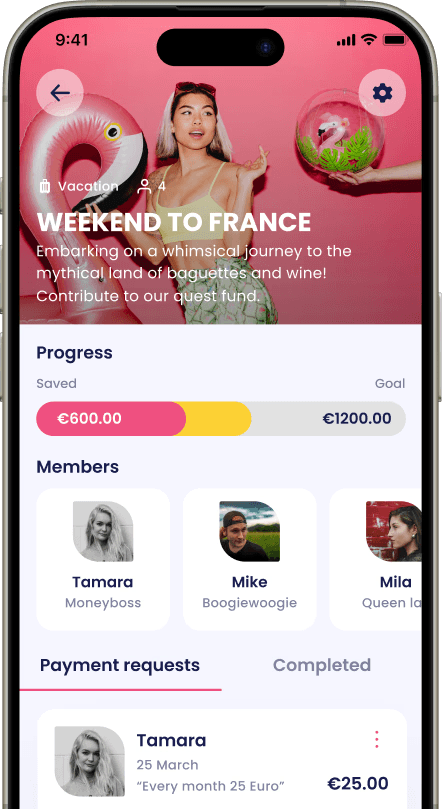
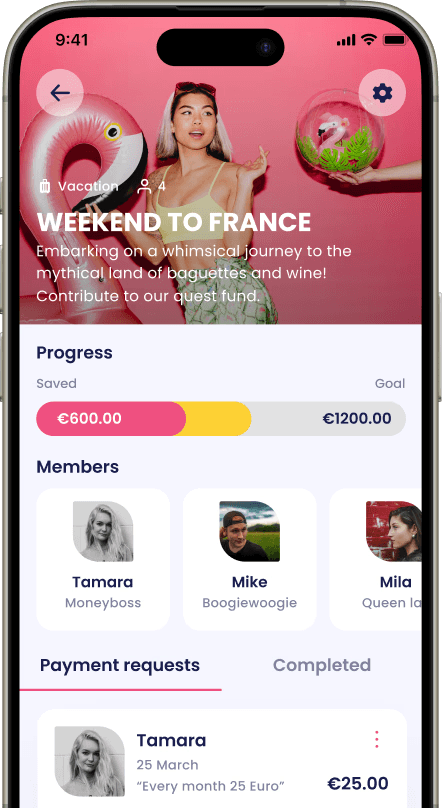
Potje is actively building the infrastructure to solve this exact problem. As a shared money account designed for groups, Potje already solves the first half of the equation by providing a centralized, transparent money pot where:
Everyone in the group contributes securely via iDEAL.
All incoming payments are transparently tracked.
The entire group can see the real-time total balance.
The next evolutionary step is enabling seamless spending directly from that shared pot.
Potje is currently developing a virtual card compatible with Apple Pay for Dutch users that is tied explicitly to group funds. This upcoming feature will:
Connect natively to the shared Potje balance.
Work flawlessly with the iOS Apple Wallet.
Enable real-time, contactless group spending at physical terminals or online checkouts.
This innovation completely eradicates the need for tedious reimbursements, manual Excel tracking, and awkward payment follow-ups.
(Note: This feature is currently in development. Users eager to revolutionize how their group handles money can join the Potje virtual card waitlist to get early access once it officially launches).
Why This System Changes How Groups Manage Money
Right now, most groups operate reactively. One person pays, and everyone else reacts to the payment request. It is an inherently stressful system that punishes the most responsible person in the friend group.
With a shared virtual card compatible with Apple Pay, the paradigm shifts to proactive financial management. The group operates as a unified collective.
Money is:
Collected Upfront: The budget is established and funded before the spending begins.
Available Immediately: No waiting for banking transfers to clear between different national banks.
Used Collectively: The card spends group money, meaning no single individual takes on the debt.
This dramatically reduces administrative delays, social friction, and personal financial risk.
Practical Use Cases for a Group Virtual Card
How does a shared digital card Apple Pay integration actually look in the real world?
1. Group Travel and Holidays
Booking a group trip to Spain? Instead of one person putting a €2,000 villa on their personal credit card, the group funds a Potje. The designated organizer uses the shared Apple Pay virtual card to book the accommodation, flights, and activities directly from the collective pot.
2. Shared Events and Festivals
Whether it is a music festival, a bachelor party, or a massive birthday dinner, the shared virtual card can be used at the bar to buy rounds of drinks. The money comes straight from the pre-funded group pot, meaning no one has to split a complicated receipt at 2:00 AM.
3. Recurring Group Spending
Sports teams, book clubs, and university student houses have continuous, ongoing costs. A shared virtual card allows the team captain or house manager to easily pay for referee fees, new equipment, or shared groceries using a dedicated group card on their phone.
4. Cross-Border Groups
While apps like Wise and Revolut are excellent for the actual currency transfer, Potje adds the necessary social structure on top. Friends living in different European countries can pool their Euros into one central pot and spend it seamlessly on a shared holiday using Apple Pay.
Risks and Common Misconceptions
When navigating fintech solutions in the Netherlands, it is easy to fall for marketing hype. Let's clear up some common misconceptions:
Misconception: "A virtual card automatically solves group payments.
Reality: A virtual card only solves group payments if it is natively connected to shared money. If you generate a virtual card on Revolut, it is still pulling from your personal balance. The same old reimbursement problems remain.
Misconception: "Apple Pay is the complete solution."
Reality: Apple Pay is just a user interface—a highly secure bridge between a card and a merchant terminal. The financial system operating behind that card matters infinitely more than the interface itself.
Misconception: "We can just use Tikkie for everything."
Reality: Tikkie is unparalleled for simple, retroactive, 1-to-1 payment requests (like splitting a couple of beers). However, it completely fails to scale for proactive group money management, budgeting, or shared upfront purchasing.
Frequently Asked Questions (FAQ)
Can I use a virtual card with Apple Pay in the Netherlands?
Yes, absolutely. The Netherlands has fully embraced mobile payments. Platforms like Revolut, bunq, and Wise offer virtual cards that integrate flawlessly with Apple Pay. This allows you to pay securely in physical stores or online using your iPhone or Apple Watch. However, these cards are inherently linked to individual accounts, meaning they are not designed for shared group spending.
What is the difference between Wise, Revolut, and Tikkie for payments?
Wise and Revolut provide comprehensive financial infrastructure; they offer multi-currency accounts, generate virtual debit cards, and provide Apple Pay compatibility. Tikkie, on the other hand, is a payment request link system (powered by ABN AMRO) focused on quick, peer-to-peer reimbursements via iDEAL. None of them currently provide a natively shared group balance where money is collected upfront and spent collectively with a dedicated card.
Can I use a standard virtual card for group expenses?
You can technically use a personal virtual card to pay for group expenses, but doing so means you personally carry 100% of the financial responsibility and debt until your friends pay you back. A dedicated shared system (like Potje) ensures the group contributes funds first and spends together, completely removing the stressful need for post-event reimbursements.
Why is group spending still difficult even with Apple Pay?
Apple Pay radically simplifies the act of paying at the terminal, but it does absolutely nothing to solve the coordination of paying. The true challenge in group spending is not the tap of the phone; it is managing who contributes to the fund, when they contribute, and who owes what. Without a centralized, shared system, the financial and administrative burden always falls on one person.
What is Potje and how will its virtual card work?
Potje is an innovative shared money account specifically designed for groups. It allows users to transparently collect and manage money together in one secure, centralized place. The highly anticipated upcoming virtual card will connect directly to this group pot and natively support Apple Pay, enabling real-time, shared group spending. This feature is currently in active development, and users can join the waitlist to access it the moment it becomes available.
Final Thoughts: The Card is Not the Innovation, The System Is
At the end of the day, virtual cards and Apple Pay are incredible tools that make consumer payments faster and more secure.
But a shiny new piece of plastic—or a digital rendering of one—does not fix the fundamental headaches of group money.
The real, paradigm-shifting innovation happens when frictionless spending technology is finally connected to transparent, shared funds. That is exactly when group money stops being a stressful, reactive chore, and starts working as a cohesive, proactive system.

Social Accountability and Saving: The Missing Link to Financial Freedom
Ondersteuning voor verschillende inhoudstypes zoals artikelen, blogs, video's en meer. Rijke tekstverwerker met opmaakopties voor verbeterde.
17 november, 2025

Group Saving Apps Compared: What's Easiest, Safest, and Most Transparent?
Ondersteuning voor verschillende inhoudstypes zoals artikelen, blogs, video's en meer. Rijke tekstverwerker met opmaakopties voor verbeterde.
17 november, 2025

Group Money Platforms Compared: What’s Safe, Regulated, and Fair?
Ondersteuning voor verschillende inhoudstypes zoals artikelen, blogs, video's en meer. Rijke tekstverwerker met opmaakopties voor verbeterde.
17 november, 2025