1 April, 2026


We often treat personal finance as a strictly private matter. We view saving money as a solitary test of character—a battle between our impulsive desires and our long-term discipline. But if willpower is the only tool in your box, you are fighting a losing battle.
Research in behavioural economics reveals a simple truth: we are terrible at self-regulation, but we are excellent at social compliance.
This is where social accountability and saving intersect. By moving your financial goals from the shadows of privacy into the light of a social circle, you can hack your psychology to save faster, consistently, and with less mental effort.
Why Willpower Is Overrated (The Psychology of Saving)
To understand why social accountability works, we first need to understand why saving alone often fails.
The Trap of Ego Depletion
Psychologists refer to willpower as a finite resource. This concept, known as ego depletion, suggests that every decision you make throughout the day—what to wear, what to eat, how to answer an email—drains your mental battery.
By the evening, when you are scrolling through a webshop or standing in the Albert Heijn looking at snacks, your willpower is exhausted. Saving requires active resistance, which is hard. Spending requires passive acceptance, which is easy.
Behavioural Economics: We Are Social Creatures
We evolved in tribes. For millennia, our survival depended on maintaining good standing with our peers. Consequently, our brains are wired to care deeply about "reputational capital."
When you save in secret, there is no reputational cost to failure. If you dip into your savings account for a holiday you can't afford, nobody knows. Social accountability introduces a "social cost" to bad financial behaviour, making discipline the easier choice.
How Social Accountability Supercharges Your Finances
Combining social dynamics with financial planning creates a powerful commitment device. Here is the science behind it.
The Hawthorne Effect: The Power of Being Watched
In the 1920s, researchers discovered that factory workers became more productive simply because they knew they were being observed. This is called the Hawthorne Effect.
The same applies to your money. When you share your savings goals with a partner, a friend, or a digital community, you trigger a sense of surveillance. You are less likely to skip a monthly deposit if you know someone else is watching the progress bar on your shared app.
Positive Peer Pressure vs. Lifestyle Creep
"Keeping up with the Joneses" is usually associated with overspending. However, peer pressure can be reverse-engineered.
If you surround yourself with a circle of friends who prioritise financial freedom and frugal wins, you experience positive peer pressure. Instead of competing on who has the newest car, you compete on who hit their savings target first. In the Netherlands, where doe maar gewoon (just act normal) is a cultural motto, this grounded approach to money is particularly effective.
Implementing Social Saving in the Netherlands
The Netherlands is uniquely positioned for social saving due to its high adoption of fintech and digital banking.
The Digital "Spaarpotje" Revolution
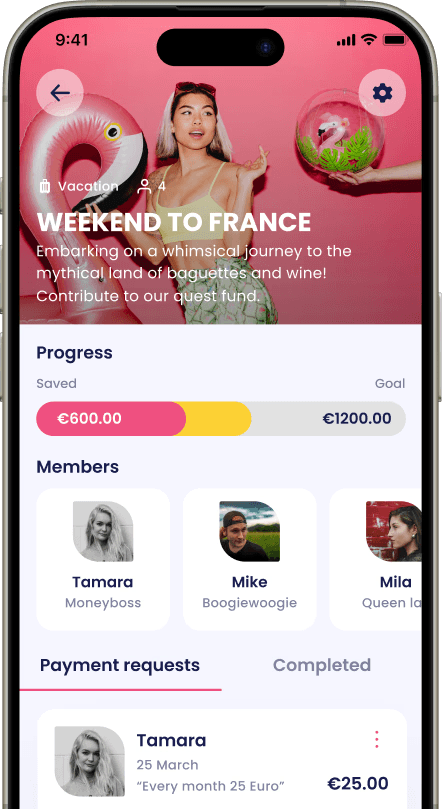
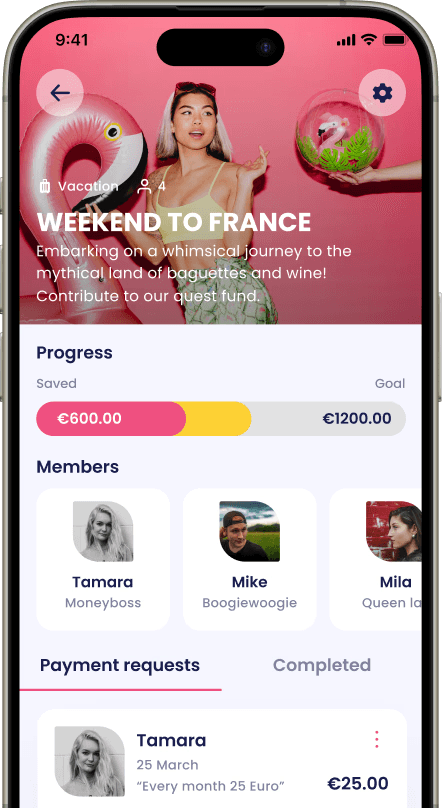
The Dutch concept of the spaarpotje (money pot) has gone digital. Potje has revolutionised this concept by allowing users to create shared spaces for money instantly.
Unlike a traditional joint account (en/of rekening) which requires complex paperwork and is usually reserved for romantic partners, modern "money pot" apps allow friends, roommates, and colleagues to pool resources or track goals together instantly. Potje makes this frictionless, lowering the barrier to entry for social saving so you can start in seconds, not days.
Finding the Right Accountability Partner
You don't need a financial advisor; you need a "money buddy." This person does not need to be wealthy; they just need to be disciplined.
A good accountability partner is:
Non-judgemental: They support your goals without shaming your slip-ups.
Transparent: They are willing to share their own progress (or lack thereof).
Consistent: They show up for the scheduled check-ins.
4 Practical Strategies to Leverage Social Accountability
Ready to stop saving alone? Here are four ways to integrate social accountability into your routine.
1. The Public Pledge
State your goal publicly. It could be a post on social media or a message in your family WhatsApp group: "I am saving €2,000 for a buffer by December."
Once the goal is public, your brain treats it as a promise. Breaking a promise hurts our ego more than breaking a private rule.
2. Gamified Savings Challenges
Gamification triggers the dopamine loop. Turn saving into a competition.
The "No-Spend" Weekend: Challenge a friend to spend €0 for 48 hours.
The Round-Up Race: Who can save the most "spare change" in a month using auto-save features?
3. Automated Group Pots
For shared goals (like a group trip, a wedding gift, or a festival), use a dedicated app to collect funds.
By using Potje, everyone can see who has contributed and who hasn't. This financial transparency ensures everyone pays their fair share on time and eliminates the awkwardness of chasing people for money later. It transforms the nagging request for repayment into a shared team effort.
4. The Check-In System
Schedule a monthly "Money Date" with your partner or accountability buddy. Review your numbers over coffee.
Did we hit the target?
What unexpected expenses derailed us?
What is the goal for next month?
This ritual normalises money conversations and keeps the momentum going.
Conclusion: Making Money Social
The narrative that money should be a private, lonely struggle is outdated. By leveraging social accountability, you bypass the limitations of your own willpower and tap into the power of community.
Whether it is through a shared digital pot for a holiday or a weekly check-in with a friend, involving others makes the journey to financial health faster, easier, and frankly, more fun. Stop acting like a lone wolf; the pack saves better.
Download Potje for free today and start building your financial community.
Social Accountability and Saving: The Missing Link to Financial Freedom
Ondersteuning voor verschillende inhoudstypes zoals artikelen, blogs, video's en meer. Rijke tekstverwerker met opmaakopties voor verbeterde.
17 november, 2025

Group Saving Apps Compared: What's Easiest, Safest, and Most Transparent?
Ondersteuning voor verschillende inhoudstypes zoals artikelen, blogs, video's en meer. Rijke tekstverwerker met opmaakopties voor verbeterde.
17 november, 2025

Group Money Platforms Compared: What’s Safe, Regulated, and Fair?
Ondersteuning voor verschillende inhoudstypes zoals artikelen, blogs, video's en meer. Rijke tekstverwerker met opmaakopties voor verbeterde.
17 november, 2025