14 January 2026


Introduction to Collective Savings Power
It is a well-established principle that saving money is more effective when done collectively. Historically, this concept has manifested in Savings Groups and Credit Associations (like ROSCAs) which foster habit, accountability, and financial inclusion, often benefiting those with limited access to traditional banking. Informal savings groups are social organizations formed to help community members save money for specific purposes. These groups often form as rotating or accumulated savings and credit associations, providing structure and support for members. Over 70% of people in emerging markets do not have a formal bank account, making these groups a vital financial tool. Some members also maintain a formal savings account alongside their participation in informal groups, combining the benefits of both systems. Additionally, savings groups provide a way to save for children’s education in low-income communities, offering a pathway to improved opportunities for future generations. Family members benefit from group savings, as family dynamics can influence saving behavior and decision-making within the group. Furthermore, these groups provide a way for vulnerable, ultra-poor households to save for their children’s education, ensuring even the most disadvantaged families can invest in their future. Savings groups can support the poorest members of the community, though challenges remain for the very poorest who may struggle to participate fully. The effectiveness and structure of savings groups can vary by country, with national contexts such as those in South Africa and Tanzania influencing how these groups operate and the impact they have on financial development and social outcomes.
In the modern context, while we may not be relying on traditional village associations, the fundamental psychological drivers remain the same. Potje applies this proven science—Social Capital, Mental Accounting, and Gamification—to group savings for everyday goals, from holidays to household bills. It transforms the often-isolated task of saving into a shared, successful collective effort. The two most common types of informal savings groups are Rotating Savings and Credit Associations (ROSCAs) and Accumulated Savings and Credit Associations (ASCAs). Members of informal savings groups are required to make a small monthly deposit to the community fund, ensuring consistent participation and growth. Contributing regular deposits is essential for group success, as it helps build trust and financial stability. Making regular deposits to the group fund is a key part of participation, supporting both individual and collective goals. Members often take out a loan from these groups to pay for school fees, manage emergencies, or invest in their livelihoods, which helps improve attendance rates and ensures children can continue their education uninterrupted. In countries like South Africa and Tanzania, savings groups have played a significant role in expanding financial access and supporting community development. Donors like USAID have funded programs to expand savings group access, while international NGOs often implement savings group programs to promote financial inclusion and capacity building.
Understanding Savings Mechanisms
Savings groups are a powerful example of how collective action can drive financial inclusion, especially in developing countries where access to formal banking services is limited. These groups, often formed at the community level, operate as informal savings and credit associations. Each savings group member contributes a set amount of money at regular intervals—weekly or monthly—into a shared fund. Over time, these accumulated savings become a valuable resource for the group.
One of the key benefits of savings groups is their ability to provide loans to members at low interest rates. This internal lending system allows group members to access credit when they need it most, without the barriers or high costs often associated with traditional financial institutions. For example, in many countries, savings groups have enabled small businesses and entrepreneurs to access the funds needed to invest in equipment, expand operations, or manage cash flow during slow periods. Additionally, savings groups help families pay for educational expenses and keep their children in school, ensuring that financial barriers do not hinder access to education. By pooling their money, group members not only save money together but also create opportunities for growth and economic development within their communities.
The structure of savings groups ensures that everyone has a stake in the group’s success. Regular contributions and the ability to access loans help members build financial discipline and resilience. As a result, savings groups play a crucial role in promoting financial inclusion, supporting small businesses, and driving economic growth in countries where formal financial services may be out of reach for many. Moreover, these groups can help reduce student absenteeism by enabling timely payment of education fees, ensuring that children can continue their studies without interruption.
The Role of Social Capital and Accountability
The primary reason group saving works is Social Capital. Saving together creates an accountability structure that is far stronger than individual willpower. Social influence can either positively encourage responsible saving or negatively lead to overspending to match peers, highlighting the importance of a well-structured group dynamic. Group settings also shape individual saving behavior, fostering positive financial habits and supporting behavioral change towards better financial decision-making. Additionally, self-efficacy, or the belief in one's ability to succeed, is linked to higher savings rates, as it empowers individuals to take consistent action toward their financial goals.
Peer Pressure as a Positive Force: In traditional savings groups, members are more likely to repay loans or contribute their fixed amount on time to avoid damaging their relationships with others. Potje leverages this same principle: when everyone can see the progress on the dashboard, the social contract encourages timely payment. Nobody wants to be the one slowing down the group’s progress towards the shared goal.
Building Community: Savings groups create a platform for members to support each other and share knowledge. Potje translates this into digital collaboration, where every member is invested in the group’s financial stability and success. Each participant plays a crucial role in supporting the group’s stability and overall success. Groups can enhance financial literacy through shared financial knowledge and advice. Additionally, savings groups can create a self-sustaining safety net to help families withstand shocks and contribute to growth. Many savings groups also set up special internal funds to support the most vulnerable local children or pay insurance premiums into the community health fund, further strengthening the social fabric. Moreover, savings groups help members accumulate assets related to livelihoods, such as garden tools, which can be used to increase income and improve financial stability.
These social mechanisms significantly increase the effectiveness of savings groups in achieving their financial goals.
Choice Architecture and Mental Accounting
These psychological concepts are critical to forming effective saving habits, and Potje uses them to its advantage. Saving in groups can demand significant mental effort and behavioral change, as individuals must overcome obstacles like inaction bias, fear, and the challenge of prioritizing future needs over immediate desires.
Structured programs like Potje leverage these psychological principles to improve saving outcomes and promote positive financial behaviors.
1. Mental Accounting
People mentally separate money into different “accounts” or “buckets” based on purpose (e.g., ‘fun money,’ ‘rent money,’ ‘holiday fund’). Often, this means physically or digitally dividing cash into separate categories for specific uses, which helps manage financial flexibility and emergencies.
The Potje Solution: Potje’s services allow users to create a dedicated, purpose-driven money pot that is legally separate from their personal current account. By assigning value to each savings pot, users can clarify their financial priorities and better measure the benefits of their savings. This acts as a digital barrier, ensuring the money saved for the trip is not accidentally spent on everyday expenses. It immediately structures your group finances in a way that aligns with informed, goal-oriented decision-making.
2. Choice Architecture (Leveraging Friction)
Choice architecture is about designing an environment that guides users toward better decisions. Sometimes, adding friction makes saving easier.
The Potje Solution: By requiring a simple click within the app to transfer money into the secure pot, Potje introduces a helpful layer of friction between the user and the shared funds. This makes it slightly more difficult to access the shared funds than their personal money, preventing impulsive spending and strengthening the saving commitment. This approach also reduces the risk of impulsive withdrawals, helping protect group savings and supporting the financial stability of members.
Leveraging Gamification for Momentum
Overcoming barriers to saving often means making the process more engaging. This is where Gamification comes in, providing rewards and incentives for saving. Gamification strategies are focused on motivating participants to achieve their savings goals, ensuring that efforts are intentionally directed toward positive outcomes. Gamification can also motivate employees to take action towards saving, turning what might feel like a chore into an enjoyable and rewarding experience.
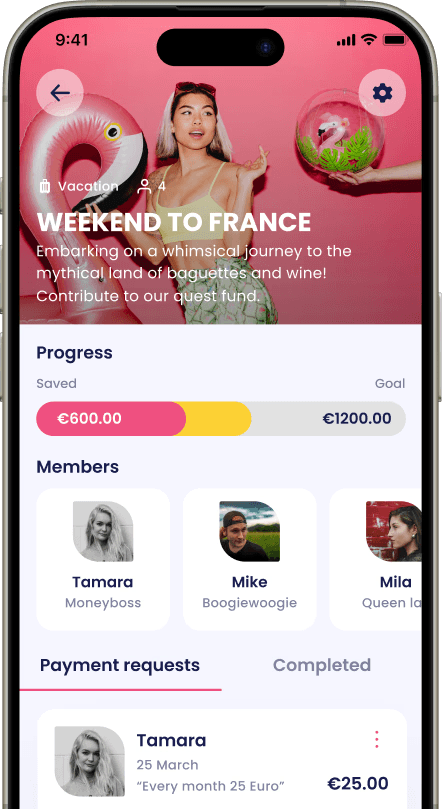
Visual Success Metrics: Potje measures the success of the savings program visually. The real-time dashboard shows the amount saved and how close the group is to its target, allowing participants to benefit from seeing their progress in real time. Seeing the pot fill up acts as a reward, injecting fun and motivation into the saving process.
Automated Reminders: Potje uses automation to eliminate the need for awkward manual chasing. This streamlined process prevents the collection effort from feeling like a tiresome chore, thereby maintaining the group’s momentum and focus on the goal.
Enabling Access and Reducing Overburden
For low and moderate-income workers or those overburdened with tasks beyond work, managing complicated finances is a heavy burden. Saving can be challenging due to insufficient and inconsistent income. Savings groups foster a savings habit, smooth household income, and build household financial assets, providing a structured way to overcome these challenges. Participation in savings groups is also correlated with improvements in household food security and dietary diversity, further enhancing the well-being of members and their families. In Tanzania, households that participated in savings groups were more likely to be food secure and have greater levels of dietary diversity, showcasing the tangible benefits of collective saving efforts. Employers can leverage trust to deliver workplace emergency savings programs, further supporting employees in building financial resilience.
Potje simplifies this complexity. By managing the payment collection and tracking automatically, Potje enables quick access to group funds for planned purchases, reducing the financial stress often associated with manual organisation. Group funds can also be used to invest in a business or support self-employed members, helping them grow their operations or manage variable income. It gives time back to the organiser while ensuring everyone meets their commitments. Loans from the group can help cover urgent expenses, such as school fees or medical bills, providing immediate financial flexibility for members. Automating savings can significantly enhance the financial health of employees, making it easier for them to consistently contribute and achieve their financial goals.
Savings groups are a key subject in development programs aimed at improving financial inclusion and community resilience.
The Impact of Financial Pressures
Financial pressures such as economic shocks, sudden illness, or job loss can have a profound impact on households, especially in low-income settings. Savings groups offer a practical solution by providing a financial safety net for their members. When group members save money together, they create a pool of funds that can be used to pay for essential expenses like school fees, food, or emergency medical bills. This collective approach helps reduce the risk of poverty and supports food security for vulnerable households.
In times of crisis, access to group loans can be a lifeline, allowing members to cover unexpected costs without resorting to high-interest debt or selling valuable assets. The shared responsibility within savings groups also encourages open discussion about financial challenges, enabling members to learn from each other and make better financial decisions. By working together, group members can plan for the future, manage risk, and build resilience against economic shocks.
Savings groups not only help households meet immediate needs but also foster a sense of community and mutual support. This collaborative environment empowers members to save, invest, and achieve greater financial stability, even in the face of ongoing financial pressures.
The Role of Technology
Technology is transforming the way savings groups operate, making it easier and more efficient for members to save money and access loans. Mobile banking and digital payment systems have opened up new possibilities for savings groups, allowing members to contribute to their savings from anywhere and at any time. This is especially valuable in rural or remote areas where traditional banking services may be unavailable.
For example, some organizations now offer mobile apps designed specifically for savings groups. These digital tools help groups manage their accounts, track contributions, and monitor loans, all in real time. By streamlining financial management, technology increases the effectiveness of savings groups and reduces the administrative burden on group leaders.
Access to digital services also means that savings groups can reach more people, expanding their impact and promoting financial inclusion on a larger scale. With technology, group members can make informed decisions, access financial services, and grow their accumulated savings more efficiently. As a result, technology is helping savings groups become even more effective in supporting their members’ financial goals.
The Importance of Emergency Savings
Building emergency savings is a critical component of financial stability, and savings groups provide an ideal platform for members to create a safety net. By setting aside a portion of their regular contributions, group members can establish an emergency fund that is available when unexpected expenses arise—such as medical emergencies, school fees, or sudden economic shocks.
Having access to emergency savings reduces the risk of falling into poverty when faced with unforeseen challenges. It allows households to pay for urgent needs without disrupting their long-term savings goals or taking on high-interest debt. For many group members, knowing that there is a secure fund available in times of crisis brings peace of mind and confidence to plan for the future.
Savings groups that prioritize emergency savings help their members achieve greater financial success and resilience. By working together to save money and support each other, group members can navigate life’s uncertainties, reduce financial risk, and build a foundation for long-term achievement and stability.
Financial Literacy and Savings
Financial literacy is a cornerstone of success for savings groups, especially in developing countries where access to traditional banking services can be limited. When savings group members understand the basics of budgeting, saving, and investing, they are empowered to make smarter financial decisions that benefit not only themselves but also their families and communities.
Savings and credit associations provide a supportive environment where members can learn how to set savings goals, manage their income, and plan for the future. For example, a member might learn to create a simple budget, prioritize essential expenses, and consistently contribute to the group’s savings pot. This habit of saving money, even in small amounts, helps households build up accumulated savings that can be used to weather economic shocks or invest in opportunities like small businesses or education.
Access to formal savings accounts is another major advantage for group members. By depositing their contributions into a secure account, members can earn interest on their savings, increasing the total amount available for future needs. This is particularly beneficial for women, who often face barriers to accessing financial services. With the support of their group, women can save money, access loans, and invest in projects that improve their families’ well-being.
Savings groups also play a vital role in promoting food security. Members can use their savings to invest in agricultural projects or start small businesses, leading to increased income and greater stability for their households. By pooling resources and sharing knowledge, group members support each other in achieving their savings goals and overcoming challenges.
The collective nature of savings groups makes them appealing and effective. When members work together, share responsibilities, and celebrate each other’s successes, they create a positive environment that encourages others in the community to join. This sense of support and shared purpose can lead to a ripple effect, inspiring more people to develop a savings habit and invest in their future.
Ultimately, financial literacy and savings groups go hand in hand in driving financial inclusion and community growth. By providing access to education, formal savings accounts, and loans, savings and credit associations help individuals and households achieve their goals, improve their quality of life, and contribute to the overall success of their communities. In countries around the world, these groups are proving to be a powerful tool for reducing poverty, increasing resilience, and building a brighter future for all.
Conclusion
The science confirms that we are inherently better at saving when we are connected by a shared goal and a system of mutual accountability. Potje takes the proven principles of social capital and behavioural science and applies them to modern group finance. The dynamic within groups helps individuals overcome self-control problems and instant gratification tendencies that hinder savings. For example, in Ghana, participants in savings groups experienced significant increases in primary and secondary school enrollment, demonstrating the broader societal benefits of collective saving efforts. While positive outcomes are common, challenges can happen during the saving process—such as unexpected expenses or delays—but structured group mechanisms help address these issues and keep members on track. However, external factors like inflation can impede the ability to save by increasing living costs, making it even more critical to have structured and supportive saving mechanisms in place.
By providing a secure, transparent, and gamified money pot, Potje allows groups to easily leverage the collective power required to achieve their financial goals.
Ready to start saving smarter, together? If you are interested in improving your financial habits, consider joining or forming a group saving initiative. Create your dedicated Potje today and unlock your group’s saving power.

Social Accountability and Saving: The Missing Link to Financial Freedom
Ondersteuning voor verschillende inhoudstypes zoals artikelen, blogs, video's en meer. Rijke tekstverwerker met opmaakopties voor verbeterde.
17 november, 2025

Group Saving Apps Compared: What's Easiest, Safest, and Most Transparent?
Ondersteuning voor verschillende inhoudstypes zoals artikelen, blogs, video's en meer. Rijke tekstverwerker met opmaakopties voor verbeterde.
17 november, 2025

Group Money Platforms Compared: What’s Safe, Regulated, and Fair?
Ondersteuning voor verschillende inhoudstypes zoals artikelen, blogs, video's en meer. Rijke tekstverwerker met opmaakopties voor verbeterde.
17 november, 2025
