14 May 2026



Can you use Apple Pay for shared group money?
You can only execute payments with Apple Pay from a Shared Group Fund if that specific digital fund is natively connected to a supported virtual debit card. Because Apple Wallet connects exclusively to cards rather than raw bank account ledgers, most current peer-to-peer (P2P) tools and standard savings accounts do not support shared group spending. While apps like Wise or bunq offer individual virtual cards, they do not offer seamless group-funded cards without heavy administrative friction. To solve this, new fintech solutions are bridging the gap. The reality of paying with Apple Pay from a shared group fund: how Potje makes it possible lies in their upcoming virtual debit card that links directly to communal group funds, enabling real-time checkout without the need for post-purchase reimbursements.
The Core Challenge: Why Group Money Breaks Down at Checkout
Using Apple Pay for your personal expenses is incredibly frictionless. You generate a virtual card, add it to your Apple Wallet, double-click your smartphone, and tap to pay at the merchant terminal.
However, the exact moment you attempt to use that seamless mobile wallet technology for a shared money account, the entire system breaks down into a chaotic administrative chore.
Why does this happen? Because traditional banking and mobile wallets are fundamentally built around the individual, not the group.
When you are managing a shared budget for a group holiday, a roommate fund, or a local sports team, the critical question at the checkout counter always becomes: "Whose card is actually being charged right now?"
Because a standard debit or credit card must be legally tied to one specific individual, you cannot just "tap" a shared vault at a terminal. Even if your group of friends has successfully pooled money into a digital savings account, you must transfer the money out of that shared pool and into someone's personal checking account. Then, that designated person uses their personal Apple Pay to cover the bill.
This creates a massive bottleneck. The designated organizer becomes the person fronting the cost, absorbing the financial liability, and chasing down friends for reimbursements. The payment itself is instant; the social coordination is absolutely not.
The Technical Gap: What You Actually Need for Apple Pay Group Spending
To successfully execute Apple Pay group spending without leaving one single person stuck with the financial liability, two specific financial components must exist simultaneously:
1. A Natively Shared Group Fund
This is the foundational digital ledger where the group’s money actually lives.
Every single member of the group must be able to contribute easily and securely (via iDEAL, credit card, or bank transfer).
The total balance must be fully transparent and visible to all participants in real time.
The funds must legally belong to the collective "pot," rather than being tangled up in one person's private checking account.
2. A Virtual Debit Card Connected Directly to That Fund
Apple Pay does not—and technically cannot—connect directly to a raw savings account routing number or a basic expense-tracking app balance. Apple Pay is strictly a secure user interface that connects to physical or digital payment cards.
Therefore, your shared fund absolutely needs a supported virtual debit card linked directly to its balance. If either of these two components is missing, the group spending system simply does not work, and you revert back to the age-old, stressful problem of sending payment requests.
Where Current Fintech Tools Fall Short
While the European financial technology market is highly advanced, a closer look reveals that almost every major tool solves only one part of the equation, leaving group coordination deeply fragmented.
Wise and Revolut (Great for Travel, Bad for Group Liability)
Both Wise and Revolut are phenomenal platforms that heavily support virtual cards and flawless Apple Pay integration.
Where they succeed: They are industry leaders for international payments, multi-currency accounts, and personal spending flexibility.
Where they fail: Both platforms are structurally designed for individual use. There is no true, transparent shared group balance where multiple people can independently fund a central pot. If you use Revolut for a group dinner, you are still personally covering the bill and praying your friends pay you back.
Splitser and Tikkie (Great for Tracking, Impossible for Spending)
Splitser and Tikkie are the undisputed champions of expense tracking and payment requests in the Netherlands.
Where they succeed: They organize the problem perfectly. They track who bought what and help collect money incredibly fast after an expense has occurred.
Where they fail: They do not actually hold your money, nor do they offer virtual cards or Apple Pay integration. They are purely debt-collection and tracking tools, not proactive money-management systems. They organize the friction, but they do not remove it.
The Bottom Line: Each of these tools solves one specific administrative headache. None of them connect everything into a single, seamless, proactive group spending flow.
Paying with Apple Pay from a Shared Group Fund: How Potje Makes It Possible
To entirely eliminate this friction, the market requires a tool that flawlessly handles both the upfront collection of funds and the point of sale.
Potje is actively building toward this complete, unified financial ecosystem.
Step 1: The Shared Group Fund (Available Now)
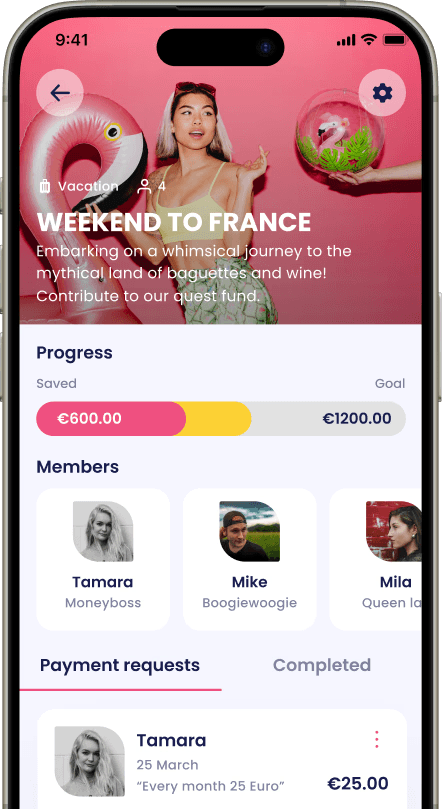
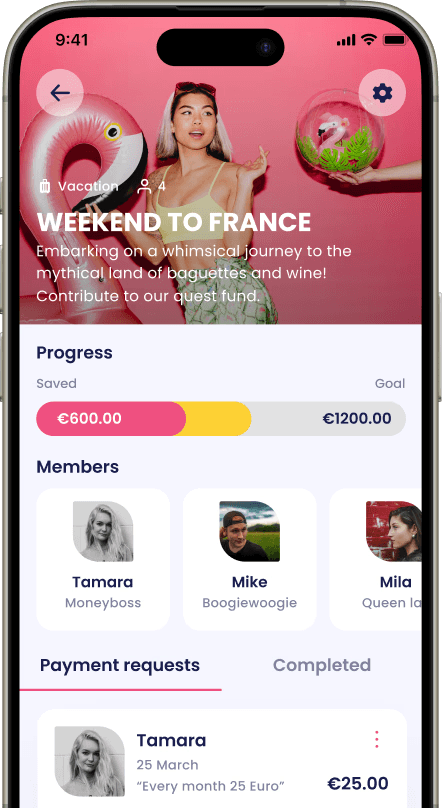
Potje already flawlessly solves the hardest part of the equation. It provides a secure, intuitive shared money account where:
Everyone in the friend group or team contributes their share upfront.
All incoming payments are tracked automatically and transparently.
The entire group sees one centralized, real-time balance on their devices.
Step 2: The Missing Piece – Proactive Spending (Coming Soon)
The next evolutionary step in fintech is connecting that perfectly organized shared money directly to Apple Pay.
Potje is actively developing a virtual debit card feature that will revolutionize group finance. This upcoming integration will:
Link Directly to the Group Pot: The card draws funds only from the shared balance, never from your personal checking account.
Be 100% Compatible with Apple Pay: You will be able to add the Potje virtual card directly to your iOS Apple Wallet.
Allow Real-Time Group Spending: The designated organizer can simply tap their phone at a terminal, and the money is instantly deducted from the collective group fund.
Important Note for Transparency: This specific virtual card functionality is currently in active development and has not launched yet. However, once available, it will completely eradicate the need to ever split costs or chase reimbursements after an event again.
You can join the Potje virtual card waitlist to be the first to access this feature.
Transforming Group Behavior: From Reactive to Proactive
Right now, group money is entirely reactive. Someone is forced to pay a massive bill, and everyone else reacts to the subsequent debt and payment requests.
With a shared Apple Pay setup natively connected to a centralized pot, group money becomes entirely proactive.
The group funds the pot upfront. The group spends the pot collectively.
This massive psychological and financial paradigm shift removes:
Financial Imbalance: No single friend is ever left carrying the credit card debt or financial pressure for the whole group.
Delayed Decision Making: You never have to wait three days for a peer-to-peer bank transfer to clear before booking a group flight.
Manual Tracking: The app acts as the unquestionable, transparent ledger for every single transaction.
It replaces social anxiety with a financial system that actually operates in real time, moving exactly as fast as your group does.
Practical Use Cases for a Shared Money Account
How does this proactive Apple Pay system actually look in the real world?
1. Seamless Group Travel
When booking a massive group trip, the organizer can use the shared Apple Pay virtual card to pay for the Airbnb accommodation, EasyJet flights, or guided tours directly from the pre-funded group pot. No one maxes out their personal credit limit, and no one is left waiting for international transfers.
2. Shared Events and Festivals
At a loud, crowded music festival or a large birthday dinner, the designated "pot manager" can walk up to the bar, double-click their iPhone, and pay for a massive round of drinks using the shared balance. There is no chaotic splitting of the receipt at the end of the night.
3. Recurring Group Expenses
Amateur sports teams, university clubs, or roommates can use one shared digital savings account for ongoing, monthly costs. Need to buy new tennis balls or pay the shared internet bill? Just tap the group card.
4. Mixed Bank Users
It does not matter if one friend uses ING, another uses Rabobank, and another uses a foreign bank. Everyone contributes securely into the Potje from their respective banks. The shared virtual card then effortlessly handles the universal spending centrally.
Risks, Red Flags, and Common Misconceptions
When searching for group financial solutions, it is easy to fall for clever marketing hype. Avoid these common misconceptions:
Misconception: "Apple Pay magically solves group payments."
Reality: It absolutely does not. Apple Pay is just a highly secure user interface. It simplifies the act of paying, but it does nothing for the coordination of paying.
Misconception: "Any virtual card can be used for group expenses."
Reality: Only if the card is natively connected to shared money. If you spin up a virtual card on your personal banking app, it still drains your personal funds. One person is still carrying 100% of the cost.
Misconception: "Expense tracking apps are enough."
Reality: Traditional tracking apps are incredibly useful after the spending has happened. They organize the debt, but they do absolutely nothing to prevent the debt from occurring in the first place.
Frequently Asked Questions (FAQ)
Can you actually use Apple Pay with a shared group fund?
You can only do this if the shared group fund officially provides a virtual debit card that is supported by Apple Pay. Because Apple Pay does not connect directly to raw bank account routing numbers, it requires a digital card interface. Currently, most casual shared savings setups do not include this feature, which is why group spending still heavily relies on one person paying upfront and everyone else reimbursing them days later. A shared card connected directly to group funds is an absolute requirement.
Why do current banking apps not support shared Apple Pay spending?
Most modern banking apps are strictly designed for individuals due to regulatory and compliance structures. Even when they offer Apple Pay or sleek virtual cards, these are inherently linked to personal accounts. Group coordination is legally and technically treated as a separate problem, which is exactly why users are forced to rely on multiple different tools (one app to chat, one app to track, one app to pay) instead of one unified system.
Is Revolut or Wise better for group spending with Apple Pay?
Both Revolut and Wise support Apple Pay brilliantly, but strictly at an individual level. While they offer exceptional currency exchange rates, one person still must physically pay the merchant and then wait for others to reimburse them. They do not provide a natively shared group fund with a connected spending card, which severely limits their usefulness in true group scenarios.
What is the actual difference between a shared group fund and a normal joint account?
A shared group fund (like Potje) allows multiple, casual participants to contribute funds and see the exact same balance with extremely low onboarding friction. A normal joint account behaves like a traditional bank product, requiring intense identity verification, shared legal liability, and complex setup procedures from all parties. In group scenarios, this difference matters immensely because it determines how easily you can onboard friends for a short-term trip versus a long-term marriage.
What is Potje and how will it work with Apple Pay?
Potje is a highly secure shared money account designed specifically for groups. It empowers users to transparently collect, track, and manage money together in one centralized dashboard. The highly anticipated upcoming virtual card will connect directly to the communal group pot and integrate flawlessly with Apple Pay. This will enable real-time group spending without ever having to split costs retroactively.
Conclusion
The future of Apple Pay and digital mobile wallets is absolutely shared.
Apple Pay has already brilliantly solved the physical mechanics of frictionless speed. Virtual cards have already solved instantaneous financial access.
What is entirely missing is shared control.
When the frictionless tap of an Apple Pay wallet is finally linked natively to pre-funded, shared communal money, the entire group dynamic changes forever. Spending stops being a reactive, stressful chore and becomes a seamless, proactive experience. That is the exact monumental shift in group finance that Potje is actively building toward, and that is what will make group money finally work for everyone.

Social Accountability and Saving: The Missing Link to Financial Freedom
Ondersteuning voor verschillende inhoudstypes zoals artikelen, blogs, video's en meer. Rijke tekstverwerker met opmaakopties voor verbeterde.
17 november, 2025

Group Saving Apps Compared: What's Easiest, Safest, and Most Transparent?
Ondersteuning voor verschillende inhoudstypes zoals artikelen, blogs, video's en meer. Rijke tekstverwerker met opmaakopties voor verbeterde.
17 november, 2025

Group Money Platforms Compared: What’s Safe, Regulated, and Fair?
Ondersteuning voor verschillende inhoudstypes zoals artikelen, blogs, video's en meer. Rijke tekstverwerker met opmaakopties voor verbeterde.
17 november, 2025