21 July 2026



You're planning a group holiday. Or a birthday gift. Or a weekend away with eight friends who all have different banks, different schedules, and very different relationships with the word "I'll transfer you later."
Sound familiar?
This is exactly where group money gets messy. And it's why more people across Europe are searching for a better way to organise shared finances before the awkward conversations start.
Two tools come up regularly in this conversation: bunq shared accounts and Potje. Both help groups manage money together. But they work very differently, and choosing the wrong one can create more friction than it solves.
Here's the honest breakdown.
What Is a Bunq Shared Account?
Bunq is a full digital bank, licensed across Europe. Their shared account feature, called a Joint Account, lets up to 10 people become co-owners of a real bank account. Everyone gets their own debit card. Everyone can see transactions in real time. And the account comes with a Dutch IBAN, making it easy to receive transfers, set up direct debits, and manage ongoing expenses.
It is genuinely useful for situations where a group needs a permanent, shared banking structure. Think couples managing household bills. Roommates splitting rent and utilities. A small club with recurring costs.
What bunq's Joint Account is built for:
Long-term shared expenses between a fixed group
Couples or partners managing household finances together
Roommates splitting bills, subscriptions, and utilities
Groups who all want their own debit card linked to one account
The catch? Every member needs their own bunq account. Creating a Joint Account requires a paid bunq subscription (Core, Pro, or Elite). And once the account is set up, co-owners cannot be removed or changed. It is a permanent financial structure, not a flexible collection tool.
That works perfectly for some situations. For many group money scenarios, it is more than most people need.
What Is Potje?
Potje is a dedicated group money platform, built specifically for one purpose: helping groups collect money together before they spend it.
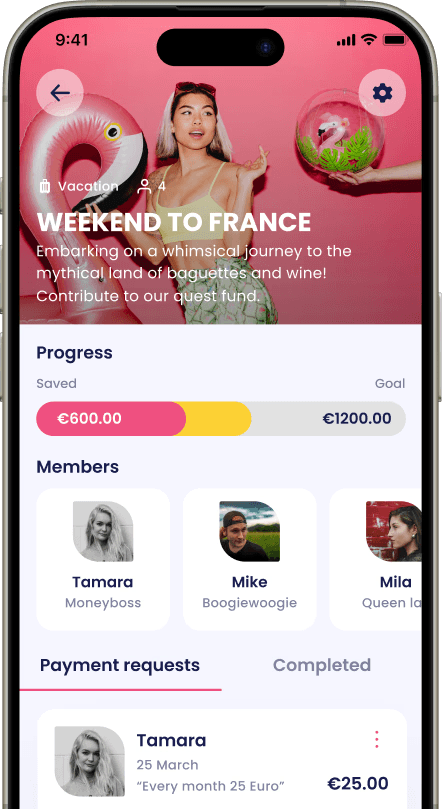
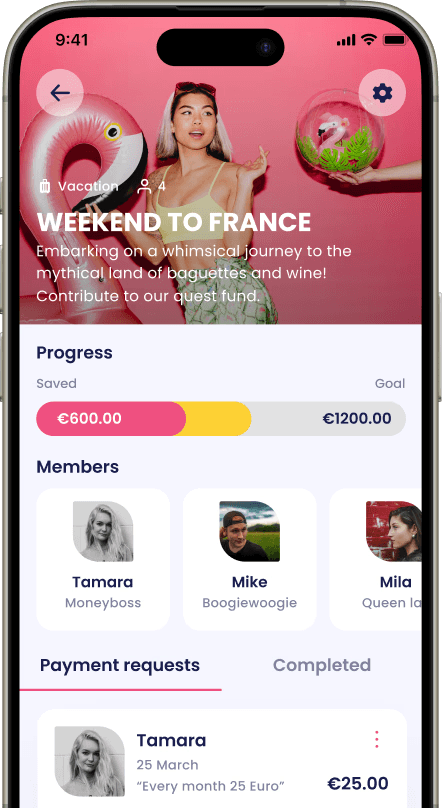
Instead of opening a shared bank account, you create a money pot. You set a goal, invite your group, and everyone contributes upfront. No one person carries the financial burden. No one chases transfers after the fact. The money is there before the booking is made.
One platform taking a different approach to group finance is Potje. Rather than adding another bank account to your life, it gives your group a dedicated space to save towards a shared goal.
What Potje is built for:
Holidays, trips, and travel funds
Group gifts and birthday collections
Festival budgets and event planning
Sports clubs and team subscriptions
Any situation where a group needs to save together before spending
The key difference is the philosophy. Bunq shared accounts are reactive: money flows in and out as people spend. Potje is proactive: the group agrees on a goal, contributes towards it, and spends only when the pot is ready.
The old way: One person books the Airbnb. Everyone promises to pay them back. Someone forgets. Reminders get sent. Awkwardness follows.
The Potje way: Everyone contributes to the pot first. The goal is reached. The booking gets made. No chasing. No friction.
Bunq Shared Account vs Potje: Side-by-Side Comparison
Feature | Bunq Joint Account | Potje |
Purpose | Shared banking for ongoing expenses | Group saving towards a shared goal |
Setup | All members need a paid bunq account | Only the organiser needs the app |
Group size | Up to 10 co-owners | Flexible group sizes |
Upfront contributions | No, reactive spending | Yes, collect before spending |
Payment reminders | No | Automated |
Goal tracking | No specific goal feature | Built around shared goals |
Best for | Couples, roommates, long-term shared bills | Friends, trips, gifts, events |
Membership fee | Paid subscription required | No subscription required |
Co-owner changes | Fixed, cannot be changed after setup | Flexible |
The Subscription Question
This is worth pausing on. To create a bunq Joint Account, at least one member needs a paid bunq subscription. That makes sense if you are already a bunq customer and want to add shared banking to your existing setup.
But if your goal is simply to collect money for a group trip or a birthday gift, paying for a full banking subscription is a significant overhead for a one-time or seasonal need.
Potje costs €5.00 per month per active pot - but that fee is split automatically across the whole group. For a group of five, that is €1.00 each. For ten people, just €0.50. The organiser sets up the pot, shares a link, and the group contributes. The cost takes care of itself.
The Flexibility Question
Bunq's Joint Account has one important limitation that catches people off guard: once co-owners are assigned, they cannot be removed or changed. The account is permanent.
For a holiday group that changes from year to year, or a birthday collection that involves different people each time, this is a real constraint.
Potje is built for exactly that kind of flexibility. Each pot is its own collection, with its own goal and its own group.
Which One Should You Use?
The honest answer is: it depends on what kind of group money problem you are trying to solve.
Choose a bunq Joint Account if:
You and your partner or roommates want a shared bank account for everyday household expenses
You need a real IBAN for direct debits, salary sorting, or recurring payments
You are already a bunq customer and want to extend your banking to a fixed group
You need everyone to have their own debit card linked to one account
Choose Potje if:
You are planning a group trip, festival, or shared experience
You want to collect money for a birthday gift, group present, or team event
You need automated payment reminders so you are not the one chasing everyone
Your group changes depending on the occasion
You want everyone to contribute upfront, before any money gets spent
The core distinction is this: bunq is a bank that happens to offer shared accounts. Potje is a group money platform built from the ground up for shared goals.
If you need banking infrastructure, bunq is a strong choice. If you need a smarter way to collect and save money as a group, Potje is purpose-built for exactly that.
Frequently Asked Questions
Can I use bunq and Potje at the same time?
Yes. They solve different problems. You might use bunq as your personal bank and Potje to organise a group holiday fund. The two tools complement each other rather than compete directly.
Does everyone in the group need to download Potje?
No. Only the organiser needs the Potje app. Contributors can pay into the pot via a shared link, without needing to create an account or download anything. This makes it significantly easier to get a group moving quickly.
Do all group members need a bunq account for a Joint Account?
Yes. Every co-owner must have their own bunq account before they can join a Joint Account. Non-bunq users will need to sign up and complete identity verification before the account becomes active.
Can I remove someone from a bunq Joint Account?
No. Once co-owners are set, they cannot be removed or changed. If the group changes, the account must be closed entirely. This is an important consideration for groups that change from one occasion to the next.
Is Potje free to use?
Potje does not require a subscription to create and manage money pots. The organiser can set up a pot, invite contributors, and track progress without paying a monthly fee.
What happens to the money in a Potje if the trip gets cancelled?
Funds in a Potje pot are held securely and can be returned to contributors or redirected to a new goal. The organiser manages the pot and decides how the money is used.
Which is better for a group holiday: bunq or Potje?
For a group holiday, Potje is the better fit. It is built around collecting money upfront towards a specific goal, sending automated reminders to contributors, and tracking progress in real time. A bunq Joint Account works better for ongoing shared expenses between a fixed group, not for one-off travel collections.
Start Saving Together with Potje
Group money does not have to be complicated.
The right tool is the one that matches how your group actually works. For ongoing household expenses with a fixed group, a shared bank account makes sense. For trips, gifts, festivals, and shared experiences where the group wants to save together before spending, Potje is built for exactly that.
No spreadsheets. No awkward reminders. No one person carrying the cost while everyone else promises to pay later.
Everyone contributes. The goal gets reached. Then you spend.
Ready to organise your group money the smarter way? Create your first money pot on Potje and see how easy it is to get your whole group saving together.
If you're saving up as a group for a trip, event, or gift, Potje makes it easy to collect money into one shared digital pot instead of chasing people for their share. Start a pot through this link and get your first month free. After that it's €5 a month per pot, taken straight from the pot balance, so there's nothing to pay upfront to start saving together.

Social Accountability and Saving: The Missing Link to Financial Freedom
Ondersteuning voor verschillende inhoudstypes zoals artikelen, blogs, video's en meer. Rijke tekstverwerker met opmaakopties voor verbeterde.
17 november, 2025

Group Saving Apps Compared: What's Easiest, Safest, and Most Transparent?
Ondersteuning voor verschillende inhoudstypes zoals artikelen, blogs, video's en meer. Rijke tekstverwerker met opmaakopties voor verbeterde.
17 november, 2025

Group Money Platforms Compared: What’s Safe, Regulated, and Fair?
Ondersteuning voor verschillende inhoudstypes zoals artikelen, blogs, video's en meer. Rijke tekstverwerker met opmaakopties voor verbeterde.
17 november, 2025
