21 May 2026



Choosing the Right Kids Money Management App
When deciding between Buut vs Potje: Which app helps parents better track and teach kids about money, the decision fundamentally comes down to individual awareness versus collective responsibility. Buut—a neobank designed for teenagers (10-16) by the creators of Tikkie (ABN AMRO)—excels at helping kids track their own personal pocket money through individual digital savings and payment pots. Potje, however, is a comprehensive family money app that allows parents and kids to securely pool funds, transparently track contributions, and collaboratively manage shared financial goals. If your goal is simply to let your child observe their personal spending, Buut is a solid choice. But if your goal is to proactively teach them how household budgeting, trade-offs, and shared financial systems actually operate in the real world, Potje provides a vastly superior, hands-on educational environment.
The Real Challenge: Kids Learn Money Through Systems, Not Just Numbers
Most parents share the exact same financial goal for their children: they want them to deeply understand the value of money.
Parents do not just want their kids to know how much cash is in their digital wallet; they want them to understand the mechanics of how money actually works. This includes understanding why consistent saving matters, how impulsive spending affects long-term goals, and how complex financial trade-offs are negotiated.
The Problem with Modern Financial Literacy:
Most digital banking tools and kids money management apps present money as something strictly personal and isolated. But in real life, household money is shared. Families plan together, save for holidays together, spend collectively, and make difficult financial compromises together.
That is exactly where the vast majority of youth banking apps fall short. They teach children how to spend, but they fail to teach them how to manage a real-world financial ecosystem.
Let's break down the five major problems in teaching kids money, and compare exactly how Buut and Potje approach the solutions.
Problem 1: Kids See Money, But Don’t Understand Where It Comes From
Giving a teenager a debit card or a basic digital banking app creates immediate awareness, but it does not create deep understanding. They might easily see their current balance or scroll through their past transactions, but they remain completely blind to the "behind-the-scenes" mechanics: how household money is collected, how collective goals are built, and how hard work turns into financial outcomes.
How Buut Handles This: Buut is a highly visual, youth-focused neobank where kids can track their own spending and divide their pocket money into handy "pots" (e.g., a pot for snacks, a pot for clothing). It successfully builds personal awareness. However, it remains entirely focused on individual behavior. The child sees what they spend, but they do not see the broader financial ecosystem.
How Potje Solves It: Potje creates a transparent, shared ecosystem. Kids see the full flow of money. They see funds coming in from multiple contributors (parents, grandparents, older siblings). They watch the total collective balance grow in real-time, and they witness how decisions are made from that unified pool. They learn how wealth is systematically built, rather than just observing how quickly it is spent.
Problem 2: Saving Feels Abstract Without a Shared, Tangible Goal
Parents often tell their children, "Let’s save up for the family holiday," or "Let's put money away for the new PlayStation."
But without a structured, visible system, that goal becomes incredibly vague to a child. Kids simply cannot visualize the progress clearly. They do not understand their specific role in achieving the goal, and they fail to grasp the massive impact of consistency over time.
With Buut: Saving is a solitary activity. A teenager can create a personal savings pot inside the app to earn a small interest yield, but it focuses entirely on their own isolated habits.
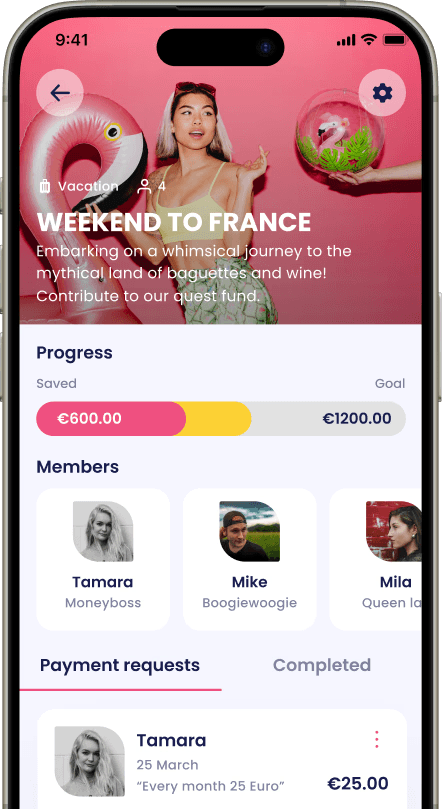
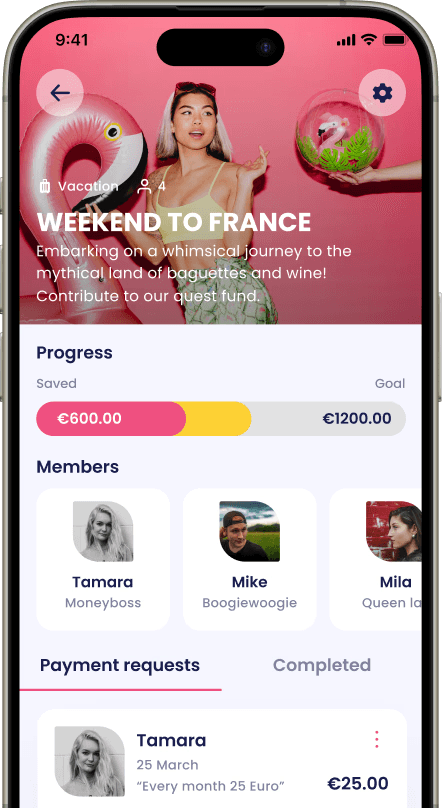
With Potje: Saving instantly becomes a collaborative, shared mission. Everyone in the family contributes to the exact same centralized pot. The overarching goal is highly visible on the dashboard, making the progress feel real and tangible. This collaborative approach motivates children because they can literally watch the family's collective outcome building up day by day.
Problem 3: Kids Are Excluded From Real Money Decisions
In the vast majority of modern families, children are completely shielded from actual financial decisions. They see the end result (buying groceries or booking a vacation), but they are entirely excluded from the stressful decision-making process. Because of this, they entirely miss out on learning about budget limits, opportunity costs, and collective compromises.
With Buut: Teenagers independently observe their own spending limits (e.g., "Empty means empty" in their clothing pot), but they do not engage in broader family financial discussions.
With Potje: Kids are granted an age-appropriate "seat at the table." Because the shared pot is visible, they can see exactly what the family has pooled together, what those funds are earmarked for, and how withdrawing money for one desire impacts the total available budget for another. Money transforms from a lecture into a lived, shared experience.
Problem 4: Parents Lack Proactive Visibility Into Spending
This is one of the most frustrating gaps in modern parenting. Parents usually default to two flawed methods: they hand out untraceable physical cash and completely lose visibility, or they transfer a digital allowance and simply hope the child uses it responsibly, only asking awkward questions after the money is already gone.
With Buut: Parents receive a dedicated interface to monitor their child's spending patterns and automate pocket money transfers. This greatly helps with parental oversight, but it is still fundamentally reactive. You are only viewing history—what has already happened.
With Potje: The financial visibility is inherently shared. Contributions from all family members are visible upfront, and the total pot is clear before a single cent is spent. Furthermore, with Potje's upcoming virtual card functionality, parents will be able to understand spending in real-time while keeping all purchasing tightly tied to a predefined, shared family goal.
Problem 5: The "Single Financial Parent" Trap
In most households, the heavy burden of financial responsibility and administration falls on exactly one parent. They are the ones tracking the allowances, paying for the school trips, and managing the subscriptions. This dynamic creates a severe lack of transparency and drastically reduces the number of "teachable moments" for the kids.
With Buut: The parents still manage the underlying funding system (transferring the allowance), while the kids passively observe their own app interface.
With Potje: The financial system is democratized. Everyone in the family sees the exact same shared balance. The contributions are entirely transparent, and the administrative process is visible to all. This removes the unfair burden from the "financial parent" and creates significantly more involvement and educational engagement across the entire family unit.
Where Other Tools Fit Into the Family Finance Ecosystem
To truly understand Buut vs Potje: Which app helps parents better track and teach kids about money, it helps to map out where other popular Dutch financial tools sit in the ecosystem.
Splitser: Excellent for tracking shared expenses after they occur. It perfectly shows who owes what, but it does not hold your funds and it absolutely does not teach proactive saving or shared family planning.
Tikkie: The gold standard for sending rapid payment requests. It is phenomenally useful for quick, peer-to-peer (P2P) transactions, but it provides zero financial structure, budgeting tools, or educational learning for children.
Buut: A highly effective, visually driven neobank tailored for teenagers. It focuses beautifully on individual tracking, personal awareness, and independent pocket money management. It is great for teaching individual spending behavior, but it completely lacks shared, multi-person family dynamics.
Potje: The ultimate shared money management tool. It seamlessly connects upfront contributions, radical financial visibility, and collective decision-making into one unified, proactive system designed for the whole family.
Practical Ways Families Use Potje to Teach Financial Literacy
How does a shared family money app actually translate into better financial parenting?
Saving for a Shared Family Goal: Whether it is pooling money for a weekend trip to Efteling, a new family gaming console, or a backyard trampoline, kids can actively see the progress bar move and feel pride in contributing their own small amounts to the collective fund.
Allowance With Real-World Context: Instead of treating pocket money as isolated spending cash, kids begin to understand how their money fits into a much larger, interconnected household system.
Mastering Shared Decisions: Families can sit down together, look at the Potje balance, and democratically choose what to spend the money on, naturally opening up healthy discussions about financial trade-offs (e.g., "If we buy this now, we have to wait a month to afford that").
Everyday Learning: Kids witness in real-time how daily actions, automated contributions, and minor expenses immediately affect the total bottom line.
The Next Evolution: Connecting Learning to Real-Time Spending
Understanding how money works conceptually is only the first step. The second, much more difficult step is actually utilizing it safely in the real world.
Right now, spending from a shared family fund often breaks the system. Why? Because the digital pot does not have a physical payment mechanism. One parent still has to use their personal credit card, withdraw the money from the savings pot to reimburse themselves, and the educational transparency is instantly lost.
What Potje is Building Next to Solve This:
Potje is actively developing a secure virtual debit card connected natively to the shared family pot.
This revolutionary integration will allow:
Direct Payments: Spending directly from the collective family pot.
Apple Pay & Google Wallet Compatibility: Modern, tap-to-pay convenience.
Real-Time Spending Visibility: Instant transaction updates visible to the whole family.
(Important Note for Transparency: The shared group card and Apple Pay functionality are currently in active development and are not live just yet. However, once launched, families will be able to add the card to their mobile wallets, spend directly from their shared funds, and physically show kids how money moves at the checkout counter in real-time. Forward-thinking parents can join the Potje waitlist here to secure early access).
Frequently Asked Questions (FAQ)
Is Buut a good app for teaching kids about money?
Yes, Buut is an excellent app for helping children understand their own personal spending. By utilizing visual "pots" to divide pocket money, it builds strong awareness of where their allowance goes and how to budget individually. However, because it focuses entirely on isolated, individual behavior, it does not show kids how money works in shared, collaborative household situations—which limits its ability to teach real-world family financial dynamics.
What is the absolute best way to teach kids money management?
The most highly effective way to teach financial literacy is through active participation, not just passive observation. Kids absolutely must see how money is earned, collected, saved, and utilized in real-life scenarios. A shared financial system allows them to understand how small contributions add up, how compromises are negotiated, and how spending directly affects future outcomes. This creates a vastly more complete learning experience than just handing them a debit card.
Can parents monitor where their kids are spending money on these apps?
Yes, but the level and quality of that insight depend entirely on the system being used. Individual banking apps (like Buut) give parents an interface to review past transactions reactively. Shared systems (like Potje) provide deep, proactive context. Potje offers the entire family full visibility into the total balance before spending occurs. With upcoming virtual card features, parents will see spending from the shared pot in real-time, helping them guide behavior without needing to constantly interrogate their children.
How is Potje fundamentally different from Buut?
The core difference lies in the architecture: Potje focuses on shared money management, while Buut focuses on individual tracking. Potje allows families to seamlessly collect money into one centralized pot, track contributions automatically, and make purchasing decisions together as a unit. This helps kids deeply understand how money operates in real-life group situations, rather than merely observing their own isolated spending habits.
What is Potje and how does it help families teach financial literacy?
Potje is an innovative shared money account designed specifically for groups and families. It empowers users to create a digital pot, invite family contributors, and securely collect money in one highly transparent place. By providing full, real-time visibility into contributions and balances—alongside upcoming features like Apple Pay spending—Potje creates the ultimate, complete system for families to teach the mechanics of both saving and spending together.
Conclusion: The Shift From Tracking to Total Visibility
Kids simply do not learn how money works by merely tracking it.
Tracking shows them what already happened. Visibility shows them how the machine actually works.
If children only ever see the final act of spending, they learn to be financially reactive. But if they are exposed to a shared, transparent financial ecosystem—where they can actively watch money pool, grow, and be allocated through collective decisions—they learn to think critically about wealth.
That is the profound difference between just handing a child an allowance, and actually teaching them how to use it well.
If you're saving up as a group for a trip, event, or gift, Potje makes it easy to collect money into one shared digital pot instead of chasing people for their share. Start a pot through this link and get your first month free. After that it's €5 a month per pot, taken straight from the pot balance, so there's nothing to pay upfront to start saving together.

Social Accountability and Saving: The Missing Link to Financial Freedom
Ondersteuning voor verschillende inhoudstypes zoals artikelen, blogs, video's en meer. Rijke tekstverwerker met opmaakopties voor verbeterde.
17 november, 2025

Group Saving Apps Compared: What's Easiest, Safest, and Most Transparent?
Ondersteuning voor verschillende inhoudstypes zoals artikelen, blogs, video's en meer. Rijke tekstverwerker met opmaakopties voor verbeterde.
17 november, 2025

Group Money Platforms Compared: What’s Safe, Regulated, and Fair?
Ondersteuning voor verschillende inhoudstypes zoals artikelen, blogs, video's en meer. Rijke tekstverwerker met opmaakopties voor verbeterde.
17 november, 2025
