7 May 2026



Flat fee pricing is usually better for group money management because it keeps costs predictable and fair across the community. A percentage-based pricing structure may seem cheaper at first, but it scales with the amount of money, which can make it much more expensive over time. To make an informed decision, the right choice depends on whether you are just moving money or actually managing it as a team.
The pricing conversation most groups ignore
No one starts a group fund thinking about fee structures. You are usually focused on other factors: who is in, how much to collect, what the budget is, and when to book the event.
Pricing only becomes a subject of messaging and discussions when a person in the group asks:
"Wait, why are we paying these fees?"
That moment matters more than it seems. Because pricing is not just about costs. It shapes the transparency of the process and dictates how fair the system feels inside the group.
Two models, two completely different philosophies
When you review the market, there are generally only two real pricing models in group money apps and online platforms.
Percentage pricing
You pay a percentage of the cash being moved. This is common in payment tools, transfer apps, and particular service programs. It works well when the product is solely focused on transactions. Many companies and business services use this model to generate profit from their clients.
Flat fee pricing
You pay a set amount per group, per plan, or per month. This is common in software and systems that give you control to actually manage money, not just move it.
The difference is subtle, but it defines how the app behaves and the value it provides.
Why percentage pricing feels right at first
Percentage pricing sounds straightforward and fair. You only pay when you use it, and you expect to pay based on how much you use.
For small expenses, it works perfectly. Sending $20 to a friend, splitting dinner after a party, or paying someone back via Apple Pay or Visa—the cost feels invisible. Many of these peer-to-peer tools integrate directly with your bank account or debit card, enabling fee-free transfers and reimbursements. That is why simple peer-to-peer tools fit this model. They are built for quick, one-off interactions.
Where percentage pricing starts to break
The moment you move from basic payments to managing group finances, things change. Now you are dealing with larger amounts, multiple members, and a longer schedule.
And suddenly, percentage pricing scales with your success. Do the math: the more money your group collects, the more you pay. You don't get lower rates for being a good saver.
That creates a strange dynamic. The system becomes more expensive as it works better. For organizations or friends saving for trips or managing a portfolio of long-term goals, this lack of limits becomes noticeably expensive very quickly.
Why flat fees match how groups actually behave
A flat fee removes that scaling problem, as shown by Potje’s simple flat-fee model for group savings. The cost stays the exact same whether:
You collect $100 or $5,000
You have 3 people or 10
The pot runs for one month or several
That stability matters in group settings. Because groups care about fairness and benefits that actually matter, not just the total cost.
Security and compliance considerations for group money apps
When choosing a group money app—whether for a business, non profit organization, or a community of friends—security and compliance should be at the top of your checklist. The right pricing structure, whether it’s a flat fee, percentage-based fee, or a free version with limits, is only valuable if the app also protects your money and data, as in Potje’s secure, Dutch-regulated group savings platform.
Fee structures can influence not just your costs, but also the level of service and security you receive. For example, some apps offer a free plan with basic features, while others charge a set amount or a percentage for access to advanced tools, custom integrations, or higher file storage limits. If you’re using a particular service like Apple Pay or Visa within the app, review any additional fees or terms that may apply.
Security is non-negotiable. Look for group money apps that provide end-to-end encryption, two-factor authentication, and secure payment processing. These features help ensure that every transaction—whether you’re paying for an event, managing a team budget, or collecting cash for a group trip—is protected from start to finish. Apps with a straightforward and transparent pricing structure, like Tab or Plates, often make it easier to understand what you’re paying for and what security measures are included.
Compliance is equally important, especially for organizations managing larger sums or sensitive data. Make sure the app complies with relevant regulations such as GDPR for data privacy and PCI-DSS for payment security. This is particularly crucial for non profit organizations or community groups that need to demonstrate responsible financial management.
Beyond security and compliance, consider the practical tools and features the app offers. Does it allow you to set a budget, track expenses, and create custom integrations for your group’s unique needs? Can you easily manage members, schedule payments, and automate reminders, like Potje’s shared expense management with reminders and tracking? The best apps combine robust security with practical management tools, giving you control and transparency over your group’s finances.
User experience matters too. A user-friendly interface, responsive customer support, and positive reviews from other users can make a big difference in how smoothly your group manages money. Before you decide, review the app’s terms and conditions, check for any hidden fees or limits, and make sure the support team is accessible if issues arise.
How Potje structures its pricing
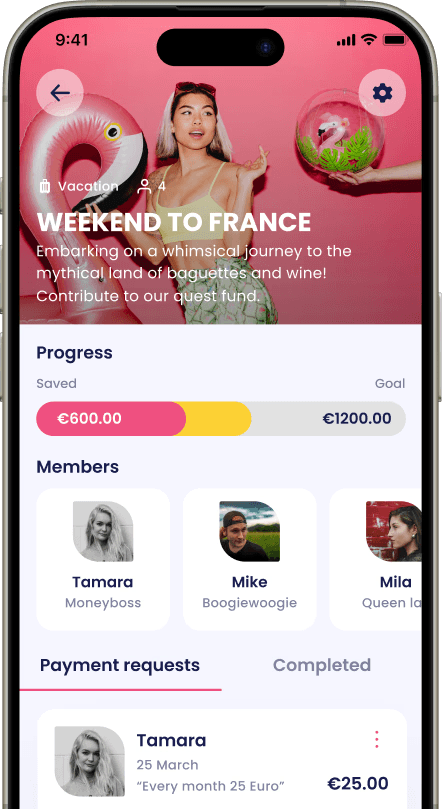
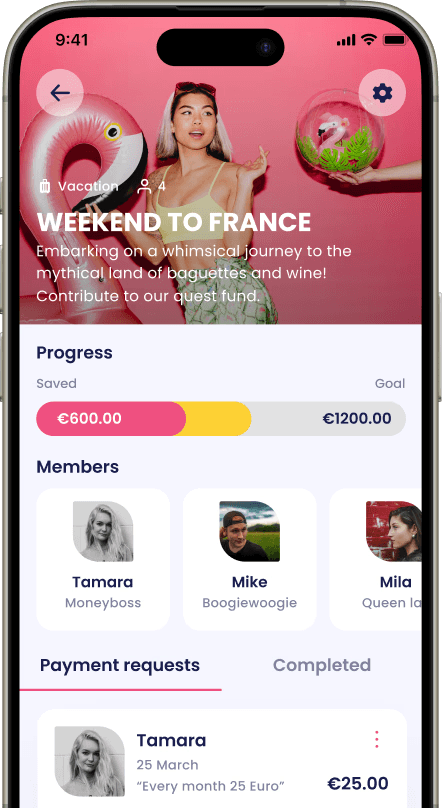
Potje uses a fixed pot price of $5 per month per group. Here is an example of how that actually works in practice:
Instead of one person paying, the cost is shared across the group structure.
In a 2-person group, it is $2.50 each
In a 5-person group, it is $1 each
In a 10-person group, it is $0.50 each
The fee is deducted from the pot itself, not charged to one individual. This means no one carries the full cost, the group shares responsibility, and the pricing scales down per person as the group grows, just like shared savings pots for group goals such as holidays, gifts, and events. This aligns directly with how group money should work: collectively.
Comparing how competitors think about pricing
Tracking Tools (Like Splitwise)
These are practical tools that often offer a free plan or free version at the core level. But they are not managing money; they are tracking it. You still have to handle payments, follow-ups, and coordination yourself. Without built-in automation, you might find yourself needing custom integrations or manual file storage just to keep track of receipts.
Transactional Apps (Like Venmo or Cash App)
These operate on simple transactions. You send a request, you receive payment. Pricing is tied strictly to usage and immediate transfers, not to supporting a group system, unlike pre-funded shared pots that streamline group expenses in advance.
Potje
Potje is not charging you just for sending money. It is charging for removing the work around it. That includes payment requests, reminders, tracking, shared visibility, and dedicated support for creating and managing shared pots for trips, dinners, and other group expenses. The pricing reflects the complete management system, not just the action of moving funds.
The hidden cost of "free"
Free tools feel like the obvious choice. But word gets around when users realize they come with trade-offs: manual tracking, chasing payments, and a complete lack of visibility.
That cost shows up in your time, meetings, and frustration—not in dollars. And for most groups, particularly if you are the event planner, that becomes the bigger problem.
Real-world scenarios where this matters
Group travel
Large amounts are collected over time. Flat fees keep costs predictable. Percentage fees increase as the trip budget grows, which matters if your group is using a shared birthday or trip savings pot to fund a big goal.
Sports teams or recurring groups
Payments happen regularly. For instance, a community team needs to decide on a system where flat fees remove the need to calculate costs every single time, similar to how shared birthday savings pots let people contribute regularly toward a goal.
Small one-off payments
Percentage pricing or a basic plan can work here. The interaction is short and simple, and you don't need heavy group management, but it’s still worth considering tools that support responsible saving and being the boss of your money.
FAQ Section
Is a flat fee or percentage better for group money apps?
Flat fees are generally better for group money management because they keep costs predictable and fair across the group. Percentage pricing works well for small, one-off payments, but becomes less efficient as the amount increases.
Why do some apps charge a percentage instead of a flat fee?
Apps that focus on payments and transfers often charge a percentage because their value is tied to each transaction. However, for group money management, the value comes from coordination, tracking, and structure, which is better reflected in a flat fee model.
Is a flat fee fair when not everyone contributes equally?
In most group scenarios, fairness comes from shared benefit rather than exact contribution. A flat fee spreads the cost across the group, which reduces the burden on any one person.
When does percentage pricing become expensive?
Percentage pricing becomes noticeable when the total amount of money increases. Since fees scale with the amount, the cost increases even if the effort required by the software does not.
Do all users need a specific phone to use these tools?
No. Whether your users are on an Android or iOS device, accessing online platforms should be seamless so everyone can participate without friction.
What is Potje’s pricing model and why does it use a flat fee?
Potje uses a fixed $5 per month per group pot. This reflects its role as a shared money management system rather than a basic payment tool. The fee is deducted from the pot and shared across members, which ensures no single person carries the cost.
The pricing model shows what the product really is
If you are paying per transaction, you are using a payment tool. If you are paying a flat fee, you are using a system. You have access to create pots and manage everything in one place.
Group money is not just about sending money faster. It is about organizing people around it. And the pricing model that supports that is the one that stays simple, predictable, and shared fairly across the group.
If you're saving up as a group for a trip, event, or gift, Potje makes it easy to collect money into one shared digital pot instead of chasing people for their share. Start a pot through this link and get your first month free. After that it's €5 a month per pot, taken straight from the pot balance, so there's nothing to pay upfront to start saving together.

Social Accountability and Saving: The Missing Link to Financial Freedom
Ondersteuning voor verschillende inhoudstypes zoals artikelen, blogs, video's en meer. Rijke tekstverwerker met opmaakopties voor verbeterde.
17 november, 2025

Group Saving Apps Compared: What's Easiest, Safest, and Most Transparent?
Ondersteuning voor verschillende inhoudstypes zoals artikelen, blogs, video's en meer. Rijke tekstverwerker met opmaakopties voor verbeterde.
17 november, 2025

Group Money Platforms Compared: What’s Safe, Regulated, and Fair?
Ondersteuning voor verschillende inhoudstypes zoals artikelen, blogs, video's en meer. Rijke tekstverwerker met opmaakopties voor verbeterde.
17 november, 2025