30 July 2026



Someone in your group pays for the Airbnb.
Someone else covers the train tickets.
A third person buys the groceries when you arrive.
By the end of the weekend, nobody is quite sure who owes what. The group chat fills with screenshots of bank transfers. One person sends too much. Another forgets entirely. The person who organised it all ends up sending awkward reminders for weeks.
Sound familiar?
This is the problem that apps try to solve. But here is the thing: not all of them solve it the same way. And the difference matters more than most people realise.
The real question is not which app splits the bill better. It is whether you should be splitting bills at all.
In this article, we break down the difference between a group savings app and an expense splitter, explain when each one makes sense, and help you figure out which approach actually solves the bigger problem for your group.
What Is an Expense Splitter?
An expense splitter is an app that tracks who paid for what during a shared experience, then calculates who owes whom at the end.
You log each expense as it happens. Tag the people involved. The app adds it all up and tells you the final balances.
Popular examples in Europe include apps like Tricount, Splid, and Kittysplit. They are useful, widely used, and genuinely good at what they do.
But here is the key word: after.
Expense splitters work after money has already been spent. One person carries the financial burden upfront. Everyone else owes them later. The app just makes the debt calculation easier.
What expense splitters are good at
Splitting a restaurant bill on the spot
Tracking costs across a short trip when spending is unpredictable
One-off situations where the group has no shared budget
Where they fall short
Someone always ends up fronting large amounts of money
Collecting repayments still relies on people actually paying
Debt between friends creates social awkwardness
They do nothing to prevent the problem. They just measure it.
What Is a Group Savings App?
A group savings app works the other way around.
Instead of tracking debt after spending, it collects contributions from everyone before the money gets spent. The group sets a shared goal, each person contributes their share upfront, and the money sits in a dedicated pot until it is needed.
No one person carries the cost. No one needs to chase repayments. The group reaches the goal together, then spends.
This is a fundamentally different approach to group money.
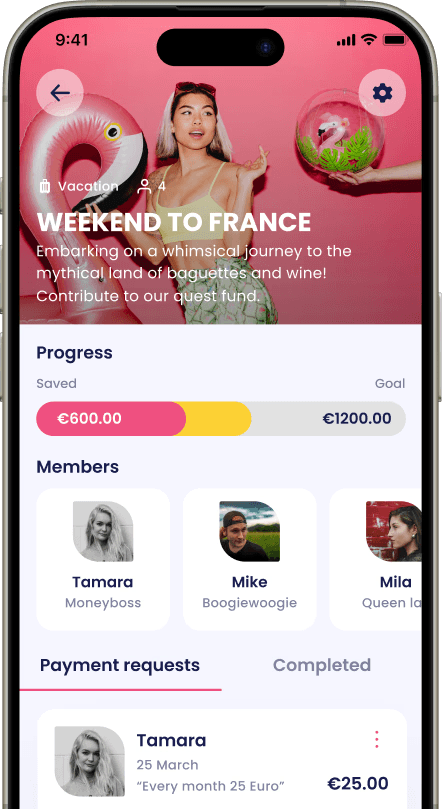
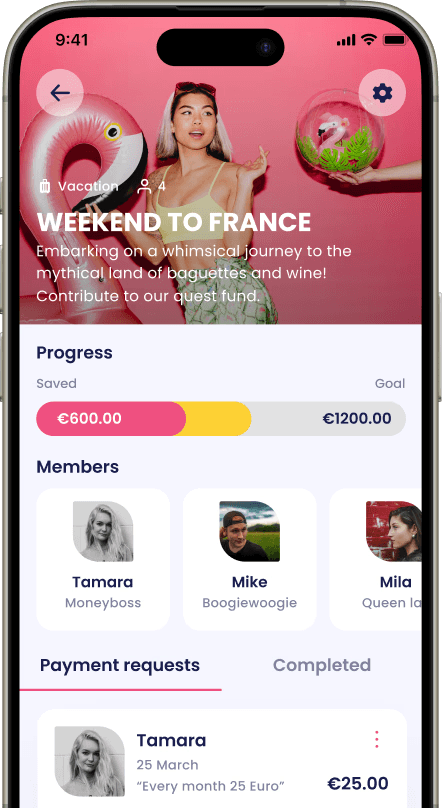
One platform taking this approach is Potje. Rather than calculating who owes what after a trip, Potje helps groups collect money before the trip even begins. Friends and families create a shared money pot, set a goal, and each contribute their share. When the pot is full, the money is ready to use.
What a group savings app is good at
Planning a group holiday, festival, or weekend away
Collecting contributions for a shared birthday gift
Saving together for a recurring group experience like a sports trip
Making sure everyone is financially committed before spending starts
The result is simpler than it sounds.
Everyone pays in. The goal gets reached. Then the group spends, together, without anyone feeling like they are chasing a debt.
Group Savings App vs Expense Splitter: The Key Differences
These two tools are solving different problems. Here is a side-by-side comparison to make that clear.
Expense Splitter | Group Savings App (Potje) | |
When it works | After spending | Before spending |
Who carries the cost | One person upfront | The whole group, equally |
Repayments needed? | Yes | No |
Best for | Spontaneous, unpredictable costs | Planned shared goals |
Transparency | Shows debt balances | Shows progress toward a goal |
Social friction | Can create awkwardness | Eliminates it upfront |
Example use case | Splitting a dinner bill | Saving for a group holiday |
The core difference comes down to timing.
An expense splitter says: "We already spent the money. Let us figure out who owes what."
A group savings app says: "We have a goal. Let us all contribute first, then spend together."
For spontaneous, unpredictable spending, an expense splitter works well.
For anything planned, a group savings app removes the problem entirely before it starts.
Which One Solves the Bigger Problem?
This is the honest answer: it depends on what your group is doing.
But for most planned group experiences, the bigger problem is not splitting the bill. The bigger problem is that one person ends up paying for everything while everyone else owes them money they may or may not actually send.
Expense splitters solve the calculation problem. They make the debt visible and organised.
They do not solve the collection problem. That still relies on goodwill, timing, and the awkward "hey, you still owe me" message.
Group savings apps solve a different and arguably harder problem: they remove the debt entirely.
When everyone contributes before the trip, there is no bill to split at the end. There is no one person out of pocket. There is no awkward group chat moment where someone has to ask for money back.
When to use an expense splitter
A spontaneous dinner where costs are unpredictable
A short trip where one person is happy to cover costs temporarily
Any situation where the group cannot or does not want to commit money upfront
When to use a group savings app like Potje
Planning a group holiday to Barcelona, a ski trip, or a festival
Organising a shared birthday gift for a friend
Any experience that requires booking in advance and costs are known
When you want everyone financially committed before anyone spends a cent
The pattern is simple. If money is already spent, use a splitter. If money has not been spent yet, use a group savings app and avoid the problem altogether.
How Potje Works for Group Goals
Potje is built around one idea: collect before you spend.
Here is how it works in practice.
Create a money pot. One person sets up the pot, names the goal (Barcelona trip, ski weekend, birthday gift), and sets the target amount.
Invite the group. Everyone in the group gets a link to contribute their share.
Everyone pays in. Contributions are collected upfront. No one person carries the full cost.
Reach the goal together. The pot tracks progress. Everyone can see how close the group is to the target.
Spend when ready. Once the goal is reached, the money is there and ready to use.
The cost is shared across the whole group. A Potje money pot costs €5.00 per month in total, split automatically between everyone. With five people, that is €1.00 each. With ten people, just €0.50 each.
No spreadsheets. No awkward reminders. No one person fronting hundreds of euros and hoping the group pays them back.
Potje is available across Europe and is designed for exactly the kind of shared experiences that friends and families plan together: holidays, group gifts, festivals, and weekend trips.
Start your first money pot with Potje
Frequently Asked Questions
What is the difference between a group savings app and an expense splitter?
An expense splitter tracks who paid for what and calculates debts after money has been spent. A group savings app collects contributions from everyone before any money is spent, so there is no debt to split at the end.
Which is better for planning a group holiday?
A group savings app is better for planned experiences like holidays, festivals, and group gifts. It ensures everyone contributes upfront, so no single person has to front the cost and chase repayments later.
Can I use an expense splitter and a group savings app together?
Yes. Some groups use a savings app to collect money for big upfront costs like accommodation, then use a splitter for spontaneous daily expenses during the trip. Both tools serve different moments.
Is Potje available across Europe?
Yes. Potje is available across Europe and is designed for groups planning shared experiences like holidays, weekends away, and group gifts.
How much does Potje cost?
A Potje money pot costs €5.00 per month in total, shared automatically across the whole group. With five people, that works out to €1.00 each per month. With ten people, just €0.50 each.
What happens if someone does not contribute to the group pot?
Potje sends automated payment reminders, so the organiser does not have to chase people manually. Everyone can see the pot's progress, which creates natural accountability within the group.
The Bottom Line
Expense splitters are useful tools. They make debt visible and organised. For spontaneous situations, they do the job well.
But if your group is planning something, whether it is a summer holiday, a ski trip, a festival weekend, or a birthday gift, the bigger problem is never the calculation. It is the collection.
The organised friend who makes group trips run smoothly does not split the bill at the end. They sort the money before the trip begins.
That is what Potje is built for.
If you're saving up as a group for a trip, event, or gift, Potje makes it easy to collect money into one shared digital pot instead of chasing people for their share. Start a pot through this link and get your first month free. After that it's €5 a month per pot, taken straight from the pot balance, so there's nothing to pay upfront to start saving together.

Social Accountability and Saving: The Missing Link to Financial Freedom
Ondersteuning voor verschillende inhoudstypes zoals artikelen, blogs, video's en meer. Rijke tekstverwerker met opmaakopties voor verbeterde.
17 november, 2025

Group Saving Apps Compared: What's Easiest, Safest, and Most Transparent?
Ondersteuning voor verschillende inhoudstypes zoals artikelen, blogs, video's en meer. Rijke tekstverwerker met opmaakopties voor verbeterde.
17 november, 2025

Group Money Platforms Compared: What’s Safe, Regulated, and Fair?
Ondersteuning voor verschillende inhoudstypes zoals artikelen, blogs, video's en meer. Rijke tekstverwerker met opmaakopties voor verbeterde.
17 november, 2025
