30 September 2026



Young adults across Europe are facing a growing debt problem.
Buy-now-pay-later schemes, student loans, and social pressure to keep up with group spending are pushing more 18 to 30-year-olds into financial difficulty before they have ever learned how to manage money properly.
Debt prevention programmes are stepping in to help. And increasingly, the tools they are turning to are not spreadsheets or budgeting workshops. They are digital money pots.
Here is why that shift is happening, and how it is changing outcomes for young people.
Why Traditional Debt Prevention Falls Short
Most debt prevention programmes have historically focused on education after the fact.
A young person gets into debt. They attend a workshop. They receive a leaflet about budgeting. Then they go home and face the same spending pressures as before.
The problem is not knowledge. Most young adults know they should spend less than they earn.
The problem is structure.
Without a system that makes saving the default behaviour, good intentions rarely survive contact with a social group, a group holiday, or a shared birthday gift.
The FINYOUTH initiative, an EU-funded programme dedicated to preventing youth debt and improving financial literacy, identifies this gap clearly. Financial education needs to be paired with practical tools that change behaviour, not just awareness.
That is exactly where digital money pots come in.
What Is a Digital Money Pot?
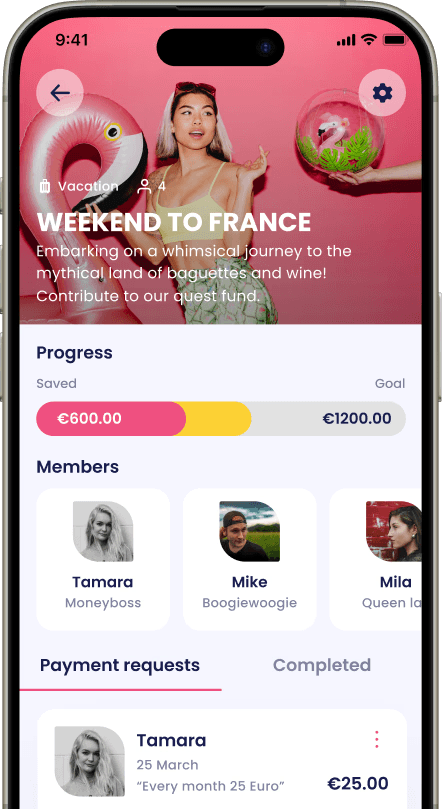
A digital money pot is a shared savings account that a group of people contribute to together, towards a specific goal.
It is not a bank account.
It is not a payment app.
It is a dedicated space where money is collected before it is spent.
Here is how it works in practice:
A group sets a shared goal (a trip, a group gift, a shared event)
Everyone contributes their share upfront
The money sits in the pot until the goal is reached
The organiser can then pay out any amount, instantly, with no fee on partial payouts
This changes the dynamic completely.
Instead of one person covering costs and chasing repayments for weeks, the group collects first and spends together. No debt. No awkward reminders. No one left out of pocket.
How Debt Prevention Programmes Are Using Digital Pots
Debt prevention organisations, schools, and social support programmes across Europe are now integrating digital pots into their frameworks for working with young adults. Here is how they use them.
Giving Young Adults a Controlled Spending Structure
One of the most effective applications is using a money pot to give a young adult a structured way to receive financial support.
Instead of transferring money directly to a young person's personal account (where it can be spent immediately on anything), a support worker or parent can contribute to a shared pot tied to a specific goal.
The money is visible. The goal is clear. Spending is controlled by the structure of the pot, not by willpower alone.
This is particularly powerful for young adults who are recovering from debt or learning to manage money for the first time.
Teaching the "Collect Before You Spend" Habit
The core habit that debt prevention programmes try to build is simple: do not spend money you do not have.
Digital pots make this concrete.
When a young adult can see a pot growing towards a goal, they experience saving as progress, not deprivation. Research from the OECD on digital financial inclusion of youth consistently shows that visible progress towards financial goals is one of the strongest predictors of sustained saving behaviour.
Potje is built entirely around this principle. Every pot has a goal. Everyone in the group can see progress. The money is only paid out when the group is ready.
Reducing Social Pressure Debt
A significant driver of debt among young adults is social spending.
Group holidays. Shared birthdays. Festival tickets. Sports club fees.
Young people often go into debt not because they are irresponsible, but because they do not want to be the one who lets the group down.
A shared money pot removes this pressure entirely. Everyone contributes what they can, upfront, before any booking is made. The group only commits to what everyone can genuinely afford.
This is explored in more depth in our post on social pressure and money habits.
Supporting Debt Prevention at an Organisational Level
Schools, youth organisations, and social work teams are also using digital pots at a programme level.
A youth worker running a group savings initiative can create a shared pot, invite participants, and track collective progress without needing everyone to have a separate bank account or financial product. For organisations that need more supervised oversight, Potje also delivers this through a dedicated partnership with Kredietbank Nederland's SUN programme.
The European Commission's 2025 Financial Literacy Strategy specifically calls for practical digital tools to be integrated into financial education programmes targeting young people. Digital pots are a natural fit for this mandate.
Why Potje Works for This Use Case
Potje is a shared money pot platform built for groups.
It was designed for exactly the situations described above: groups of people who need to collect money together, stay organised, and spend only when everyone is ready.
Here is what makes it particularly well suited for debt prevention work:
Feature | Why It Matters for Debt Prevention |
First month free | Organisations and young adults can start with zero cost |
Instant payouts of any amount | Support workers can release funds immediately when needed |
No fee on partial payouts | Flexibility to release money in stages without penalty |
Shared goal visibility | Everyone sees progress, building accountability |
No personal bank account required | Accessible for young adults without full banking setup |
The pricing is also built for groups. At €5.00 per month total, shared across the group, the cost per person scales down quickly. A group of five pays just €1.00 each per month.
You can learn more about how Potje supports structured saving in our post on why group saving works.
FAQs
What is a digital money pot?
A digital money pot is a shared savings space where a group of people contribute money towards a specific goal. The money is collected before it is spent, which removes the need for debt or repayments after the fact.
How do debt prevention programmes use digital pots?
Debt prevention programmes use digital pots to give young adults a structured, visible way to save and receive financial support. Rather than transferring money freely, support workers and parents can contribute to a goal-based pot that keeps spending controlled and accountable.
Is Potje suitable for young adults who are new to managing money?
Yes. Potje is designed to be simple. One person creates a pot, sets a goal, and shares a link. Everyone can see progress. There is no complex setup and no need for a separate bank account.
How much does Potje cost?
Potje costs €5.00 per month in total, shared across the group. A group of five people pays €1.00 each per month. The first month is completely free.
Can money be paid out in stages?
Yes. Potje supports instant payouts of any amount, with no fee on partial payouts. This makes it easy to release funds in stages, which is ideal for structured support programmes.
Where can I learn more about Potje's debt prevention work?
Visit the Potje debt prevention page to learn how Potje works with schools, social organisations, and parents to support young people.
Start Building Better Financial Habits Today
Debt prevention is not just about stopping bad spending.
It is about building a better system before the problem starts.
Digital money pots give young adults a structure that works with their social lives, not against them. Everyone contributes. Everyone sees progress. Nobody ends up carrying the group's financial burden alone.
Potje is free for your first month. No commitment. No complex setup. Just a shared pot, a shared goal, and a better way to manage money together.
Create your first money pot on Potje and see how it works for your group or programme.

Social Accountability and Saving: The Missing Link to Financial Freedom
Ondersteuning voor verschillende inhoudstypes zoals artikelen, blogs, video's en meer. Rijke tekstverwerker met opmaakopties voor verbeterde.
17 november, 2025

Group Saving Apps Compared: What's Easiest, Safest, and Most Transparent?
Ondersteuning voor verschillende inhoudstypes zoals artikelen, blogs, video's en meer. Rijke tekstverwerker met opmaakopties voor verbeterde.
17 november, 2025

Group Money Platforms Compared: What’s Safe, Regulated, and Fair?
Ondersteuning voor verschillende inhoudstypes zoals artikelen, blogs, video's en meer. Rijke tekstverwerker met opmaakopties voor verbeterde.
17 november, 2025