7 September 2026



Someone always ends up paying first.
Maybe it's the sibling who set up the Netflix account years ago. Maybe it's the parent who owns the holiday cottage and quietly absorbs the annual maintenance bill. Maybe it's you, quietly resenting the fact that you send a reminder every single month and still wait two weeks for everyone to transfer their share.
Extended families share more costs than ever. Streaming plans, Spotify, cloud storage, annual holiday home upkeep, utility bills on a shared property. These are not one-off expenses. They come back every month, every quarter, every year. And without a proper system, one person always ends up carrying the group.
The good news: there is a better way to organise it. You just need the right tool.
Why Recurring Family Costs Are the Hardest to Split
One-off costs are manageable. You book the Airbnb, split it five ways, and move on.
Recurring costs are a different problem entirely. They never stop. And the friction compounds every single cycle.
Here is what that looks like in practice for most extended families:
Streaming: One person holds the Netflix or Disney+ account. Since streaming services in Europe now tie accounts to a single household, adding a family member in another home costs around €4.99 per month extra. Multiply that across two or three relatives, and the bill lands entirely on one person.
Spotify Family: Up to six members, but the plan manager pays the full €17.99 and hopes everyone chips in.
A shared holiday home: Cleaning fees, insurance, garden maintenance, utility standing charges. These bills arrive on someone's doorstep whether the rest of the family uses the property that month or not.
Cloud storage: Shared Google or Apple family plans mean one account holder pays and informally collects from the others.
The pattern is always the same. One person organises, one person pays upfront, and the rest owe them money in an informal, easy-to-forget way.
The real cost is not just financial. It is the awkwardness of chasing family members for money. The tension at Christmas dinner. The quiet resentment that builds when someone keeps forgetting to transfer.
The Old Way Does Not Work for Ongoing Costs
Most families try one of three approaches. None of them hold up over time.
The WhatsApp reminder method
Someone sends a message asking for transfers. People see it, intend to pay, get distracted, and forget. The organiser sends it again. Awkwardness follows.
The spreadsheet method
One family member tracks who owes what in a shared document. It works for about three months until someone stops updating it and nobody trusts the numbers anymore.
The "I'll sort it out at Christmas" method
Debts accumulate across the year and get settled in one messy conversation during a family gathering. Nobody remembers the exact amounts. Someone always feels shortchanged.
The problem with all three approaches is that they rely on memory, goodwill, and manual effort. Recurring costs need a recurring system.
What actually works is collecting money before the bill arrives, not chasing it afterwards. That shift changes everything. You can read more about why collecting upfront removes the awkwardness entirely in our guide on group money psychology.
How a Shared Money Pot Solves This for Extended Families
A shared money pot works differently from a payment reminder app.
Instead of one person paying and then chasing reimbursements, everyone contributes to a shared pot first. When the bill arrives, the money is already there. Nobody is owed anything. Nobody needs to be chased.
This is exactly how Potje works.
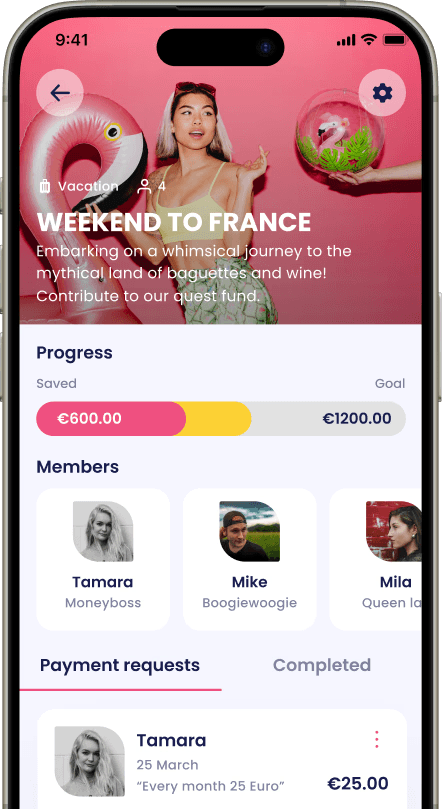
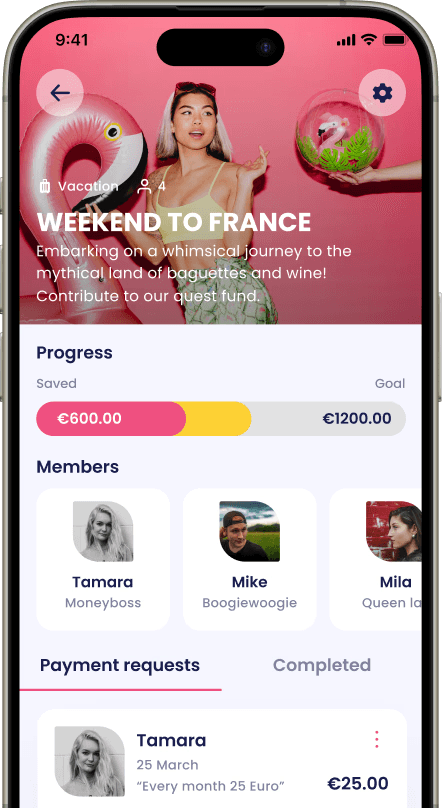
You create a money pot, set a goal amount, and share the link with your family. Each person contributes their share directly into the pot. The organiser can pay the bill straight from the pot balance, or withdraw the funds instantly to their own account.
What makes Potje work for recurring family costs
Everyone sees the balance. No more "did you get my transfer?" conversations. The pot is transparent.
Instant payouts of any amount. When the holiday home maintenance bill arrives, you can pay out immediately, with no minimum amount required.
No fee on partial payouts. You can withdraw part of the balance whenever you need it, without any extra charges.
The cost is shared automatically. Potje costs €5.00 per month in total, split across everyone in the group. With five family members that is just €1.00 each per month.
Your first month is free. There is no cost to try it. Set up the pot, invite your family, and see how much smoother it runs before spending a cent.
This model works particularly well for a shared holiday home fund, where costs are predictable but timing is irregular. You collect monthly contributions into the pot, and when the annual insurance bill or the plumber's invoice arrives, the money is waiting.
A practical example
Say your family shares a holiday cottage. Annual costs come to around €3,600: insurance, maintenance, utilities, and a deep clean between seasons. That is €300 per month across four households.
With Potje, each household contributes €75 per month to the shared pot. When any bill arrives, the organiser pays it directly from the balance. No debt. No reminders. No resentment.
The same logic applies to streaming. If your family shares a Netflix Premium plan at €21.99 per month across four households, each person owes roughly €5.50. Create a Potje pot, collect contributions at the start of each month, and the account holder never pays out of pocket again.
Setting Up a Family Cost Pot: Step by Step
Getting started takes less than five minutes.
Download the Potje app and create your account at potje.tech.
Create a new money pot. Give it a name that makes sense to your family, like "Holiday Home Fund" or "Family Streaming Pot."
Set a monthly contribution goal. Divide the total recurring cost by the number of households contributing.
Share the payment link with your family via WhatsApp, email, or any other channel.
Each family member contributes their share directly. Everyone can see the running balance.
Pay bills from the pot or withdraw instantly when you need to cover a cost.
That is the entire process. No spreadsheets. No reminders. No awkward conversations.
You can also run multiple pots at the same time. One for the holiday home, one for the family streaming bundle, one for a shared cloud storage plan. Each pot is separate, with its own balance and goal. Learn more about how group money management works without a joint bank account.
Frequently Asked Questions
Can I use Potje for monthly recurring costs, not just one-off collections?
Yes. Potje works perfectly for recurring costs. Family members can contribute every month, and the pot balance builds up over time. You set the goal, share the link, and contributions come in on whatever schedule your family agrees on.
Is Potje free to use?
Your first month is completely free. After that, the pot costs €5.00 per month in total, shared automatically across all group members. With five people contributing, that is €1.00 each per month.
Can I withdraw money from the pot at any time?
Yes. Potje offers instant payouts of any amount, with no fee on partial withdrawals. You do not need to wait until the pot is full. If a bill arrives and you have enough in the pot, you can pay it out immediately.
Do all family members need the Potje app?
Only the organiser who creates the pot needs the app. Other family members can contribute via a shared payment link, making it easy for less tech-savvy relatives to participate.
How is Potje different from just asking for bank transfers?
With bank transfers, one person pays first and then chases reimbursements. With Potje, everyone contributes before the bill arrives. The money is already collected when you need it. There is no debt, no chasing, and no one carrying the group.
Stop being the one who pays first and waits longest to be paid back.
Create a shared money pot for your family's recurring costs and try Potje free for your first month. Get started at potje.tech.

Social Accountability and Saving: The Missing Link to Financial Freedom
Ondersteuning voor verschillende inhoudstypes zoals artikelen, blogs, video's en meer. Rijke tekstverwerker met opmaakopties voor verbeterde.
17 november, 2025

Group Saving Apps Compared: What's Easiest, Safest, and Most Transparent?
Ondersteuning voor verschillende inhoudstypes zoals artikelen, blogs, video's en meer. Rijke tekstverwerker met opmaakopties voor verbeterde.
17 november, 2025

Group Money Platforms Compared: What’s Safe, Regulated, and Fair?
Ondersteuning voor verschillende inhoudstypes zoals artikelen, blogs, video's en meer. Rijke tekstverwerker met opmaakopties voor verbeterde.
17 november, 2025
