12 August 2026



Quick answer: The easiest way for a padel group to split court costs without chasing payments is to collect everyone's share upfront into a shared money pot before the session is booked. When the money is already there, nobody owes anyone anything.
You booked the court. You paid the full amount. Now you're in the WhatsApp group asking four people to pay you back.
Two of them reply immediately. One says "I'll do it later." One goes quiet.
Sound familiar? It happens to almost every padel group in Europe, every single week.
The problem is not the people. The problem is the process.
Padel is a four-player sport. The court fee is always shared. But the way most groups handle that sharing is completely backwards: one person pays upfront, then spends the next three days chasing the others for their share.
There is a better way. And it starts with collecting money before the court is booked, not after.
Why Padel Payments Always Get Messy
Padel is one of the fastest-growing sports in Europe. According to the World Padel Tour, there are now over 25 million padel players worldwide, with the sport growing fastest across Spain, the Netherlands, Belgium, Sweden, and the UK.
Most players join a regular group. Same four people, same weekly slot, same court.
And the same payment headache every single time.
The typical padel payment cycle
Here is how it usually goes:
One person books and pays the full court fee
They send a payment request in the group chat
Most people pay, eventually
One person always forgets, or pays late
The person who booked feels awkward chasing their friend for €8
Next week, the same thing happens again
The real cost is not the €8. It is the friction, the awkwardness, and the mental load of being the person who always has to ask.
Why splitting after the fact never works cleanly
Court hire in Europe is charged per court, not per player. A typical session costs between €20 and €45 per hour depending on location and time of day. Split four ways, that is €5 to €11 per person per session.
On paper, it is straightforward. In practice, someone always pays late, someone pays the wrong amount, or someone drops out at the last minute and the others scramble to cover the difference.
The math is simple. The human behaviour is not.
The Fix: Collect Before You Book
The single most effective change a padel group can make is this: collect the money first, then book the court.
It sounds obvious. But almost nobody does it, because there was never a simple way to do it.
That is exactly what a shared money pot is for.
Instead of one person fronting the cost and chasing the others, everyone contributes their share into a shared pot before the session. When the booking needs to be paid, the money is already there. No chasing, no reminders, no awkward conversations.
This is the difference between managing debt and managing a shared goal.
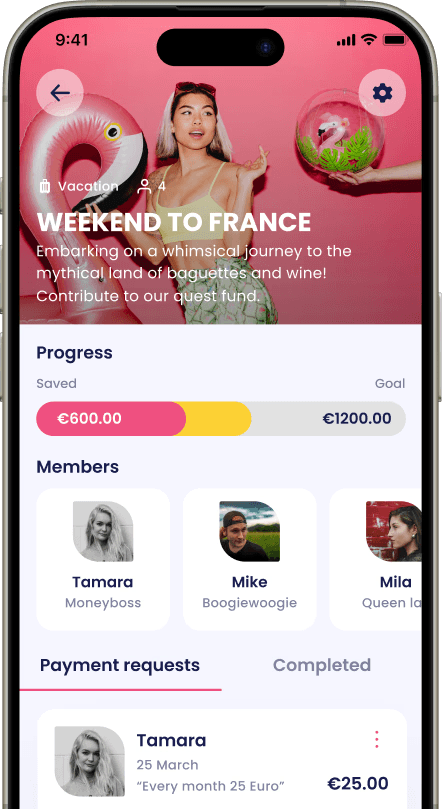
One platform taking a different approach to this is Potje. Rather than tracking who owes who after spending has happened, Potje helps groups collect money before it gets spent. Your padel group creates a shared money pot, everyone contributes their share upfront, and the person booking the court uses the pot balance to pay.
No one person carries the cost. No one has to ask for their money back.
What changes when you collect upfront
Old approach | New approach |
One person pays, others owe | Everyone contributes first |
Payment reminders in WhatsApp | Automated contribution tracking |
Awkward chasing | No chasing needed |
Someone always pays late | Money is there before booking |
Confusion over amounts | Clear, agreed contribution per person |
The shift is small. The difference in group dynamics is significant.
How to Set Up a Padel Money Pot with Potje
Setting up a shared pot for your padel group takes about two minutes. Here is how it works in practice.
Step 1: Create a shared money pot
One person in the group creates a pot on Potje. Give it a name, set a contribution amount per person, and share the link with the group.
Step 2: Everyone contributes their share
Each player contributes their share directly into the pot. No bank transfers, no PayPal requests, no "I'll get you next time."
With four players and a court fee of €32 per session, each person contributes €8. That is it.
Step 3: Book the court from the pot
When it is time to book, the organiser uses the pot balance to pay. The money is already there. The court gets booked. Everyone plays.
No debt. No chasing. No friction.
What does Potje cost?
Potje costs €5 per month in total for the whole group, not per person. Split four ways, that is just €1.25 per player per month to completely remove the payment headache from your padel routine.
For a group playing once a week, that is less than the cost of one ball per month to never have to chase anyone again.
You can read more about how a shared money pot works and why it is a smarter approach than everyone paying separately.
What About Regular Padel Groups?
If your group plays every week, a shared pot becomes even more powerful.
Instead of collecting per session, you top up the pot at the start of each month. Four players, one monthly contribution each, and every court booking for the month is covered automatically.
A practical example:
Your group plays twice a week. Court hire is €28 per session in your city. That is €56 per week, or roughly €240 per month for the group. Each player contributes €60 per month into the pot. Every booking gets paid from the balance. Nobody thinks about it. Nobody chases anyone.
This is how regular padel groups in the Netherlands, Belgium, and across Europe are starting to organise their court costs. The pot sits in the background. The money is always there. The game happens.
For more on how groups manage recurring shared costs without the drama, see our guide on why group saving works better than everyone paying separately.
Frequently Asked Questions
How do padel groups usually split court costs?
Most padel groups have one person book and pay the court, then request payment from the others via a payment app or bank transfer. This works, but it creates a debt cycle where someone always ends up chasing. A better approach is to collect everyone's share into a shared money pot before the court is booked.
How much does padel court hire cost in Europe?
Court hire varies by country and city. In Spain, expect around €15 to €20 per hour. In the Netherlands, courts typically cost €20 to €40 per hour. In the UK, London averages around £22 per hour at peak times. Split four ways, most European sessions cost between €5 and €11 per person, making padel one of the most affordable group sports available.
What is the best app for splitting padel costs?
A shared money pot app like Potje works better than a split app for regular padel groups. Split apps track debt after spending. A money pot collects contributions before spending, so there is no debt to track in the first place. Everyone contributes upfront, and the court gets paid from the shared balance.
Can a padel group use one shared account for court bookings?
Yes. A shared money pot gives your group a collective balance that anyone in the group can use to pay for court bookings. This is different from a shared bank account, which requires formal setup and joint account holders. A money pot is faster to set up and designed specifically for shared group goals.
What happens if someone drops out of the session?
This is one of the most common padel frustrations. When money is collected upfront into a pot, the group already has the funds to cover the booking regardless of last-minute dropouts. The person who drops out contributes their share back into the pot for next time, or the group agrees on a fair policy in advance. Either way, the organiser is not left covering the difference alone.
Stop Being the Group's Unpaid Accountant
Padel is supposed to be fun. The two hours on court are great. It is the three days of payment admin before and after that nobody enjoys.
The organiser of every padel group carries a silent tax: the time, energy, and awkwardness of managing the money so everyone else can just show up and play.
A shared money pot removes that tax entirely.
Everyone contributes. The pot is always ready. The court gets booked. The game happens.
If your group plays regularly and you are tired of being the one who chases, it is worth trying a different approach. Set up a shared pot, agree on a monthly contribution, and let the money take care of itself.
Ready to stop chasing? Start your padel group's money pot at potje.tech and see how different it feels when the money is already there before anyone picks up a racket.

Social Accountability and Saving: The Missing Link to Financial Freedom
Ondersteuning voor verschillende inhoudstypes zoals artikelen, blogs, video's en meer. Rijke tekstverwerker met opmaakopties voor verbeterde.
17 november, 2025

Group Saving Apps Compared: What's Easiest, Safest, and Most Transparent?
Ondersteuning voor verschillende inhoudstypes zoals artikelen, blogs, video's en meer. Rijke tekstverwerker met opmaakopties voor verbeterde.
17 november, 2025

Group Money Platforms Compared: What’s Safe, Regulated, and Fair?
Ondersteuning voor verschillende inhoudstypes zoals artikelen, blogs, video's en meer. Rijke tekstverwerker met opmaakopties voor verbeterde.
17 november, 2025