6 August 2026



You post the message.
"Can everyone send their share for the pitch this week?"
Six people react with a thumbs up. Three people actually pay. One person says "on it" and then disappears. And you spend the next four days privately chasing the rest while trying to keep the group chat friendly.
Sound familiar? If you run a sports team on WhatsApp, you have lived this exact situation.
The problem is not your teammates. The problem is the tool.
WhatsApp is brilliant for banter, match updates, and last-minute lineup changes. It is genuinely terrible for collecting money. And yet, almost every casual sports team in Europe still tries to run their finances through a group chat.
This guide explains why that keeps failing, and what actually works instead.
Why WhatsApp Is the Wrong Tool for Team Money
WhatsApp was built for conversation. Every feature it has is designed around messaging, not money.
When you post a payment request in a group chat, a few things happen immediately.
The message competes with dozens of other notifications from that day
People react with a thumbs up emoji instead of actually paying
The message scrolls out of view within an hour
There is no record of who has paid and who has not
The organiser has to track everything manually, in their head or in a spreadsheet
Nobody wants to be the person publicly chasing teammates for money. And nobody wants to be publicly called out for not paying. So the organiser either lets it slide or sends awkward private messages. Neither works.
The real cost of chasing
It is not just annoying. It is genuinely time-consuming.
Research from sports club payment platforms suggests the average team organiser spends between 3 and 5 hours every month chasing payments that should take minutes to collect. Over a full season, that is 30 to 60 hours of avoidable admin.
That time should be spent organising training, planning the end-of-season trip, or just enjoying being part of the team.
What WhatsApp actually does well
To be fair, WhatsApp is not the villain here. It is excellent for:
Match-day communication and lineup updates
Sharing photos and celebrating wins
Organising meetups and social events
Quick polls for availability
The issue is using it for something it was never designed to do. Asking for money in a group chat is awkward by design, and no amount of friendly wording changes that. There is even a dedicated Potje vs WhatsApp comparison that goes deeper on exactly why reminders alone are never enough.
The Root Cause: Collecting Money After It Is Already Spent
Here is the pattern that almost every sports team follows.
The organiser books the pitch, buys the kit, or pays the referee
They post in the group asking everyone to pay them back
A few people pay quickly
The rest forget, delay, or quietly hope someone else covers it
The organiser chases individually
The organiser either absorbs the shortfall or creates tension trying to recover it
The problem is not that people are unwilling to pay. The problem is that money is being collected after the spending has already happened.
Once the pitch is booked and the game is played, the urgency disappears. There is nothing at stake anymore. People genuinely forget, or they deprioritise it because there is no immediate consequence.
Flip that sequence and everything changes.
Collect the money first. Then book the pitch. Then play.
When everyone contributes upfront, the organiser never carries the cost personally. There is no awkward chasing because the money is already there. The group reaches its goal together, before anything gets spent.
This is not a new idea. It is just one that most teams have never actually implemented because they did not have a simple way to do it. That is exactly the gap a shared money pot fills.
Key takeaway: The chasing problem is not a people problem. It is a sequencing problem. Fix the order of operations and the friction disappears.
How to Set Up a Proper Team Money System in 5 Steps
You do not need a complicated setup. You need a clear process that everyone follows from the start of the season.
Step 1: Define what the money is for
Before a single euro changes hands, be specific about the goal.
Is it weekly pitch fees? A kit fund? An end-of-season trip? A referee budget for the whole season?
Vague goals create vague commitment. When everyone knows exactly what they are contributing to, they are far more likely to pay promptly.
Step 2: Agree on a fixed contribution per person
Decide upfront what everyone owes and when.
Equal splits are the simplest. If your pitch costs €80 per week and you have 10 players, that is €8 each. Set it, communicate it clearly, and stick to it.
This removes any ambiguity. Nobody can claim they did not know what was expected.
Step 3: Collect the money before you spend it
This is the most important step.
Do not book the pitch and then ask for transfers. Create a shared money pot, share the link in the WhatsApp group, and only confirm the booking once the contributions are in.
When the money is collected first, two things happen. The organiser is never personally out of pocket. And every group member has real skin in the game, which means they actually show up.
Step 4: Make the progress visible to everyone
Nobody likes being in the dark about money.
When the whole group can see how much has been collected and how much is still needed, it creates natural accountability. People pay faster when they can see others already have.
Transparent progress removes the need for the organiser to chase anyone individually.
Step 5: Let automated reminders do the chasing for you
Instead of posting another awkward message in the group chat, automated payment reminders go out to everyone who has not yet contributed. It is impersonal, non-confrontational, and effective.
The organiser stays out of it. The reminder does the work.
You can read more about how automatic payment requests to a group actually work and why they outperform any manual follow-up.
What to Use Instead of a WhatsApp Message
The goal is not to replace WhatsApp. You still need the group chat for communication. The goal is to move the money side of things to a tool that is actually built for it.
Here is how the most common options compare for a typical sports team.
Tool | Good for | The problem |
WhatsApp group | Communication, banter, updates | No payment tracking, no accountability |
Bank transfer | Simple one-off payments | No shared visibility, hard to track |
Spreadsheet | Tracking who owes what | Manual, ignored, no actual payments |
Shared money pot | Collecting and saving as a group | Requires everyone to use a payment link |
A dedicated shared money pot solves the core problem. Everyone contributes to the same goal. The organiser sees exactly who has paid and who has not. Automated reminders handle the follow-up. And the money is collected before anything gets booked.
What Potje does differently
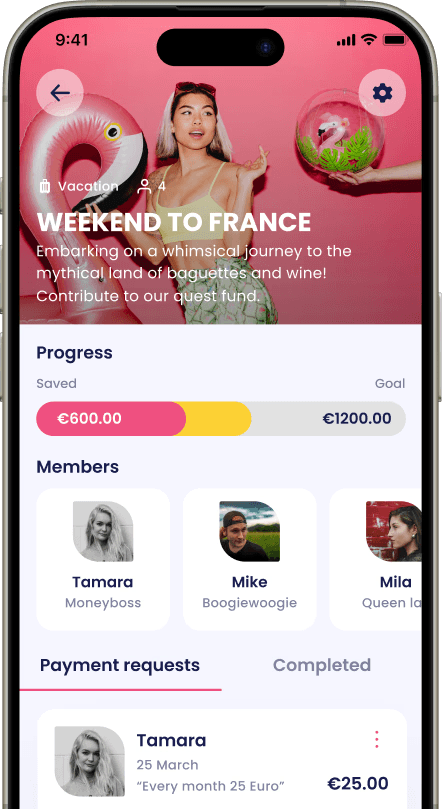
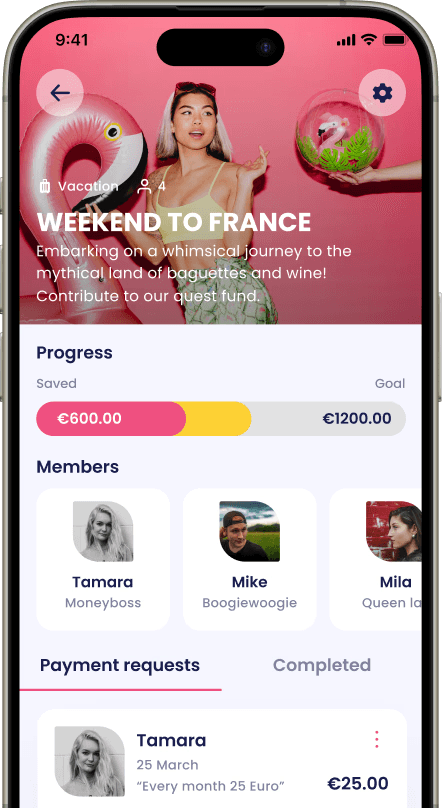
Potje is a shared money pot built specifically for groups. Rather than tracking who owes what after the fact, the whole approach is built around collecting contributions before spending begins.
For a sports team, that looks like this:
Create a pot for "Weekly Pitch Fees" or "End of Season Trip"
Set the contribution amount per person
Share the payment link directly in your WhatsApp group
Everyone pays into the shared pot at their own pace
Automated reminders go out to anyone who has not contributed yet
The organiser sees the progress in real time and books once the target is reached
The cost is €5.00 per month total, shared automatically across the group. For a 10-person team, that works out to €0.50 each per month. Less than a coffee, and it eliminates hours of chasing every season.
You can learn more about how a shared money pot works here, or explore how Potje compares to a joint bank account for managing group money.
Common Sports Team Money Situations (and How to Handle Each One)
Every team has slightly different needs. Here is how the collect-first approach applies to the most common scenarios.
Weekly pitch or court fees
This is the most frequent pain point. The fix is a recurring pot with a fixed weekly contribution per player. Set it up at the start of the season. Share the link once. Let reminders handle the rest.
The organiser stops being a debt collector and goes back to being a teammate.
Kit and equipment costs
Kit orders are a classic source of team tension. Someone always pays late, or not at all, and the organiser ends up covering the shortfall.
Create a dedicated pot for kit costs. Set the exact amount per person. Only place the order once the full amount is collected. No guessing, no gaps, no awkward conversations.
End-of-season trips or events
Away trips and end-of-season dinners involve larger amounts and longer planning windows. This is where a shared savings goal works especially well.
Everyone contributes gradually over several weeks. The organiser can see progress toward the total. Nobody has to front a large sum personally. And when the trip comes around, the money is already there.
Fine pots and bonus funds
Many teams run a fine system for being late, missing training, or forgetting kit. A shared pot works perfectly here too. Everyone can see the balance growing, which adds a bit of fun to the accountability.
Some teams even use a separate pot as a bonus fund for the player of the season or a shared celebration at the end of the year. You can read more about how a fine pot for teams actually works in practice.
Frequently Asked Questions
Can I use Potje for a sports team?
Yes. Potje is designed for any group that needs to collect and save money together. Sports teams use it for weekly fees, kit costs, trips, and fine pots. You create a pot, set a goal, share the link, and the platform handles contributions and reminders automatically.
How much does Potje cost for a team?
The total cost is €5.00 per month for an active money pot. That fee is shared automatically across the group. For a 10-person team, that is €0.50 per person per month. For a 5-person group, it is €1.00 each. The cost scales down as more people join.
Do all my teammates need to download an app?
Only the organiser needs to set up the pot. Teammates can contribute via a shared payment link without needing to create an account, which removes the biggest barrier to adoption.
What if someone still does not pay?
Automated reminders go out to anyone who has not contributed. The organiser does not need to chase personally. If someone consistently does not pay, that becomes a team conversation rather than an awkward individual one.
Is a shared money pot safe?
Yes. Potje is a regulated platform, meaning your group's money is held securely and separately from personal accounts. You can read more about how group money security works here.
What is the difference between a shared money pot and just asking for bank transfers?
Bank transfers are one-directional and invisible to the group. A shared money pot gives everyone visibility of the progress, sends automatic reminders, and keeps the funds separate from the organiser's personal account. It is purpose-built for groups, not adapted from a personal finance tool.
Stop Chasing. Start Collecting.
Managing money in a sports team does not have to be the most stressful part of your week.
The group chat is for celebrating goals, organising training, and the kind of banter that makes being part of a team worth it. It is not a payment platform.
Move the money to a system that was built for groups. Set the goal before the season starts. Share the link once. Collect contributions before booking anything. Let automated reminders handle the follow-up.
The organiser should be the person who keeps the team together. Not the person who spends their evenings chasing €8 from fourteen different people.
Start a free money pot with Potje and set up your team's finances properly before the next season begins.

Social Accountability and Saving: The Missing Link to Financial Freedom
Ondersteuning voor verschillende inhoudstypes zoals artikelen, blogs, video's en meer. Rijke tekstverwerker met opmaakopties voor verbeterde.
17 november, 2025

Group Saving Apps Compared: What's Easiest, Safest, and Most Transparent?
Ondersteuning voor verschillende inhoudstypes zoals artikelen, blogs, video's en meer. Rijke tekstverwerker met opmaakopties voor verbeterde.
17 november, 2025

Group Money Platforms Compared: What’s Safe, Regulated, and Fair?
Ondersteuning voor verschillende inhoudstypes zoals artikelen, blogs, video's en meer. Rijke tekstverwerker met opmaakopties voor verbeterde.
17 november, 2025