26 August 2026



Group money is awkward. Not because people are bad at maths. Because asking friends for money feels like keeping score, and keeping score feels like you don't trust them.
That tension is real. Research in behavioural economics shows that the moment money enters a social situation, two conflicting sets of rules collide: the transactional logic of fair exchange and the relational logic of friendship. Both feel valid. Neither feels comfortable at the same time.
The result? Someone ends up paying more than they should. Someone sends a reminder that creates friction. Someone quietly resents the person who "forgot." And what started as a fun trip or a group gift becomes a source of low-level stress.
The good news: group contributions do not have to feel like this. The fix is not about being more assertive or having a difficult conversation. It is about setting things up correctly from the start.
Here is how to make group contributions feel clear, fair, and genuinely low-pressure, whether you are organising a holiday, a birthday collection, a weekend away, or a shared gift.
Why Group Contributions Feel Uncomfortable in the First Place
Before you can fix the problem, it helps to understand why it exists.
Research on loss aversion by Daniel Kahneman shows that people feel the pain of a financial loss roughly twice as intensely as the pleasure of an equivalent gain. When applied to group money, this means the discomfort of raising the topic often feels worse than just absorbing an unfair cost.
So people stay quiet. They overpay. They tell themselves it is fine. And then, three months later, it is not fine.
The real problem is timing, not trust
Most group money friction comes from one structural flaw: contributions are expected after the experience, not before it.
Someone books the Airbnb. Someone pays for the festival tickets. Someone fronts the group gift. And then the chasing begins.
The moment you flip that structure, and collect contributions before spending, the dynamic changes completely. There is no debt to chase. No awkward reminder. No one person carrying the financial risk while they wait for everyone else to pay them back.
This is the difference between reactive group money and proactive group money. Reactive feels uncomfortable. Proactive feels organised.
Five Ways to Make Group Contributions Feel Clear and Fair
These are not abstract tips. They are practical shifts that remove the friction from group money before it has a chance to build.
1. Set a clear goal before you set a deadline
Vague contribution requests feel like pressure. Clear goals feel like a shared plan.
Instead of: "Everyone needs to pay their share soon."
Try: "We need €600 total for the Airbnb. That is €75 per person. We are collecting until the 15th."
When people can see the goal, understand their exact contribution, and know the timeline, they are far more likely to pay promptly and without resentment. Psychology Today notes that clarity about expectations is one of the most effective ways to reduce financial anxiety in social settings.
2. Collect contributions before spending, not after
This is the single biggest change you can make.
When one person pays upfront and chases others afterwards, two things happen. The organiser carries financial and emotional stress. Everyone else carries low-level guilt. Neither is a good foundation for a fun shared experience.
Collecting contributions before spending eliminates both. The money is there before anyone needs to spend it. Nobody owes anyone anything. The group reaches the goal together, and then the money gets used.
3. Make the amount per person specific, not approximate
"Roughly €50 each" creates ambiguity. Ambiguity creates avoidance.
Be specific. Tell people exactly what they owe. Show them why. A transparent breakdown removes the guesswork and makes it easy to say yes without needing to ask follow-up questions.
If contributions genuinely vary by person (for example, some people are joining for fewer nights), explain that too. Transparency about how the number was calculated builds trust far faster than a round figure that nobody questions but everyone silently wonders about.
4. Assign one person as the group organiser
Research on group dynamics consistently shows that diffused responsibility leads to missed contributions. When everyone assumes someone else is tracking, nobody is really tracking.
Designate one person to manage the collection. Not to chase people repeatedly, but to set it up clearly, share the link or details, and let the system do the rest.
The organiser role works best when it is framed as helpful, not authoritative. "I will set up the shared pot and send everyone the link" lands very differently from "I need everyone to pay me back."
5. Use a shared money pot, not a personal bank account
This is where the practical setup matters.
When group money goes into one person's personal account, it creates an invisible power imbalance. That person controls the money. Everyone else has to trust them. And if anything goes wrong, the lines of responsibility are blurry.
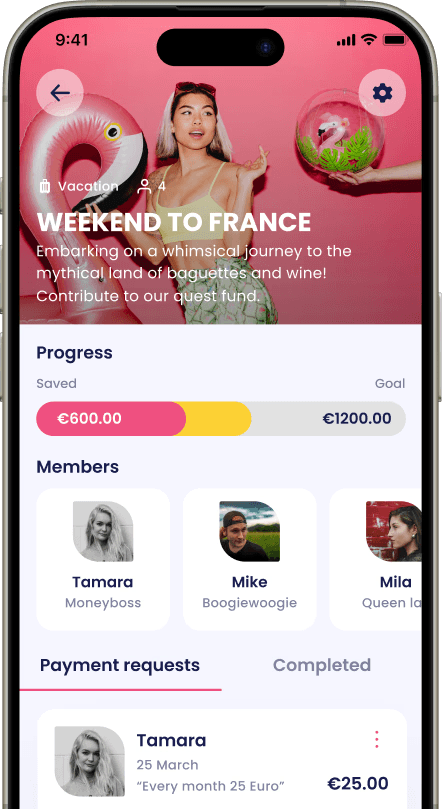
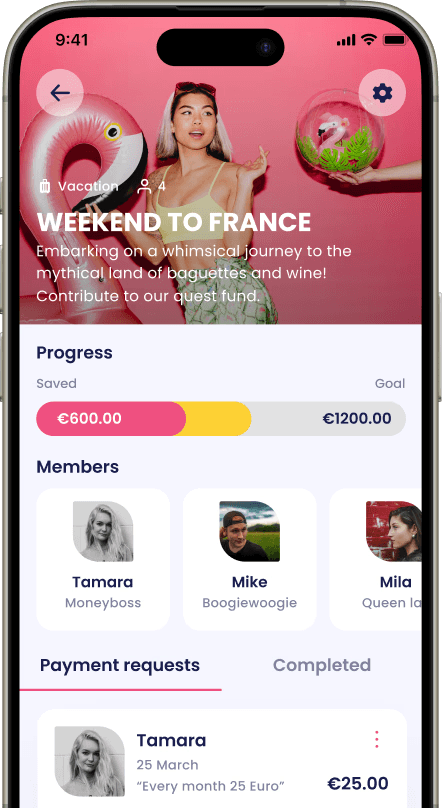
A shared money pot changes that entirely. Everyone can see the goal, track progress, and confirm their own contribution. Nobody has to wonder whether their payment arrived. Nobody has to ask the organiser for an update.
Key insight: transparency is not just good for fairness. It is good for the friendship. When everyone can see the same information, there is nothing to argue about.
What Low-Pressure Group Contributions Actually Look Like
Here is what the same situation looks like with and without a clear structure in place.
Scenario | Without a clear structure | With a clear structure |
Holiday Airbnb | One person pays, sends reminders for weeks | Everyone contributes to a shared pot before booking |
Group birthday gift | Organiser fronts the cost, chases 8 people | Link is shared, contributions tracked, goal visible to all |
Festival tickets | Spreadsheet, WhatsApp chaos, someone drops out | Fixed amount per person, collected upfront, no spreadsheet needed |
Sports team fees | Treasurer manually tracks who has and has not paid | Automated reminders, progress visible, no awkward conversations |
The difference is not the people. The difference is the process.
When the process is clear, contributions feel like participation in something shared, not a debt being called in. That shift in framing changes everything about how the experience feels for everyone involved.
How Potje handles this
Potje is a shared money account built specifically for groups. You set a goal, invite your group, and everyone contributes directly to the pot. Progress is visible to all. Contributions are tracked automatically. No one person holds the group's money in their personal account.
The cost is shared too. An active money pot costs €5.00 per month in total, split automatically across the group. For a group of five, that is €1.00 each per month. For a group of ten, €0.50 each.
You can learn more about how it works on the Potje homepage or read about how groups use shared money pots for everything from holidays to group gifts.
Frequently Asked Questions
How do I ask friends for money without it feeling awkward?
Frame it as a shared goal, not a debt. Instead of asking people to pay you back, set up a shared pot with a clear target and invite everyone to contribute before the event or purchase. When the goal is visible and the amount is specific, contributing feels like being part of something, not settling an obligation.
What is the fairest way to split group contributions?
Equal splits work well when everyone is participating equally. If participation varies (for example, some people join for fewer nights on a trip), adjust contributions accordingly and explain the breakdown clearly. Transparency about how the amount was calculated removes any sense of unfairness.
Why do people avoid paying their share in group situations?
Research shows that people are less likely to challenge financial situations with friends than with strangers, because the perceived social cost of speaking up outweighs the financial benefit. The solution is to remove the need for anyone to speak up at all, by making the structure clear and automatic from the beginning.
What is a shared money pot?
A shared money pot is a joint account where a group can save together towards a specific goal. Everyone contributes directly, progress is visible to all members, and the money is only used once the group decides to spend it. It is different from a personal bank account because no single person controls the funds, which makes the process transparent and fair for everyone involved.
How does Potje make group contributions easier?
Potje lets you create a shared money pot in minutes. You set a goal, share a link, and everyone contributes at their own pace. Progress is tracked automatically, so there is no need to chase anyone or manage a spreadsheet. The total cost of €5.00 per month is split across the group, making it affordable for everyone.
The Bottom Line
Group money does not have to be awkward. It feels that way because most groups are using a process that was never designed for shared goals.
Set the goal clearly. Collect before you spend. Give everyone visibility. Assign one organiser. Use a shared pot instead of a personal account.
Do those five things, and the dynamic shifts completely. Contributions stop feeling like a favour being asked and start feeling like a shared plan being executed.
Ready to try a better way? Create a free money pot with Potje and see how much easier group saving can be.

Social Accountability and Saving: The Missing Link to Financial Freedom
Ondersteuning voor verschillende inhoudstypes zoals artikelen, blogs, video's en meer. Rijke tekstverwerker met opmaakopties voor verbeterde.
17 november, 2025

Group Saving Apps Compared: What's Easiest, Safest, and Most Transparent?
Ondersteuning voor verschillende inhoudstypes zoals artikelen, blogs, video's en meer. Rijke tekstverwerker met opmaakopties voor verbeterde.
17 november, 2025

Group Money Platforms Compared: What’s Safe, Regulated, and Fair?
Ondersteuning voor verschillende inhoudstypes zoals artikelen, blogs, video's en meer. Rijke tekstverwerker met opmaakopties voor verbeterde.
17 november, 2025