20 August 2026



Someone in the group chat says "we should do a trip."
Everyone agrees. Dates get picked. A destination gets chosen.
Then comes the silence. The part where nobody wants to be the one to ask: "So... how much is everyone actually putting in?"
That silence is where group plans start to fall apart.
The money conversation is not the awkward part. Skipping it is.
Most group plans fail not because of bad intentions, but because nobody agreed on the rules before the excitement took over. One person assumed the Airbnb would be split equally. Another thought they'd just pay for what they personally used. A third was quietly hoping to keep costs lower than everyone else had in mind.
By the time the booking is made, the expectations are already misaligned.
This guide is about fixing that. Before the plan starts, not after.
Key takeaway: Setting payment expectations before a group plan starts is the single most effective thing you can do to protect both the plan and the friendships involved.
Why Most Groups Skip This Conversation (And Regret It)
Talking about money feels uncomfortable. Especially with friends.
Nobody wants to seem like the person who cares too much about money, or the one who can't afford it. So the conversation gets avoided. Everyone assumes it will "work itself out."
It rarely does.
What actually happens when there are no agreed rules
Here is the pattern that plays out in almost every group:
One person fronts a big payment (the Airbnb, the group dinner, the festival tickets).
They expect to be paid back quickly. The others assume there is no rush.
Reminders get sent. Some people pay fast. Others go quiet.
The person who fronted the money starts to feel used. The others start to feel chased.
The trip ends. The awkwardness lingers.
Research on group travel behaviour consistently shows that vague payment expectations are the root cause of most post-trip financial disputes. Not the amounts. The ambiguity.
The difference between "we'll sort it out" and a real plan
"We'll sort it out" is not a plan. It is a postponement.
A real plan answers three questions before anything gets booked:
How much is everyone contributing? A specific number, not a range.
When does the money need to be in? A date, not "soon."
What happens if someone does not pay on time? An agreed consequence, not an assumption.
Those three answers take about ten minutes to agree on. They prevent weeks of follow-up messages and strained friendships.
The honest truth: According to personal finance experts who study group travel, nearly half of group travellers now have an explicit money conversation before any booking is made. The other half tend to wish they had.
How to Set Payment Expectations That Actually Stick
The goal is not to turn a fun group chat into a finance meeting. It is to have one clear, short conversation so the fun part stays fun.
Here is a practical framework that works for any group plan, whether it is a weekend trip, a group gift, a festival, or a shared holiday fund.
Step 1: Agree on a total per-person amount before anything is booked
This is the most important step. And the one most groups skip.
Before you confirm any accommodation, tickets, or bookings, every person in the group should know exactly how much they are expected to contribute in total.
Not a rough estimate. A real number.
If your group is planning a weekend in Barcelona, work backwards:
Cost category | Group total | Per person (6 people) |
Accommodation (3 nights) | €900 | €150 |
Shared transport | €120 | €20 |
Group meals (2 dinners) | €360 | €60 |
Activities | €180 | €30 |
Total | €1,560 | €260 |
Once everyone sees that number and agrees to it, the conversation is done. The ambiguity is gone.
Step 2: Set a payment deadline, not a payment request
Here is where most organisers go wrong.
They collect contributions reactively: they send a payment request after the booking, then wait, then send reminders, then feel like they are chasing people.
The better approach is to set a deadline upfront.
"Everyone needs to have contributed their €260 by [date]" is far more effective than "just send it when you can." People respond to deadlines. They do not respond to open-ended requests.
This is exactly why collecting money before the plan starts works so well. The group reaches its goal together first. Then the booking gets made. Nobody is fronting money on behalf of others.
Step 3: Decide what is shared and what is individual
Not every expense needs to be split equally. Being clear about this upfront prevents arguments later.
A simple rule that works for most groups:
Shared costs: Accommodation, group transport, pre-agreed group meals, activities everyone joins
Individual costs: Personal drinks, solo activities, shopping, anything optional
Write this down somewhere the whole group can see it. A pinned message in the group chat works fine.
Step 4: Name a single person to manage the money
Every group needs one person who is responsible for tracking contributions and spending.
This person is not the one who pays for everything. They are the one who keeps the overview. They confirm when contributions have arrived. They flag when something is missing. They update the group on where the shared money stands.
Having one named person removes the confusion of "I thought someone else was tracking that."
Why Collecting Money Upfront Changes Everything
There is a fundamental difference between two approaches to group money.
The old way: One person books everything, everyone else pays them back afterwards. The organiser carries the financial burden. The others carry the guilt of being chased. Both sides end up uncomfortable.
The better way: Everyone contributes to a shared money pot first. The goal is reached together. Then the booking is made from the shared fund.
This is not just a nicer experience. It is structurally better.
When money is collected upfront:
Nobody is out of pocket waiting for reimbursements
The group can only spend what has actually been contributed
Everyone has equal skin in the game, which makes people more likely to commit
The organiser is not personally carrying the financial risk of the whole group
This approach works for a weekend trip, a group birthday gift, a festival fund, or any shared goal where multiple people are contributing. You can read more about how this works in practice in our guide on saving together for a holiday.
The mindset shift: Stop thinking of the organiser as the one who pays first and gets paid back. Start thinking of the group as the one that saves first and then spends together.
How Potje Helps You Set and Keep Payment Expectations
One platform taking a different approach to this problem is Potje.
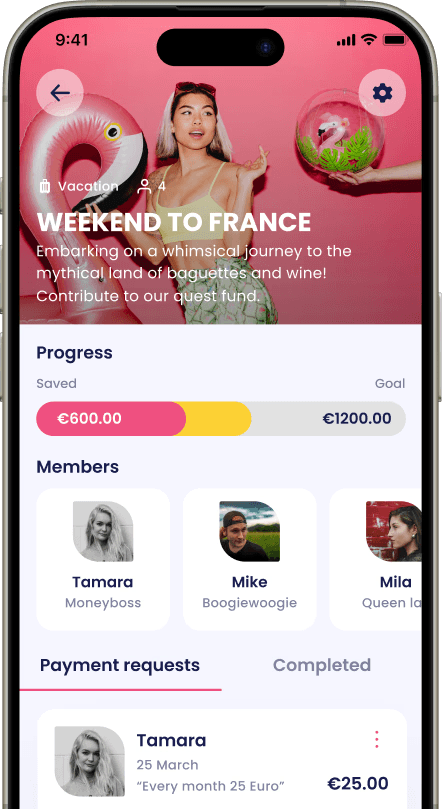
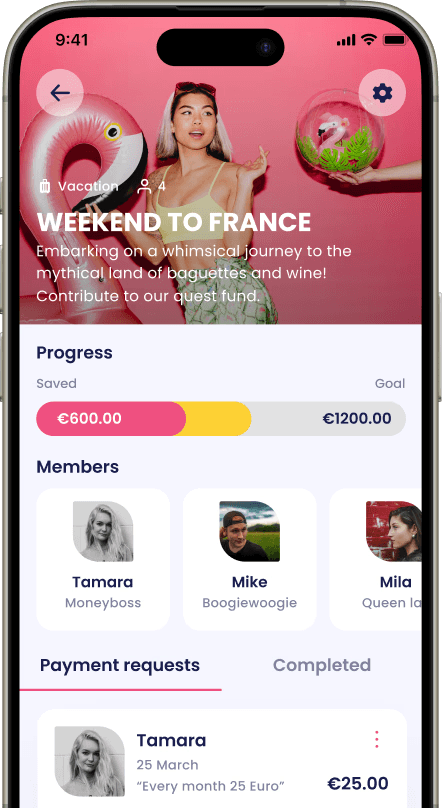
Rather than tracking who owes what after the fact, Potje helps groups collect money before spending begins. The organiser creates a shared money pot, sets a contribution goal, and shares a payment link with the group. Everyone contributes their share directly into the pot.
No one person fronts the money. No chasing after the event. No awkward reminders weeks later.
What this looks like in practice
Say your group of six is planning a ski trip. You need to collect €1,500 in total before you can book the chalet.
The organiser creates a Potje money pot with a €1,500 goal
Each person receives a link and contributes their €250
The group can see progress towards the goal in real time
Once the target is reached, the booking gets made
The payment expectation is built into the structure. Everyone knows what they owe, when they need to contribute, and where the money stands. There is nothing to chase because the money arrives before anything is spent.
Potje costs €5.00 per month in total for an active money pot, shared automatically across the group. For a group of six, that is less than €1 per person per month.
If you are curious about what else a shared money pot can be used for, this overview covers the most common use cases groups come back to again and again.
The science backs this up too. Research on group saving behaviour shows that people are significantly more likely to follow through on financial commitments when they are made to a group rather than to themselves alone.
Common Questions About Group Payment Expectations
What should I say to bring up the money conversation without making it awkward?
Keep it simple and frame it positively. Something like: "Before we book anything, let's just quickly agree on what everyone is putting in. It takes five minutes and saves a lot of hassle later." Most people are relieved when someone else brings it up first.
What if someone in the group cannot afford the full amount?
Address this privately, not in the group chat. Give them the option to contribute what they can, skip certain optional costs, or join for a smaller share of the plan. The key is to agree on this before the booking, not after.
Should I collect money before or after booking?
Before. Always before. Once a booking is made, the financial commitment is already set. Collecting money before the booking means the group only commits to what everyone can actually afford. This is the core principle behind how a shared money pot works.
What is the best way to track who has contributed?
Use a shared tool that gives the whole group visibility. A dedicated money pot like Potje shows everyone the progress in real time, so there is no need for the organiser to send manual updates or chase individuals. Everyone can see where things stand.
What if someone agrees to pay but then does not?
Set a clear deadline upfront and communicate it to the group. If someone misses the deadline, follow up privately with a specific ask: "The deadline was [date]. Can you sort this by [new date]?" Most delays are not deliberate. A clear, specific request resolves the majority of them.
Start the Plan Right
The best group plans are not the ones with the fanciest destination.
They are the ones where everyone is on the same page from the start.
Setting payment expectations before a group plan starts is not about being the cautious one. It is about being the organised one. The one who makes sure the trip actually happens, that nobody feels resentful afterwards, and that the group is ready to do it again.
Agree the amount. Set the deadline. Collect before you spend.
If you want a tool that makes this the default rather than a conversation you have to force, create a money pot with Potje and share the link with your group before you book anything.
The money comes in first. The plan starts properly. Everyone enjoys it more.

Social Accountability and Saving: The Missing Link to Financial Freedom
Ondersteuning voor verschillende inhoudstypes zoals artikelen, blogs, video's en meer. Rijke tekstverwerker met opmaakopties voor verbeterde.
17 november, 2025

Group Saving Apps Compared: What's Easiest, Safest, and Most Transparent?
Ondersteuning voor verschillende inhoudstypes zoals artikelen, blogs, video's en meer. Rijke tekstverwerker met opmaakopties voor verbeterde.
17 november, 2025

Group Money Platforms Compared: What’s Safe, Regulated, and Fair?
Ondersteuning voor verschillende inhoudstypes zoals artikelen, blogs, video's en meer. Rijke tekstverwerker met opmaakopties voor verbeterde.
17 november, 2025