7 July 2026



You've been there.
You organised the group trip, booked the Airbnb, fronted the money, and then spent the next three weeks sending awkward reminders to people you actually like.
Chasing friends for money is one of the most uncomfortable parts of group planning. Not because your friends are bad people. But because the whole system is set up wrong from the start.
The good news: you don't have to chase anyone if you change how money gets collected in the first place.
This guide walks you through a simple 5-step system that removes the awkwardness entirely. No more reminders. No more IOUs. No more mental spreadsheets of who owes what.
One platform that takes a completely different approach to this problem is Potje. Rather than tracking who owes who after the fact, Potje helps groups collect money before spending begins. We'll show you exactly how it fits into the system below.
Why Chasing Friends for Money Never Really Works
Let's be honest about what "I'll pay you back" actually means.
It means: I'll pay you back when I remember, when I have cash, when you remind me, and only if it doesn't feel too awkward by then.
The problem isn't your friends. The problem is the model.
The Old Way Creates Friction at Every Step
Here's how group money usually goes wrong:
One person pays upfront for the whole group
Everyone agrees to pay them back "later"
Some people pay quickly. Others forget.
The organiser sends a reminder. It feels rude.
The person who forgot feels guilty. The organiser feels resentful.
Somehow a fun trip becomes a source of tension.
This pattern plays out for holidays, birthday gifts, festival tickets, sports club fees, and weekend trips. Every time.
Why Reminders Make It Worse
Sending a payment reminder to a friend is uncomfortable because money and friendship aren't supposed to mix.
When you chase someone, you're essentially saying: "I don't trust you to remember."
Even if that's not how you mean it, that's how it lands.
The solution isn't to get better at sending reminders. The solution is to build a system where reminders aren't needed.
The 5-Step System to Stop Chasing Friends for Money
This system works for any group situation: holidays, shared gifts, sports clubs, group dinners, or weekend getaways. The core principle is simple.
Collect before spending. Not after.
Here's how to do it.
Step 1: Set a Clear Goal Before Anyone Books Anything
The biggest mistake groups make is jumping straight to booking before money is sorted.
Before you book the Airbnb, buy the festival tickets, or order the birthday gift, get the group to agree on three things:
What you're saving for (e.g. Tomorrowland weekend, skiing trip, group gift)
How much each person needs to contribute
When contributions need to be in by
This sounds obvious. Most groups skip it entirely.
When there's no clear goal or deadline, nobody feels urgency. When there's a specific target and a date, people act.
Step 2: Create a Dedicated Money Pot for the Goal
This is where most groups go wrong.
They either use someone's personal account (messy, awkward, hard to track) or they rely on everyone paying at different times via different methods.
The cleaner approach is to create a shared money pot specifically for the goal.
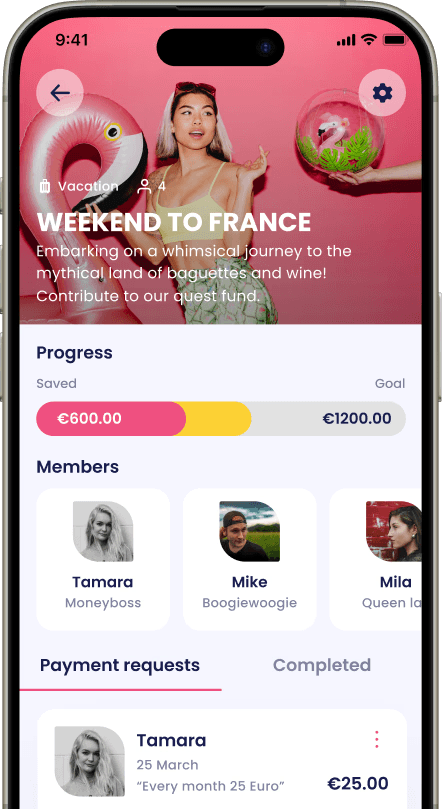
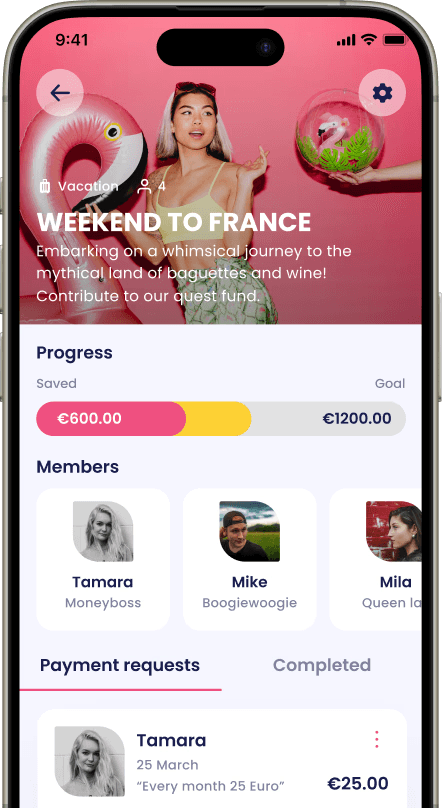
Potje lets groups do exactly this. You create a pot, set the goal amount, and share a payment link with the group. Everyone can see how much has been collected and how much is still needed.
Nobody has to be the banker. Nobody has to keep track manually. The pot does it for you.
Create your first pot here and share the link before anyone books a thing.
Step 3: Share the Link, Not the Responsibility
Here's a small but important mindset shift.
Instead of saying: "Hey, can you all pay me back for the hotel?"
Say: "Here's the link to our group pot. Once everyone's in, we'll book."
The difference is significant.
The first version puts you in the position of collector and chaser. The second version makes contributing a shared action that the whole group takes together.
When everyone contributes to a shared pot before the booking is made, there's nothing to chase. The booking only happens when the money is there.
Step 4: Make the Goal Visible to Everyone
Chasing happens when people forget.
People forget when the goal isn't visible.
When everyone in the group can see a shared money pot filling up towards a target, it creates natural momentum. Nobody wants to be the person holding the group back.
This is why Potje shows progress towards the goal. Everyone can see how much has been collected. Everyone understands what's left.
It turns a private financial obligation into a shared group goal. That's a completely different feeling.
Step 5: Spend Only What's Already Been Collected
This is the rule that changes everything.
Don't book until the money is in.
It sounds strict. But it removes every single awkward conversation that comes after.
When you spend money that's already been collected from the group, there's nothing to chase. There are no IOUs. There are no reminders. There are no "I'll get you next time" conversations.
The group saves together. Then the group spends together.
That's the whole system.
What's Coming Next for Potje
Potje is currently developing a virtual spending card for groups.
Once it launches, the whole cycle will be complete. Groups save together into a shared money pot, and then spend directly from it using the card. No transfers. No one person fronting costs. Just a group spending from money the group already collected.
It hasn't launched yet, but you can join the waiting list here to be first in line when it does.
What About Apps Like Tikkie or Splitwise?
These tools are genuinely useful for certain situations.
Tikkie works well when you've already paid for something and need one or two people to pay you back quickly. For a simple dinner split or a one-off purchase, it does the job.
Splitwise is good for tracking who owes what across a group over time. If you want a running ledger of shared expenses, it handles that well.
But neither of them solves the chasing problem.
Both tools still operate on the "pay me back later" model. Someone fronts the money. The app tracks the debt. You still have to wait for people to settle up.
Potje takes a different approach entirely. Instead of tracking debt after spending, groups collect money into a shared pot before spending happens. There's no debt to track because there's no debt created.
If you're organising something with more than two or three people and you want to avoid carrying the financial burden yourself, Potje is built for exactly that.
Real Situations Where This System Works
This isn't just theory. Here's how the 5-step system plays out in real group scenarios.
Group Holiday or Weekend Away
Eight friends want to book an Airbnb in Amsterdam for a long weekend.
Old way: one person books, spends weeks chasing the other seven for their share.
New way: create a Potje pot for the trip, share the link in the group chat, and only book once everyone has contributed. No chasing. No awkward messages.
Birthday Gift Collection
Your friend is turning 30 and the group wants to get something meaningful together.
Old way: one person buys the gift, sends a payment request to ten people, and follows up with whoever hasn't paid.
New way: create a shared money pot for the gift. Everyone contributes at their own pace. You buy the gift when the pot hits the target.
Sports Club or Team Fees
A football team needs to collect membership fees, pitch hire costs, or kit money every season.
Old way: the team treasurer manually tracks who has paid and chases the rest every month.
New way: a recurring pot where everyone contributes on schedule. Everyone can see who's in and what's been collected.
Festival Planning
A group of friends is going to Tomorrowland and needs to cover tickets, travel, and accommodation.
Old way: one person co-ordinates everything, fronts various costs, and spends weeks piecing together repayments.
New way: create a shared savings pot for the whole festival budget. Everyone contributes their share before anything gets booked.
Frequently Asked Questions
How do I stop chasing friends for money?
Stop collecting money after spending and start collecting before. Set a shared goal, create a dedicated money pot, share a contribution link with the group, and only spend once everyone has paid in. Tools like Potje are built specifically for this model.
What is a shared money pot?
A shared money pot is a joint account created for a specific group goal. Everyone contributes their share before the money gets spent. It removes the need for one person to front costs and then chase others for repayment. Potje lets groups create dedicated money pots for holidays, gifts, events, and shared expenses.
Why do friends forget to pay back money?
Usually because there's no clear deadline, no visible goal, and no system in place. When money is owed informally after the fact, it's easy to deprioritise. When there's a shared pot with a target and a deadline, contributing feels like part of the plan rather than an obligation.
Is it rude to ask friends to pay before booking?
Not at all. Framing it as "let's all contribute to the pot before we book" is far less awkward than chasing people afterwards. It sets clear expectations upfront and means nobody has to carry the financial burden alone.
Can only one person manage the pot?
Yes. With Potje, only the organiser needs the app. You create the pot, set the goal, and share a payment link. Everyone else can contribute without needing to download anything.
Ready to Stop Chasing?
The system is straightforward.
Set a goal. Create a pot. Share the link. Collect before you spend.
That's it. No reminders. No awkward messages. No mental accounting of who still owes you.
The next time your group is planning a trip, a gift, or any shared expense, try a different approach. Create a free pot on Potje, share the link in your group chat, and let the money come to you.
Your friendships will thank you for it.

Social Accountability and Saving: The Missing Link to Financial Freedom
Ondersteuning voor verschillende inhoudstypes zoals artikelen, blogs, video's en meer. Rijke tekstverwerker met opmaakopties voor verbeterde.
17 november, 2025

Group Saving Apps Compared: What's Easiest, Safest, and Most Transparent?
Ondersteuning voor verschillende inhoudstypes zoals artikelen, blogs, video's en meer. Rijke tekstverwerker met opmaakopties voor verbeterde.
17 november, 2025

Group Money Platforms Compared: What’s Safe, Regulated, and Fair?
Ondersteuning voor verschillende inhoudstypes zoals artikelen, blogs, video's en meer. Rijke tekstverwerker met opmaakopties voor verbeterde.
17 november, 2025