5 November 2026



Someone in your group books the Airbnb. Someone else pays the deposit on the minibus. A third person covers the first round of festival tickets. By the time you actually leave, three people are owed money, nobody knows the exact totals, and the group chat has turned into a string of awkward payment reminders.
Sound familiar? It is one of the most common problems in group travel and shared events across Europe, and it has nothing to do with people being dishonest. It is simply what happens when spending comes before collecting.
Revolut Group Bills is a useful tool for tracking who paid what. But it still relies on someone fronting the money first, and that person then waits, sometimes for weeks, to be paid back.
Potje takes a completely different approach. Instead of tracking debts after the fact, it collects everyone's contribution upfront into a shared money pot. The money is there before anyone spends a single euro.
This article explains both approaches honestly, when each one makes sense, and why collecting first is the smarter move for trips, events, and anything with an upfront cost.
What Is Revolut Group Bills and What Does It Do Well?
Revolut Group Bills is a shared expense tracking tool built into the Revolut app. You create a group, add bills as they happen, and the tool automatically calculates who owes what to whom. It is free to use and non-Revolut users can now also join with just an email address.
That last point is a meaningful improvement. Previously, everyone in the group needed a Revolut account. Now, a friend without the app can be added, receive notifications when bills are updated, and pay their share using a payment link sent by the Revolut user.
What Group Bills does particularly well
Retroactive tracking: You add expenses after they happen, so it works well for spontaneous spending on a trip already underway.
Flexible splitting: You can split bills equally, by custom amounts, or by percentages, which suits groups with different budgets.
Smart Settle: The tool suggests the minimum number of transfers needed to clear all debts, reducing the back-and-forth.
No app required for non-Revolut users: They can participate via the Group Bills website, which removes a major barrier.
It is also worth being clear about what Group Bills is not. According to Revolut's own terms, it is not a regulated financial service and it does not hold or move money. Entries in Group Bills are informal records. Settlement still happens outside the tool, through bank transfers, card payments, or Revolut's P2P features.
For a quick meal split or a weekend where expenses are small and spontaneous, Group Bills does the job. But the moment your group needs to commit money upfront, a tracking tool is not enough. That is where the approach needs to change entirely.
The Gap: Someone Always Has to Pay First
Here is the structural limitation that no expense tracker can fully solve: before you can split a bill, someone has to pay it.
That person is usually the most organised one in the group. The one who books the villa, confirms the festival camping pitch, or puts down the holiday deposit. They do the admin, and then they spend weeks waiting to be reimbursed.
The real problem is not that people forget to pay. It is that the system puts one person in an uncomfortable position from the start.
This matters more than it sounds. Consider a group of eight friends booking a ski trip. The Airbnb deposit is €400. Someone pays it. The flights are €160 each. Someone pays those too. By the time the trip begins, one person has fronted over €1,500 of shared money, and Group Bills is faithfully recording who owes what.
The tracking works. But the financial exposure is real.
Why chasing payment is harder than it looks
Even with the best tools, collecting money after the fact creates friction:
People pay at different times, so the organiser never quite knows where things stand.
Some contributions arrive days or weeks after the initial spend.
Partial payments are common, which means the debt lingers.
Reminders feel awkward, even between close friends.
This is not a technology problem. It is a sequencing problem. Expense trackers, by design, work after the money has moved. They are excellent at recording what happened. They are not built to prevent the imbalance in the first place.
That is the gap a shared money pot is designed to close.
When to Split Afterwards and When to Collect First
Neither approach is universally better. The right choice depends on the situation.
When splitting afterwards works well
Retroactive splitting makes sense when:
Spending is spontaneous and unpredictable. A weekend city break where the group decides on restaurants as they go is hard to budget in advance.
Amounts are small and trust is high. A dinner between four close friends does not need a pot. A quick split app is plenty.
The group is already together. When everyone is physically present, settling up at the end of the night is natural and fast.
Group Bills is genuinely well suited to these situations. The tracking is clean, the Smart Settle feature minimises transfers, and it costs nothing.
When collecting first is the smarter move
There are situations where waiting to collect creates real problems:
Situation | Why collecting first helps |
Group holiday with upfront deposits | No one person carries the financial risk |
Festival or event tickets | Payment is required before the event, not after |
Shared accommodation (Airbnb, villa, campsite) | Booking requires full or partial payment at the time |
Group gifts | The recipient expects the gift by a specific date |
Sports team or club fees | Regular contributions need to be in before costs are committed |
Shared transport (minibus, coach hire) | Deposits are often non-refundable |
The pattern is clear: whenever a group needs to commit money before the experience happens, collecting first removes the risk from the individual who would otherwise front it.
This is the situation Potje was built for.
How a Shared Money Pot Works with Potje
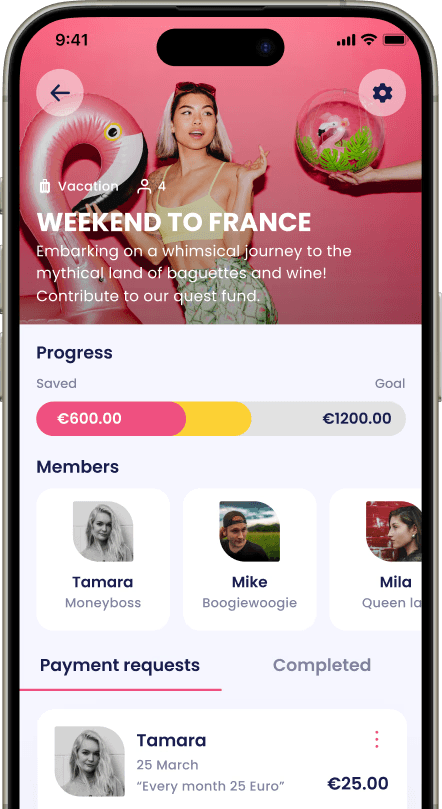
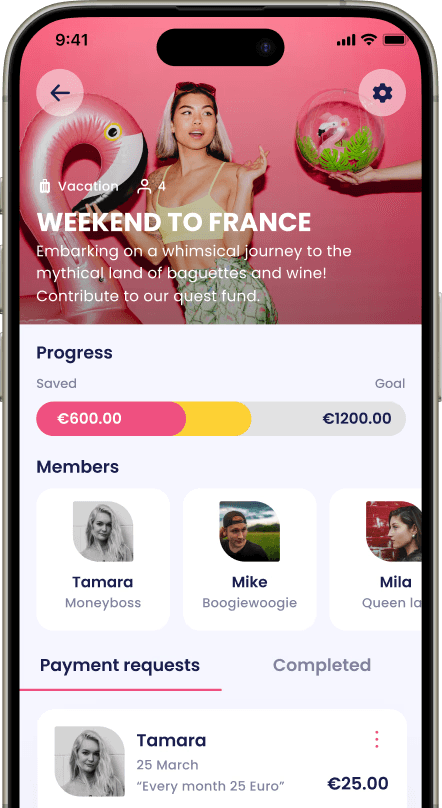
Potje is a shared money pot built specifically for groups. It does not track debts after the fact or leave anyone waiting to be paid back. Instead, it collects contributions upfront into a single shared account, so the money is there before anyone spends a single euro.
That one difference changes everything about how group money feels.
Here is how the flow works in practice:
Step 1: One person creates the pot
The organiser sets up a pot in the Potje app, names it (say, "Tenerife 2027"), sets the goal amount, and shares a payment link with the group. No one else needs the app to contribute.
Step 2: Everyone contributes by link
Each person in the group pays their share via the link, using Pay by Bank, iDEAL | Wero, Bancontact or SEPA bank transfer. Contributions are visible to everyone, so there is no ambiguity about who has paid and who has not.
Step 3: The money boss pays from the pot
Once the pot has enough, the organiser (the "money boss") pays out from the shared balance to cover the booking. No one person fronts the full amount. No one waits to be reimbursed.
The result: the group goes from idea to booked without anyone carrying the financial risk alone. No fronting. No chasing. No awkward group chat messages asking who still hasn't paid.
What makes Potje different from a standard split app
Feature | Expense tracker (e.g. Group Bills) | Potje shared money pot |
When money moves | After spending | Before spending |
Who carries the risk | The person who pays first | Nobody (shared upfront) |
Settlement required | Yes, after every expense | No, money is already pooled |
Transparency | Who owes what | Live balance visible to all |
Works without the app | Yes (Group Bills website) | Yes (contribute via link) |
Pricing that shares itself
Potje costs €5 per month in total for an active pot. That fee is split automatically across the group:
5 people: €1.00 each per month
10 people: €0.50 each per month
Your first month is free, so you can try it for an upcoming trip or event at no cost. There are no fees on partial payouts, and instant payouts of any amount are available whenever the group needs them.
Real Situations Where a Shared Pot Changes Everything
Abstract comparisons only go so far. Here is what the difference looks like in practice.
Planning a group holiday
Eight friends want to book a villa in Portugal for a week. The villa costs €2,400 and requires a €600 deposit immediately.
With Group Bills: Someone pays the €600 deposit and logs it. The group owes them €75 each. Some pay quickly, others take a week. The organiser is out of pocket in the meantime and has to keep track of who has settled.
With Potje: The group creates a pot with a €2,400 goal. Everyone contributes €300. Once the pot has €600, the organiser pays the deposit from the shared balance. Nobody fronts anything alone.
Buying festival tickets
A group of six wants to buy Tomorrowland tickets the moment they go on sale. Tickets sell out in minutes. There is no time to wait for everyone to transfer money.
With Group Bills: One person buys all six tickets (potentially hundreds of euros) and hopes to be reimbursed quickly. The stress of the purchase is entirely theirs.
With Potje: The group pre-fills the pot in the weeks before the sale. When tickets go live, the money is already there. The organiser buys immediately from the shared balance.
Collecting for a group gift
A team of twelve wants to buy a leaving gift for a colleague. The budget is €180.
With Group Bills: Group Bills is designed for shared expenses, not collections. It is not the right tool for this scenario.
With Potje: Create a pot, share the link, and watch contributions come in. The group gift pot fills up before you need to buy anything. No awkward chasing, no spreadsheet.
The common thread in all three scenarios: the money needs to exist before the purchase. A shared pot makes that possible without putting any individual in a difficult position.
Can You Use Both?
Yes, and for longer trips it often makes sense to do exactly that.
Use a shared pot to collect and hold the big upfront costs: accommodation, transport, event tickets. These are the items that require payment before the trip, and they are the ones that create the most financial stress when one person covers them alone.
Once you are on the trip, spontaneous daily expenses (meals, drinks, activities you decide on the day) can be tracked with a split app or settled informally. The amounts are usually smaller, the group is together, and it is easy to settle at the end of the day.
The combination looks like this:
Pre-trip: Create a Potje pot for the big fixed costs. Everyone contributes before anything is booked.
During the trip: Track day-to-day spending however suits the group.
After the trip: Settle any remaining small balances quickly.
This approach removes the heaviest financial burden from the organiser while keeping daily spending flexible. It is particularly useful for groups travelling across Europe, where managing shared travel costs can involve multiple currencies and booking platforms.
Start Your First Pot Free
If your group has a trip, event, or shared goal coming up, Potje's first month is free. There is no commitment, no setup fee, and no fee on partial payouts. Instant payouts of any amount are available from the moment the pot has a balance.
The total cost of an active pot is €5 per month, shared automatically across the group. For five people, that is €1 each. For ten people, €0.50.
Ready to stop fronting money and start collecting it?
Start your shared money pot today and see how different group money feels when everyone contributes before anyone spends.
Frequently Asked Questions
Does Revolut Group Bills actually hold the group's money?
No. According to Revolut's own terms, Group Bills is not a regulated financial service and does not hold or move money. It is an expense tracking tool. All entries are informal records. Settlement happens separately, through bank transfers or Revolut's P2P features. If your group needs money to actually sit somewhere before it gets spent, Group Bills cannot do that.
If Group Bills is free, why would I pay for Potje?
Group Bills tracks who owes what after someone has already paid. That means one person in your group always carries the financial risk first. Potje collects contributions before anyone spends, so nobody fronts the money alone. The cost is €5 per month in total, split automatically across the group. For five people, that is €1 each. For ten people, €0.50 each. The first month is free. For any trip or event with upfront costs, that is a small price to remove a big headache.
What happens with Group Bills when someone doesn't pay up?
Group Bills records the debt, but it cannot force settlement. The organiser has to chase manually, which is exactly the awkward dynamic most groups are trying to avoid. Potje removes this problem by collecting contributions before any money is spent. If someone hasn't contributed, the pot simply hasn't reached its goal yet. No chasing required.
Does Potje require everyone to download an app?
No. Only the pot organiser (the money boss) needs the Potje app. Everyone else contributes via a payment link, using Pay by Bank, iDEAL | Wero, Bancontact or SEPA bank transfer. No account needed. No app download required.
When is Group Bills actually the right choice?
Group Bills works well for spontaneous, day-to-day spending where the group is already together and amounts are small. A dinner split, a round of drinks, a taxi shared between friends. For anything requiring upfront payment, such as a holiday deposit, festival tickets, or a group gift, collecting first with Potje is the smarter approach.
How does Potje handle payouts?
The pot organiser (the money boss) can pay out any amount at any time. Payouts are instant. There are no fees on partial payouts. If the group needs to release funds in stages, that works too.
Is Potje available across Europe?
Yes. Potje is available to groups across Europe. Contributors can pay via link using Pay by Bank, iDEAL | Wero, Bancontact or SEPA bank transfer, wherever they are based in Europe.
Can I use Potje alongside Group Bills?
Yes, and for longer trips it often makes sense to do exactly that. Use Potje to collect the big fixed costs upfront: accommodation, transport, event tickets. Then use a split tool like Group Bills for smaller spontaneous expenses during the trip. The two approaches work well together.

Social Accountability and Saving: The Missing Link to Financial Freedom
Ondersteuning voor verschillende inhoudstypes zoals artikelen, blogs, video's en meer. Rijke tekstverwerker met opmaakopties voor verbeterde.
17 november, 2025

Group Saving Apps Compared: What's Easiest, Safest, and Most Transparent?
Ondersteuning voor verschillende inhoudstypes zoals artikelen, blogs, video's en meer. Rijke tekstverwerker met opmaakopties voor verbeterde.
17 november, 2025

Group Money Platforms Compared: What’s Safe, Regulated, and Fair?
Ondersteuning voor verschillende inhoudstypes zoals artikelen, blogs, video's en meer. Rijke tekstverwerker met opmaakopties voor verbeterde.
17 november, 2025