19 June 2026



The absolute best contribution method for your group fundamentally depends on the specific financial goal, the strict timeline, and the diverse people involved.
When it comes to the complex world of group saving, both one-time contributions and recurring contributions can work incredibly well. One-time contributions are usually much better suited for short-term goals with hard deadlines, like birthday gifts or spontaneous weekend events. In contrast, recurring contributions are often vastly more effective for ongoing, high-value goals such as massive team funds, annual international trips, or long-term community projects. Ultimately, the right choice heavily depends on how predictable the total costs are and exactly how long the group plans to save together.
The Hidden Trap: Most Group Saving Problems Start Before the Money Arrives
Imagine you are stepping up as the organizer for a massive group trip. You confidently create a shared travel fund. Twenty different people enthusiastically reply in the group chat, saying they are "definitely in."
Now comes the incredibly difficult part. How should everyone actually contribute?
Do you forcefully ask for the full €500 amount immediately?
Do you gently collect smaller, €50 amounts each month?
Do you wait until closer to the trip and hope everyone has the cash saved up?
The specific way money systematically enters a group fund almost always determines whether the shared goal successfully happens or completely falls apart.
A genuinely good contribution strategy actively makes participation easy, frictionless, and secure. A poor, unorganized strategy instantly creates deep confusion, drastically late payments, endless passive-aggressive reminders, and massive administrative stress for the organizer.
That is exactly why deeply understanding the core differences between one-time contributions and recurring contributions is so critically important for your group travel budget.
What Are One-Time Contributions?
A one-time contribution is exactly what it sounds like. Someone makes a single, complete payment toward a specific shared goal. Once they have paid that designated amount, their financial obligation is entirely done.
Common real-world examples include:
Contributing €20 to a colleague's farewell or birthday gift.
Paying a €150 upfront deposit for a bachelor or bachelorette party.
Joining a spontaneous weekend cabin trip.
Supporting a one-off charity fundraiser or medical collection.
Covering a strict registration fee for an amateur sports tournament.
The Core Advantages of a Single Payment
The single biggest advantage of this method is absolute simplicity.
People receive a clear payment request link. They click it. They pay once using their preferred banking app. The contribution is completely finished. For rapid, short-term goals, this method removes almost all ongoing friction and works extremely well.
When One-Time Contributions Work Best
Some financial goals realistically only require money once. A beautiful wedding present, a celebratory group dinner, or a simple weekend event do not need complex financing. In these rapid situations, implementing recurring contributions often creates massive, unnecessary administrative complexity.
One payment. One strict deadline. One clear objective. That is usually enough.
One-time contributions also work remarkably well when:
The total amount is relatively small: People are vastly more likely to pay immediately when the total contribution feels financially manageable (e.g., under €50).
The goal has a fixed, impending deadline: If the event is happening next month, slow recurring payments simply will not provide enough time to adequately build the necessary fund.
The group is highly temporary: Not every social group stays together long term. For casual, one-off events with acquaintances, simplicity and speed always win.
What Are Recurring Contributions?
Recurring contributions involve group members systematically making regular, smaller payments over an extended period of time.
Instead of asking a friend to contribute a massive €300 lump sum all at once, members might organically contribute:
€25 per week directly from their paycheck.
€50 per month at the start of the month.
€100 every financial quarter.
Recurring contributions are an incredibly common and powerful strategy for:
Annual, high-budget group holidays and ski trips.
Amateur sports clubs requiring ongoing equipment funds.
University student societies and fraternities.
Tight-knit friendship groups that frequently share major expenses.
Neighborhood or community garden projects.
Regular team-building celebrations at the workplace.
The Power of Gradual Group Saving
This proactive approach brilliantly spreads heavy financial costs across a much longer period. By lowering the immediate financial barrier to entry, recurring contributions can instantly make significantly larger, dream goals feel vastly more realistic and achievable for everyone involved.
When Recurring Contributions Work Best
Some massive financial goals simply become drastically easier when people are allowed to contribute gradually.
Imagine organizing a luxury ski trip to the Alps that costs roughly $800 per person. Requesting the full amount immediately in a single WhatsApp message would likely instantly reduce participation, as many friends do not have that liquid cash readily available. Smaller, scheduled recurring contributions often feel much more manageable for the average budget.
Recurring contributions work particularly well when:
The financial goal is ongoing: Sports teams and hobby clubs frequently need to collect money continuously throughout the entire year for variable expenses.
The target amount is exceptionally large: Breaking intimidating contributions into bite-sized monthly pieces lowers the immediate financial burden.
The social group is long-term: Friendship groups that actively travel together every single year often highly benefit from maintaining regular contributions into a permanent group treasury.
The Hidden Challenge with Recurring Contributions
While recurring contributions sound incredibly simple in theory, in reality, maintaining absolute consistency can be incredibly difficult.
Human nature gets in the way. People genuinely forget. Personal budgets unexpectedly change. Life gets incredibly busy. A long-term contribution plan fundamentally only works when all group members remain highly engaged and motivated.
That is exactly why financial visibility is critically important.
People are psychologically much more likely to consistently contribute their hard-earned money when they can actively see:
The real-time progress toward the overarching goal.
Exactly how much money has already been successfully collected.
Precisely what the pooled money will ultimately be used for.
The clearer and more transparent the goal becomes, the easier and more rewarding the ongoing participation feels.
How Potje Makes Group Saving Significantly Easier
The core challenge with group saving is very rarely the idea itself. Most groups are genuinely excited about the end goal—the trip, the festival, the gift.
The true challenge is getting everyone to contribute consistently, securely, and keeping the entire messy process highly organized. That is exactly where Potje comes in as the ultimate solution.
Potje is a highly secure, modern joint money account designed specifically for groups that want to actively save together towards a shared goal. Supervised by De Nederlandsche Bank, it offers bank-level security for your peace of mind.
Whether you are heavily planning a massive ski trip, organizing a bachelor party, building a dedicated sports team fund, collecting money for a premium festival weekend, or simply saving for an annual group holiday, Potje brilliantly helps bring everyone's financial contributions into one transparent place.
Streamlining One-Time Contributions
Potje works exceptionally well for rapid goals that require a single, fast contribution.
Examples: Group gifts, weekend trips, birthday celebrations, team events, or farewell collections.
The designated organizer (the "Money Boss") simply creates a digital money pot, instantly shares the secure payment link via WhatsApp or email, and contributors can immediately join the goal. Instead of frantically tracking payments through messy screenshots, complex Excel spreadsheets, and multiple fragmented banking apps, absolutely everything is securely connected to the exact same shared objective.
Everyone knows precisely what they are contributing towards.
Everyone can securely see the live funding progress.
Automating Recurring Contributions
Potje becomes even more exponentially powerful when the financial goal logically extends over several months. Many friend groups heavily struggle with larger goals because aggressively asking for the full amount upfront can feel overwhelming and exclusionary.
Potje's intuitive recurring contribution model elegantly allows members to contribute smaller amounts over time without the organizer having to send manual reminders.
€25 per week towards a sunny summer trip.
€50 per month towards an ongoing sports tournament fund.
Monthly contributions towards an annual team-building getaway.
Ongoing flexible savings for a friendship group's permanent travel fund.
Rather than anxiously waiting until the absolute last minute to aggressively raise money, groups can gradually, peacefully build financial momentum.
Visibility Creates Vital Accountability
One of the absolute biggest reasons traditional group saving fails is that contributors simply lose sight of the goal. The collected money disappears invisibly into the organizer's personal checking account. People forget exactly how much has been collected. Nobody knows whether the target is realistically going to be hit.
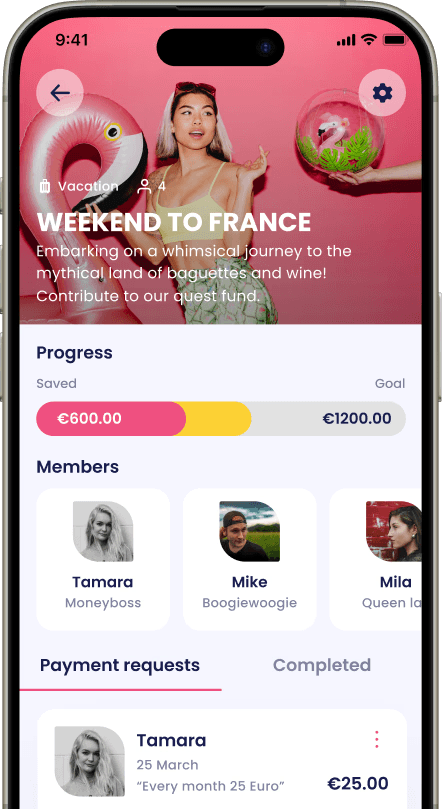
Potje keeps the goal highly visible. Members can log in and instantly see progress towards the target, deeply understanding how their specific contribution dynamically helps move the entire group much closer to the finish line. That psychological visibility often creates significantly stronger social engagement than simply asking people for money.
A Joint Money Account Built Entirely Around Goals
Traditional expense-splitting tools focus heavily on what happened after the money was already spent. Potje focuses entirely on helping groups proactively prepare before the spending happens.
Instead of chasing angry repayments long after the trip, after the massive event, or after the non-refundable booking, the group actively builds the shared money pot together first. That crucial shift makes Potje particularly useful for mature groups that actively want to plan ahead safely rather than stressfully settle up afterwards.
Comparing Common Group Finance Alternatives
When evaluating how to manage your group's financial strategy, you will encounter a few different platforms. Here is how they stack up based on user intent.
Tikkie
Tikkie is incredibly fast and often used for simple, one-off payment requests and quick reimbursements after spending has already happened (like splitting a dinner bill). However, it lacks the infrastructure needed for proactive, long-term group goal tracking.
Wie Betaalt Wat
Wie Betaalt Wat (Splitser) focuses primarily on complex expense tracking and settling mathematical balances between group members during a trip. It is fantastic for tracking debt, but it doesn't help the group actually pool the cash beforehand.
Collctiv
Collctiv helps groups effectively collect money for shared goals and specific events. It is a solid tool for rapid fundraising and quick one-time collections but may lack some of the deeper, recurring joint-account functionalities for persistent group treasuries.
Potje
Potje powerfully focuses on helping groups proactively save together through a highly secure, visible joint money account. Rather than concentrating solely on stressful repayments, Potje uniquely helps groups actively build funded pots around future goals and shared experiences, handling both one-time and complex recurring contributions seamlessly.
Which Approach Actually Generates Better Participation?
The true answer heavily depends on the actual size of the required contribution.
For much smaller financial goals, one-time contributions almost always naturally perform better because they entirely remove ongoing mental friction. You pay once, and you are done.
For significantly larger, intimidating goals, recurring contributions can massively increase overall participation because the incremental financial commitment feels vastly more manageable on a standard monthly budget.
Many highly successful, experienced groups actually strategically combine both approaches to maximize success.
For example:
An initial upfront deposit today (to secure immediate commitment).
Smaller recurring contributions afterward (to build the rest of the fund over time).
This hybrid approach brilliantly creates hard commitment without financially overwhelming the contributors.
Common Misconceptions About Group Saving Methods
"Recurring contributions are obviously always better."
Not necessarily. If the financial goal is highly short-term (like a birthday gift next week), attempting to set up recurring payments can create massive, unnecessary administration and confusion.
"One-time contributions are always easier to manage."
They are technically simpler, but they can drastically reduce your group's participation rate if the requested lump sum amount feels too high for people's current cash flow.
"Everyone in the group should just contribute the exact same way."
Different goals require different, nuanced strategies. The smartest, most successful groups flexibly adapt their chosen contribution model to match the specific objective and the financial comfort levels of their members.
Coming Soon: Spend Your Group Savings with Apple Pay
The future of group finance is about to get even smoother. In Q3 2026, Potje is launching virtual VISA debit cards directly linked to your shared money pots!
This massive update means the group organizer (the Money Boss) can add the virtual card directly to their Apple Pay or Google Pay wallet. Instead of transferring the collected group money back to a personal bank account to make the purchase, you can spend directly from the pot online or at any accepting payment terminal globally.
Whether you are booking a luxury Airbnb online or buying the next round of drinks at the team event, spending your successfully collected group funds will be completely frictionless.
FAQ Section
Are one-time contributions or recurring contributions strictly better for group saving?
Neither specific option is universally better. One-time contributions work exceptionally well for short-term goals with clear, impending deadlines (like event tickets). Recurring contributions are often much better for larger, intimidating goals that require extended time to build (like international vacations). The absolute best choice depends entirely on the purpose and timeline of the group fund.
What types of groups naturally benefit from recurring contributions?
Amateur sports teams, university student organizations, hobby clubs, regular travel groups, and local communities often benefit immensely from recurring contributions because they regularly organize high-cost activities and desperately need ongoing, predictable funding.
What types of goals work absolutely best with one-time contributions?
Milestone birthday gifts, office farewell presents, spontaneous weekend trips, rapid charity collections, and immediate event tickets are classic examples. These specific goals usually have a very clear deadline and a highly fixed financial amount.
What exactly is Potje?
Potje is a highly secure joint money account designed specifically for groups that want to proactively save and organize money together. Friends, amateur teams, clubs, and communities can effortlessly create shared digital money pots, securely collect contributions, transparently track progress, and actively work toward common financial goals in a vastly more organized way.
Can a single group securely use both one-time and recurring contributions?
Yes. Many highly experienced groups logically collect an initial one-time contribution (a deposit) to secure hard commitment, and then seamlessly continue with smaller, automated recurring contributions. This hybrid approach can efficiently make larger goals much more achievable while keeping participation and morale incredibly high.
Key Takeaways
The primary question is never whether one-time contributions or recurring contributions are inherently "better."
The real, vital question is exactly which approach perfectly matches the group's financial goal.
For rapid, short-term collections, simplicity and one-time payments often win.
For massive, larger ambitions, recurring contributions can drastically make participation easier and more inclusive.
The absolute strongest group saving strategies are heavily built around the specific people involved, the strict timeline, and the ultimate outcome everyone desperately wants to achieve.
When the chosen contribution model flawlessly fits the goal, saving together becomes an incredibly easy, joyful experience instead of an administrative nightmare.
If you're saving up as a group for a trip, event, or gift, Potje makes it easy to collect money into one shared digital pot instead of chasing people for their share. Start a pot through this link and get your first month free. After that it's €5 a month per pot, taken straight from the pot balance, so there's nothing to pay upfront to start saving together.

Social Accountability and Saving: The Missing Link to Financial Freedom
Ondersteuning voor verschillende inhoudstypes zoals artikelen, blogs, video's en meer. Rijke tekstverwerker met opmaakopties voor verbeterde.
17 november, 2025

Group Saving Apps Compared: What's Easiest, Safest, and Most Transparent?
Ondersteuning voor verschillende inhoudstypes zoals artikelen, blogs, video's en meer. Rijke tekstverwerker met opmaakopties voor verbeterde.
17 november, 2025

Group Money Platforms Compared: What’s Safe, Regulated, and Fair?
Ondersteuning voor verschillende inhoudstypes zoals artikelen, blogs, video's en meer. Rijke tekstverwerker met opmaakopties voor verbeterde.
17 november, 2025