22 June 2026



Collecting money before spending is often easier than chasing repayments later.
When analyzing Potje vs Splitwise, the biggest difference between the two platforms fundamentally comes down to timing. Splitwise helps groups divide expenses after someone has already paid out of pocket. Potje, on the other hand, helps groups collect money before the spending happens. For many trips, events, gifts, and shared activities, collecting funds upfront through a digital joint money account reduces awkward repayments, improves budget planning, and gives everyone total visibility before a single euro is spent.
In this comprehensive guide, we will break down the mechanics of group money management, evaluate how traditional expense trackers compare to shared savings pots, and explore why upfront pooling is quickly becoming the preferred method for modern group finance.
The Friend Nobody Wants to Be
Every friend group has one.
The organiser.
This is the highly responsible person who books the Airbnb. They are the ones who buy the festival tickets, pay the heavy security deposit, cover the large dinner bill, and reserve the group activity.
Then, they wait. And they wait. And they wait some more.
The group inevitably has a great time and makes wonderful memories. But after the fun concludes, the uncomfortable part begins: getting paid back. The organiser is suddenly forced to become an unofficial debt collector, sending out payment requests, gentle nudges, and awkward WhatsApp messages to remind friends to pay their fair share.
This exact pain point—the friction of shared expenses—is the problem that traditional expense tracking apps like Splitwise, Wie Betaalt Wat, and Tikkie were originally created to solve.
But what if the real solution isn’t meticulously splitting bills afterwards? What if the smarter, more effective solution is avoiding the repayment problem altogether?
How Expense Tracking Apps Work: The Splitwise Approach
Expense splitting applications like Splitwise are fundamentally built around debt calculation and expense tracking.
The process is generally the same across these platforms:
One person pays for an expense upfront.
The user logs into the app and records who owes what.
The app calculates the total debts, and the group settles balances later.
When Expense Tracking Makes Sense
This retrospective approach to group money management works reasonably well under specific conditions:
Expenses are unpredictable: You don't know exactly how much things will cost ahead of time.
Spending happens frequently: There are multiple micro-transactions happening daily.
Multiple people pay throughout an event: Different friends are pulling out their cards at different times.
The goal is simply tracking: You just need a running ledger of shared expenses.
For example, on a spontaneous weekend road trip, different people might organically pay for fuel, accommodation, fast food, and spontaneous activities. Splitwise helps calculate exactly who owes whom at the end of the weekend so that nobody is severely out of pocket.
It is undeniably useful. But it still relies on a major assumption: it assumes someone is willing and able to spend their own money first.
The Proactive Solution: How Potje Approaches Group Money Differently
Potje approaches group money from the exact opposite direction.
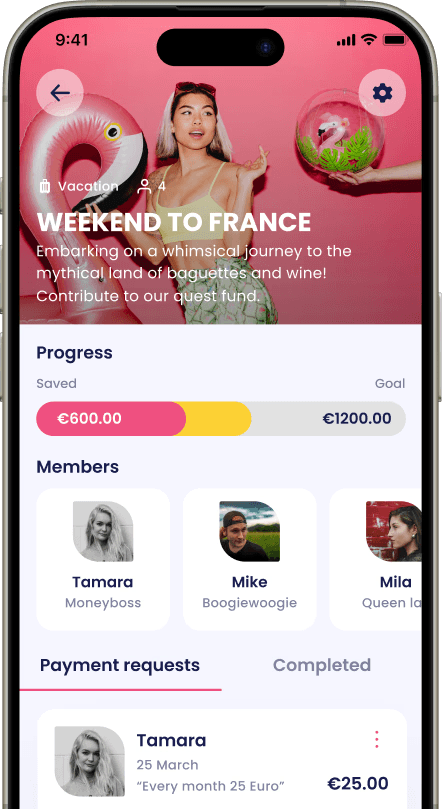
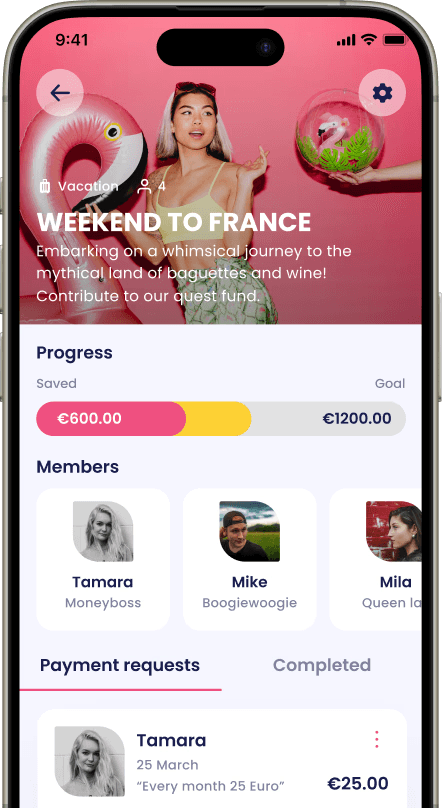
Instead of tracking money after it leaves someone's personal bank account, Potje helps groups build the money first. The group members contribute upfront. The money sits securely inside a digital joint money account. Then, all the actual spending happens directly from that shared pool.
The difference might sound small on paper, but in reality, it changes the entire psychological and logistical experience of group money management.
Instead of an organiser nervously asking, "Can everyone send me their share via Tikkie?" the conversation confidently becomes, "We already have the money." By utilizing a dedicated secure group payment app, the financial burden is lifted off the individual and placed safely into a transparent, collective pot.
Why Upfront Group Pooling Often Works Better
Most group money stress does not come from the cost of the activity; it comes from uncertainty.
When organizing an event using traditional splitting methods, the organiser faces multiple unknowns:
Who will actually pay?
When will they pay?
Will everyone contribute their fair share?
Has enough money been collected to cover the total bill?
Upfront group pooling completely removes those questions. Before anything is officially booked or reserved, the financial groundwork is laid:
Contributions are collected in full.
Budgets become highly visible to all members.
Financial targets become crystal clear.
Expectations are seamlessly aligned.
The organiser gains confidence because the funds are secured. The group gains transparency because everyone can see the shared progress.
The Hidden Cost of Splitting Bills Afterwards
On the surface, expense splitting sounds incredibly simple. Until real life gets involved.
People genuinely forget to pay. App notifications get swiped away and ignored. Somebody disputes a charge from three days ago. Someone accidentally leaves the group chat. A few organized contributors will pay their share immediately, but others might take weeks—or even months—to settle their debts.
None of these problems are usually caused by bad intentions. They are caused by timing.
Once the event or trip is over, the excitement fades, and repaying people naturally becomes a lower priority in people's busy daily lives. That is precisely why repayment-based systems often create interpersonal friction. The spending already happened; the urgency to contribute is completely gone.
Potje vs Splitwise vs Wie Betaalt Wat vs Tikkie: A Feature Breakdown
To better understand the landscape of group money management, it helps to see how the top tools compare based on their core functionality.
Feature / App | Potje | Splitwise | Wie Betaalt Wat | Tikkie |
Core Concept | Upfront Group Pooling | After-the-fact Splitting | After-the-fact Splitting | Direct Payment Requests |
Best Used For | Planning, saving, and paying collectively | Tracking complex, overlapping debts | Settling shared house/trip expenses | One-off immediate reimbursements |
Holds Actual Funds? | Yes (Joint Money Account) | No (Calculates debts only) | No (Calculates debts only) | No (Facilitates bank transfers) |
Reduces Financial Risk? | Yes (Money is collected first) | No (Requires someone to front money) | No (Requires someone to front money) | No (Requires someone to front money) |
While Wie Betaalt Wat and Tikkie are excellent tools for standard debt settlement in certain regions, they ultimately share the same underlying philosophy as Splitwise: they are reactive tools. Potje is a proactive financial tool.
Practical Examples Where Potje Wins
Understanding the theoretical difference is helpful, but seeing how upfront pooling applies to real-world scenarios highlights its true value.
Group Holidays and Vacations
Instead of one generous friend paying a $2,000 accommodation deposit on their personal credit card and waiting nervously for reimbursement, the entire group contributes upfront. Once enough money has been collectively gathered in the Potje account, the booking can be safely made.
Bachelor and Bachelorette Trips
Large groups of acquaintances often struggle with financial coordination. A shared money pot creates absolute clarity around budgets before massive commitments—like party bus rentals, VIP tables, or group flights—are finalized.
Shared Household Expenses
When living with flatmates, managing shared expenses is a monthly chore. By utilizing a reliable group expense management app that focuses on upfront pooling, roommates can deposit their share of rent and utility money into a central pot before the bills are actually due, avoiding the dreaded end-of-month scramble.
Birthday Gifts
Nobody wants to be the person who purchases an expensive group gift and then has to beg colleagues or friends to pay them back. With a shared savings pot, the contributions arrive first. The gift comes second.
Sports Teams and Clubs
Tournament entry fees, away-game travel costs, and new equipment purchases become infinitely easier to manage when club money is collected steadily before the major expenses occur.
Potje vs Splitwise: Which is Better for Group Saving?
The answer to this debate entirely depends on what specific problem you are trying to solve.
👉 Choose Splitwise (or Wie Betaalt Wat) if:
You need granular expense tracking.
Multiple people regularly pay for different things throughout a single trip.
You are comfortable settling complex financial balances afterwards.
Your primary challenge is purely calculating the math of repayments.
👉 Choose Potje if:
You are actively planning future spending.
You want to collect money upfront securely.
You want budget visibility before any purchases happen.
You want to completely avoid the awkwardness of chasing repayments.
For many friend groups, teams, and households, the real challenge isn't calculating who owes what. The real challenge is collecting the money in the first place. That is exactly where Potje becomes particularly valuable.
How Potje Helps Groups Save and Spend Together
Potje is much more than a simple digital collection tool. It is a fully functional joint money account designed entirely around shared goals.
Groups can easily create a digital money pot for specific targets:
Travel and Holidays
Festival and Event Tickets
Team Funds and Club Dues
Group Gifts
Shared Experiences
Instead of relying on a messy web of multiple bank transfers, complicated Excel spreadsheets, and passive-aggressive WhatsApp reminders, contributions are neatly organised around a single, unified goal.
Everyone in the group understands exactly why they are contributing, exactly how much has been collected so far, and exactly how close the group is to reaching the final target. This transparent visibility helps groups make confident purchasing decisions. For organisers, it drastically reduces administration time. For contributors, it establishes absolute financial trust.
Most importantly, it changes group money from a stressful repayment exercise into an exciting planning exercise. That mental shift is often the difference between a smooth group experience and a highly awkward one.
Common Misconceptions About Group Money
"Splitting bills is exactly the same as pooling money."
Not really. One action happens after the spending has occurred, effectively creating interpersonal debt. The other happens before the spending, effectively creating shared capital. The timing creates vastly different psychological and financial outcomes.
"Collecting upfront is more difficult to coordinate."
In almost all cases, it is actually much easier. People know exactly what they are contributing towards, and organisers instantly know whether the necessary budget exists before they blindly commit to expensive non-refundable purchases.
"You only need a shared fund for massive groups."
Even small groups of 3 or 4 people heavily benefit from having their money neatly organized in a shared pot before the spending begins, as it keeps personal bank accounts separated from group activity budgets.
FAQ Section
Is Potje the same as Splitwise?
No. Splitwise focuses primarily on tracking and mathematically settling shared expenses after spending has naturally occurred. Potje focuses on collecting money before the spending happens through a secure joint money account built around shared financial goals.
Why is collecting money upfront better for groups?
Collecting money upfront significantly reduces financial uncertainty. Organisers know exactly how much money is readily available before making large purchases, which completely eliminates the risk of someone being left out of pocket and avoids awkward reimbursement issues later.
Is Splitwise better for travel groups?
Splitwise works incredibly well when multiple people spontaneously pay for different minor expenses (like coffees, taxis, or quick meals) throughout a trip. Potje works particularly well when groups want to collect the core travel funds (flights, hotels, rental cars) before any bookings are made.
What exactly is Potje?
Potje is a digital joint money account that helps friends, sports teams, clubs, and groups save towards shared goals. It allows groups to create custom money pots, easily collect contributions via payment links, and precisely organise their budgets before major expenses occur.
Can Potje and Splitwise be used together?
Yes, they make a highly effective combination. Many organized groups use Potje to securely collect money upfront before a trip for major expenses, and then utilize Splitwise or Wie Betaalt Wat to track any small, unexpected daily expenses that randomly arise during the trip itself.
How does Potje compare to Tikkie?
Tikkie is a great tool for sending an immediate payment request after you have already fronted the bill for a friend. Potje eliminates the need to front the bill in the first place, allowing the group to pool funds into a neutral account beforehand so the purchase is made with group money, not personal money.
Final Thoughts
Ultimately, the biggest difference between Potje and Splitwise isn't found in their user interfaces or technology. It is found in their underlying philosophy.
Splitwise helps groups solve their repayment problems. Potje helps groups prevent repayment problems from happening in the first place.
For groups actively planning future experiences, trips, events, and shared goals, collecting money before spending almost always creates a smoother, less stressful experience than frantically splitting bills after the fact. When everyone contributes their fair share upfront, the group spends significantly less time chasing annoying repayments, and much more time focusing on the real reason they got together in the first place.
Stop fronting the bill. Start collecting upfront with Potje today.
If you're saving up as a group for a trip, event, or gift, Potje makes it easy to collect money into one shared digital pot instead of chasing people for their share. Start a pot through this link and get your first month free. After that it's €5 a month per pot, taken straight from the pot balance, so there's nothing to pay upfront to start saving together.

Social Accountability and Saving: The Missing Link to Financial Freedom
Ondersteuning voor verschillende inhoudstypes zoals artikelen, blogs, video's en meer. Rijke tekstverwerker met opmaakopties voor verbeterde.
17 november, 2025

Group Saving Apps Compared: What's Easiest, Safest, and Most Transparent?
Ondersteuning voor verschillende inhoudstypes zoals artikelen, blogs, video's en meer. Rijke tekstverwerker met opmaakopties voor verbeterde.
17 november, 2025

Group Money Platforms Compared: What’s Safe, Regulated, and Fair?
Ondersteuning voor verschillende inhoudstypes zoals artikelen, blogs, video's en meer. Rijke tekstverwerker met opmaakopties voor verbeterde.
17 november, 2025