17 November 2026



A sailing week with friends is one of those trips that sounds expensive until you do the maths per person.
Split eight ways, a week on the water in Croatia or Friesland can cost less than a city-break hotel room. The challenge is never the price. It is getting everyone to contribute their share before the trip starts, without one person carrying the whole charter fee on their credit card for weeks.
This guide covers exactly how a group boat charter works, what every cost category means, and how to manage the money so the sailing week stays fun from the first WhatsApp message to the last sundowner.
The short answer: a typical sailing charter for a group of 6 to 8 people in Europe costs between €200 and €500 per person for a week on the Frisian lakes, and €800 to €2,500 per person in Croatia, all-in. The exact figure depends on the destination, the boat, whether you hire a skipper, and how well the group organises the shared costs upfront.
How a Group Boat Charter Actually Works
Most people assume you just book a boat and show up. The reality is more structured, which is a good thing when you are splitting costs with a group.
A bareboat charter means you rent the boat without a crew. Your group sails it yourselves, provided someone holds a recognised licence (such as an RYA Day Skipper or equivalent). A skippered charter adds a professional skipper, removes the licence requirement, and adds a knowledgeable local to the crew.
What the Charter Company Charges You
The weekly boat hire fee is the base rate. On top of that, most charters add mandatory extras: an end-of-week cleaning fee (€150 to €300), a dinghy outboard (around €95), a transit log or cruising permit (required in Croatia), and tourist tax (around €1.33 per person per day in Croatia).
The booking is secured with a 30 to 50 per cent deposit, with the balance due 10 to 12 weeks before departure. That structure is where group money management becomes critical, because one person typically pays it and spends weeks chasing the rest.
The Charter Deposit and the Security Deposit
These are two separate things, and confusing them causes real arguments in groups.
The Charter Deposit
This is the advance payment to secure the boat. You pay 30 to 50 per cent of the total charter fee when you book. The remaining balance is due weeks before you sail. This is a commitment fee. If you cancel, you typically lose it (unless your charter company offers a free cancellation window, which some do for the first 72 hours after booking).
For a group, this means one person is usually fronting several thousand euros. That is a significant financial risk to take on behalf of friends who have not yet transferred their share.
The Security Deposit
This is entirely different. The security deposit is a refundable hold against damage to the boat itself. It is authorised on a credit card at the marina when you check in, and released at the end of the week once the boat is inspected.
In Croatia and the Mediterranean, security deposits typically range from €1,500 to €3,000 for a mid-range sailing yacht. If the boat returns undamaged, the full amount is released. Any damage to the hull, sails, or equipment is deducted from it.
Key point: The security deposit is not a group cost to split in advance. It sits on one person's credit card as a hold. Make sure the person with the highest credit limit volunteers for this one, and agree upfront how any damage costs would be shared.
Some charter companies offer a damage waiver as an alternative. This is a non-refundable daily fee (paid upfront) that caps your liability even if the boat is seriously damaged. It is worth calculating whether the waiver fee is cheaper than the anxiety of a large credit card hold.
Skipper or No Skipper?
This is the first real decision a group needs to make, and it has both a financial and a practical dimension.
Going Bareboat
A bareboat charter saves the skipper's daily fee, which runs at around €180 per day in European waters. Over a week, that is roughly €1,260 plus meals and a tip. For a group of eight, going bareboat saves each person around €180 to €200.
The catch: someone must hold a recognised qualification. In Croatia, that means an ICC, RYA Day Skipper, or equivalent, plus a VHF radio operator certificate. Without those documents, the charter company will not hand over the keys.
Hiring a Skipper
A professional skipper knows the anchorages, reads the weather, and handles marina paperwork. For first-time charterers or groups where nobody fancies the responsibility, a skipper is genuinely worth it. Bear in mind they need a cabin, so the group loses one sleeping space on a monohull.
The practical rule: if nobody holds a sailing licence, a skipper is not optional. Factor the cost in from day one.
Fuel and Harbour Fees
These are the two costs that most groups underestimate, and they are paid on the water, not in advance.
Fuel
A typical week of mixed sailing and motoring uses 200 to 400 litres of diesel. Budget €300 to €600 for fuel across the week. Split eight ways, that is €40 to €75 per person.
Harbour and Marina Fees
Costs vary most dramatically depending on where you sail.
Location | Typical marina cost per night |
ACI Marinas, Croatia (peak) | €90 to €160 for a 12-metre yacht |
Frisian lakes, Netherlands | €15 to €35 per night |
Adriatic anchorage buoy | €20 to €50 per night |
Konoba restaurant dock (Croatia) | Often free if you eat there |
Over seven nights, marina fees alone can add €600 to €1,100 to the group bill in Croatia, or considerably less in Friesland. Anchoring free in a quiet bay is always an option in the Med, but Croatian national park waters charge entry fees of €40 to €100 per night.
The smartest groups put fuel and harbour fees into a shared cash kitty at the start of the week. Everyone contributes an equal amount on day one, and any surplus is refunded at the end.
The Shared Food Kitty
Most groups run a shared food kitty. Everyone contributes a fixed amount at the start of the week, one person manages the budget, and all provisions come out of the shared pot.
How to Set the Food Budget
A realistic onboard food budget is €80 to €150 per person for a week. Groups that cook most meals onboard sit at the lower end. Groups eating at waterfront restaurants every other night land closer to the top.
A practical approach:
Agree a daily food budget per person before you leave (€15 to €25 per day is common)
Collect the full week's contribution from everyone on day one
Track restaurant meals separately and split them at the table
Keep the food kitty separate from fuel and marina money. Mixing them creates confusion that compounds quickly by day four.
Popular Sailing Destinations for Groups in Europe
The destination shapes the budget more than almost any other decision. Here are two of the most popular choices for European groups, and what to expect from each.
Friesland, Netherlands
Friesland is the go-to for groups who want to sail without flying. The Frisian lakes and the IJsselmeer offer hundreds of kilometres of sheltered inland waterways, traditional Dutch harbour towns, and some of the best freshwater sailing in Europe.
No flights required from the Netherlands or Belgium, harbour fees are modest (€15 to €35 per night), and most inland charter boats require no sailing licence. A week's charter on the Frisian lakes typically costs €1,500 to €3,500 for the boat, depending on size and season. Split among six to eight people, that is a very accessible per-person cost.
Croatia
Croatia is the Mediterranean choice for groups who want guaranteed sun, clear blue water, and dramatic island scenery. The Dalmatian coast around Split and Hvar is the most popular base, with over 1,000 islands to explore.
What to budget in Croatia:
Bareboat monohull charter: €3,000 to €5,000 per week in shoulder season (May, June, September)
Catamaran charter: €4,500 to €9,000 per week in May to June, higher in peak summer
ACI marina fees: €90 to €160 per night in peak season
National park entry (Kornati, Krka): €40 to €100 per night
A professional skipper: approximately €180 per day plus meals and tip
Croatia requires a sailing licence for bareboat charters. The ICC (International Certificate of Competence) is widely accepted, as is the RYA Day Skipper and equivalent national qualifications.
Rough all-in budget for a week in Croatia: €13,000 to €19,000 for a mid-range catamaran group in peak season. Divided by eight people, that is €1,625 to €2,375 per person.
How to Collect the Money Before You Sail
This is where most groups go wrong. Someone books the boat, pays the deposit, and then sends a message to the group chat. A few people transfer immediately. Two people say they will do it later. One person goes quiet. The organiser ends up hundreds of euros out of pocket for weeks, feeling awkward about chasing friends.
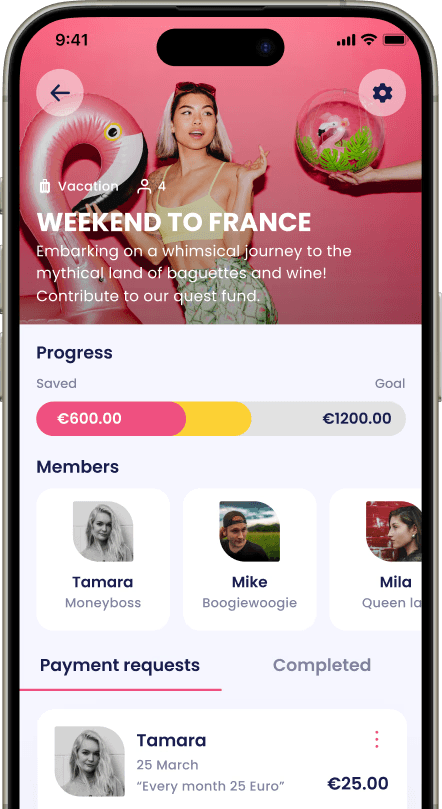
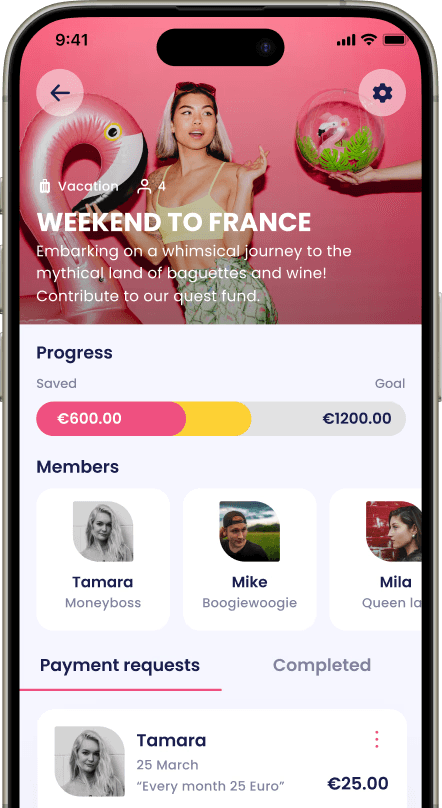
The solution is to collect the money before the booking is confirmed, not after. That is exactly what Potje is built for.
The organiser creates a pot, sets a target (say, €400 per person for the charter deposit), shares a link, and everyone pays in directly. No chasing. No one person carrying the cost.
What makes Potje work for a sailing trip:
Your first month is free. No cost to get started while the group is still deciding.
Instant payouts of any amount. When the charter deposit is due, the organiser pays it out immediately.
No fee on partial payouts. Pay the marina or buy fuel mid-trip without penalty.
Transparent for everyone. Every member can see contributions and the goal. No awkward conversations.
Shared cost. The pot costs €5 per month in total, split across the group. With eight people, that is €0.63 each per month.
Set up separate pots for different cost categories: one for the charter fee, one for the food kitty, one for fuel and marina fees. Each has its own goal and payment link. That way nobody ends up chasing anyone, which is the whole point of collecting money for a group trip without the awkward chasing. If your crew has never sailed together before, also agree how to split holiday costs without arguments before you cast off.
A Realistic Cost Breakdown for a Group Charter
To make the numbers concrete, here is a sample budget for a group of eight sailing a monohull in Croatia for one week in June.
Cost Category | Total Group Cost | Per Person (8 people) |
Charter fee (monohull, June) | €4,000 | €500 |
Mandatory extras (cleaning, outboard, transit log) | €450 | €56 |
Skipper (7 days at €180/day + tip) | €1,450 | €181 |
Fuel (estimated 300 litres) | €450 | €56 |
Marina fees (7 nights average €70) | €490 | €61 |
Tourist tax (€1.33 x 8 x 7 days) | €74 | €9 |
Food kitty (€100 per person) | €800 | €100 |
Total | €7,714 | ~€964 |
This is a shoulder-season estimate for a skippered monohull. A catamaran in peak July would be significantly higher. Friesland would be considerably lower.
The takeaway: a sailing week is genuinely affordable when the costs are shared properly. The challenge is the logistics of collecting the money, not the money itself.
Ready to Start Saving for Your Sailing Trip?
The logistics of a sailing week are genuinely simple once the money is sorted. Book the boat. Agree the costs. Collect contributions upfront. Sail.
Potje fixes the money collection before it becomes a problem. Create a shared money pot, set a goal, share the link with your crew, and watch the contributions come in. Your first month is free, payouts are instant, and there are no fees on partial withdrawals.
Create your sailing trip money pot
Frequently Asked Questions
Do I need a sailing licence to charter a boat in Europe?
In Croatia and most Mediterranean countries, yes. A bareboat charter requires a recognised qualification (ICC, RYA Day Skipper, or equivalent) plus a VHF radio licence. In the Netherlands, most inland charter boats on the Frisian lakes require no formal licence. Always confirm with the charter company before booking.
What is the difference between the charter deposit and the security deposit?
The charter deposit is the advance payment to secure the boat (30 to 50 per cent of the charter fee). The security deposit is a separate refundable hold against damage, placed on a credit card at the marina and released at the end of the week if the boat is returned undamaged. Budget for them separately.
How much does a group boat charter cost per person?
Friesland can cost as little as €200 to €500 per person all-in. Croatia in shoulder season runs €800 to €1,500 per person for a monohull, and up to €2,500 for a catamaran in peak summer. Always include fuel, marina fees, food, and skipper costs in your per-person figure.
What is a bareboat charter?
A bareboat charter means renting the boat without a skipper or crew. It is cheaper, but requires at least one person to hold a valid sailing qualification.
How do we split charter costs fairly as a group?
Collect contributions upfront before the booking is confirmed. A shared money pot like Potje lets everyone pay their share into a group fund. The organiser pays the charter company from the pot when the deposit is due, with instant payouts and no fees on partial withdrawals.
How much should we budget for a food kitty on a sailing trip?
Budget €80 to €150 per person for a week. Collect a fixed amount from everyone on day one and manage it separately from other shared costs. A separate Potje pot for the food kitty keeps it apart from the charter money.
Is Croatia or Friesland better for a first group sailing trip?
Friesland is the easier starting point: no flights, modest fees, no licence required, and sheltered waters for beginners. Croatia offers more dramatic scenery and guaranteed sun, but needs more planning, a sailing licence, and a higher budget.

Social Accountability and Saving: The Missing Link to Financial Freedom
Ondersteuning voor verschillende inhoudstypes zoals artikelen, blogs, video's en meer. Rijke tekstverwerker met opmaakopties voor verbeterde.
17 november, 2025

Group Saving Apps Compared: What's Easiest, Safest, and Most Transparent?
Ondersteuning voor verschillende inhoudstypes zoals artikelen, blogs, video's en meer. Rijke tekstverwerker met opmaakopties voor verbeterde.
17 november, 2025

Group Money Platforms Compared: What’s Safe, Regulated, and Fair?
Ondersteuning voor verschillende inhoudstypes zoals artikelen, blogs, video's en meer. Rijke tekstverwerker met opmaakopties voor verbeterde.
17 november, 2025