20 May, 2026



Getting Your Digital Card
To sign up for a virtual VISA card online, you need to download a secure financial app or neo-bank that issues digital cards (such as Revolut, Wise, or soon, Potje). After creating an account, you must complete a standard identity verification process (KYC). Once verified, you can generate your digital card online instantly with a single tap. This provides you with a 16-digit card number, expiry date, and CVV that you can immediately use for e-commerce checkouts or link to an Apple Pay virtual card setup for contactless in-store payments. While most providers currently issue these cards strictly for individual use, innovative platforms like Potje are actively developing virtual VISA cards connected to shared group funds to streamline collective spending.
The Massive Shift Toward Digital-First Banking
The shift in consumer finance is incredibly simple to understand: people no longer want to wait three to seven business days for a piece of plastic to arrive in the mail.
Modern consumers demand:
Instant Access: The ability to spend money the second an account is opened.
Enhanced Security: The power to freeze, delete, or regenerate card numbers instantly to prevent online fraud.
Mobile Wallet Compatibility: Seamless integration with Apple Wallet or Google Wallet for tap-to-pay convenience.
A virtual VISA card delivers all of this. You sign up, you get a card rendered on your screen, and you start spending immediately. There are no postal delays and no physical wallets to lose.
What a Virtual VISA Card Actually Is
A virtual VISA card is the exact digital equivalent of a traditional bank card. It functions identically to a virtual debit card or credit card. It possesses:
A unique 16-digit card number.
An expiration date.
A dynamic or static CVV security code.
Because it exists entirely inside a secure banking app, you can pay online instantly, add it to your Apple Pay or Google Pay, and use it for secure contactless payments at physical merchant terminals. The primary difference is simply the speed of access and the lack of a physical plastic footprint.
Step-by-Step: How to Sign Up for a Virtual VISA Card Online
Getting a digital card online is a highly streamlined process. Here is the exact workflow you can expect when setting up your new payment method.
Step 1: Choose the Right Provider
Start by selecting a financial platform that explicitly offers virtual VISA cards. Popular current options include global neo-banks like Wise and Revolut, or localized apps like Current. Each platform has different fee structures and features. Furthermore, specialized fintech apps—like Potje—are entering the market to solve niche problems like shared group spending.
Step 2: Create Your Account
Download the provider's app and begin the registration process. You will typically need to provide:
Your email address.
Your mobile phone number (for 2FA security).
Basic personal details (Name, Date of Birth, Address).
Step 3: Verify Your Identity (KYC)
To comply with anti-money laundering (AML) laws, legitimate financial providers require identity verification—often called Know Your Customer (KYC).
You will be asked to upload a clear photo of a government-issued ID (passport, driver's license, or national ID card).
You may need to take a quick selfie to confirm your identity.
Note: This step is mandatory for compliance and protects your digital funds.
Step 4: Generate Your Virtual Card
Once your identity is verified (which often takes just a few minutes), navigate to the "Cards" section of the app. Tap the option to create a new virtual VISA card. It will render on your screen instantly, ready to be funded.
Step 5: Add to Apple Pay or Google Pay
To maximize convenience, locate the "Add to Apple Wallet" or "Add to Google Pay" button within your banking app. Follow the prompts to seamlessly connect your new card to your mobile wallet. This crucial step transforms your digital card into a powerful tool that allows you to tap-to-pay in physical stores.
Step 6: Fund and Start Spending
Transfer funds into your new account via a bank transfer or an existing debit card. You can now spend securely online, pay in person via your smartphone, and manage all your transactions digitally.
The Hidden Limitation: Individual vs. Group Spending
Getting a virtual card is incredibly easy. However, using it in complex, real-world scenarios is exactly where the friction starts—especially when shared money is involved.
The Problem with Current Virtual Cards
Most financial providers design virtual cards strictly for personal use. That means:
One person legally owns the card.
One individual account holds the money.
One person carries 100% of the financial responsibility.
This architecture works flawlessly for buying your own morning coffee or paying your personal Netflix subscription. But it completely breaks down in group situations, like a shared holiday, a roommate expense fund, or a sports team budget.
What Happens When You Use an Individual Card for a Group?
Even with the speed of an Apple Pay virtual card, the social workflow remains painfully manual:
One person steps up and uses their individual virtual card to pay the €300 group dinner bill.
They take on the financial risk and temporary debt.
They manually track who owes what.
They send out payment requests (like Tikkie) and wait days for reimbursements.
The technological payment at the terminal is instant. The social coordination afterward is absolutely not.
Where Legacy Competitors Fall Short
To understand this gap, we must look at how current tools operate in the market.
Wise: Wise is phenomenal for multi-currency accounts and international payments. It offers brilliant virtual cards. However, it is built around individual accounts. There is no true, transparent shared group balance.
Revolut & Current: Both offer sleek digital banking features and instant virtual cards. They focus heavily on individual convenience and personal budgeting. Group coordination still largely happens outside their core systems.
Splitser / Splitwise: These apps are the gold standard for tracking shared expenses. But they do not provide a card, they do not hold your money, and they do not enable payments at the checkout. They merely organize the debt after the spending has happened.
What is fundamentally missing from the current ecosystem is a complete loop: A shared balance combined with a shared spending card.
How Potje is Building the Next Generation of Virtual Cards
To make a virtual VISA card actually work for real-world group use, the money needs to belong to the collective, and the card needs to draw directly from that collective pool.
Potje is actively building toward this revolutionary financial infrastructure.
The Foundation: A Shared Money System
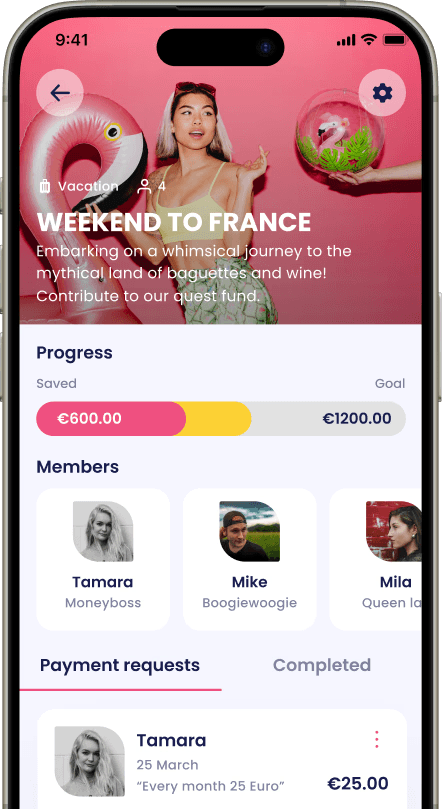
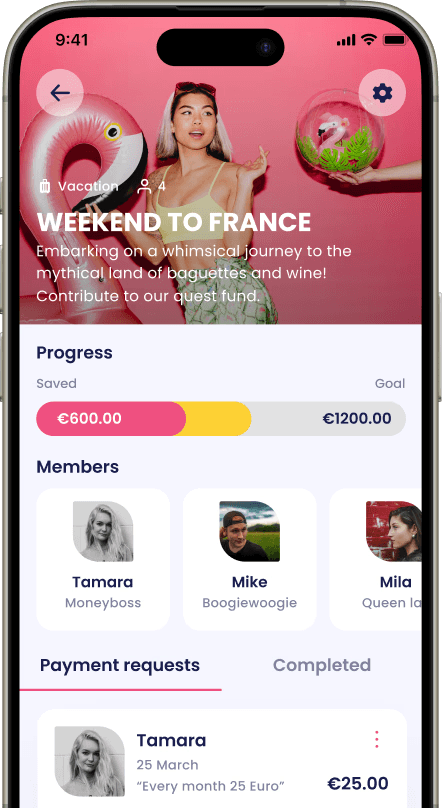
Potje already provides a highly secure shared digital savings account where users can effortlessly create a pot, invite friends or family, collect contributions upfront, and track financial progress in one completely transparent dashboard.
The Next Step: Virtual VISA Cards for Groups
Potje is currently developing a proprietary virtual VISA debit card designed specifically to eliminate group payment friction. This upcoming feature will:
Connect directly and natively to the shared group pot.
Integrate flawlessly with Apple Pay and Google Wallet.
Allow for real-time, proactive group spending.
By funding the pot upfront and spending collectively from a single card, you completely remove the need for one person to pay upfront, eliminating messy cost-splitting and manual debt tracking.
(Important Note: The group virtual VISA card feature is currently in active development and is not live just yet. However, once launched, users will be able to add the shared card to Apple Pay and spend directly from their shared funds anywhere VISA is accepted globally. You can join the Potje waitlist here to secure early access).
Practical Use Cases for Digital Cards
Whether you are using an individual card or preparing for a shared group card, virtual VISA cards drastically simplify daily life:
Secure Personal Spending: Use your virtual card for online shopping. If the merchant is ever compromised, you can delete the digital card instantly without needing to replace your physical bank card.
Travel and Cross-Border Payments: Add your digital card to Apple Pay to tap for the London Underground or buy coffee in Paris without carrying a physical wallet that could be stolen.
Event Planning (The Shared Future): Instead of one person fronting the cost for concert tickets or group Airbnb bookings, a shared group card allows the collective to fund the pot and execute the purchase together, with total visibility.
Risks, Red Flags, and Common Misconceptions
When navigating digital banking, it is important to separate marketing hype from reality:
Misconception: "A virtual card automatically solves group payments."
Reality: It absolutely does not. It only solves the physical mechanics of how you pay the merchant. It does not solve how the underlying money is managed or who carries the debt.
Misconception: "All virtual cards work exactly the same way."
Reality: They differ wildly based on the banking system behind them. An individual card pulls from your personal checking account. A shared card (like what Potje is building) pulls from a democratized group fund. The account structure matters infinitely more than the card itself.
Misconception: "Apple Pay is the complete solution."
Reality: Apple Pay is just a highly secure user interface. The financial structure operating behind that interface determines its actual usability for complex scenarios like group finance.
Frequently Asked Questions (FAQ)
How do I get a virtual VISA card with Potje?
To access Potje's financial tools, you first need to create a shared money pot and invite others to contribute. Potje is currently developing a virtual VISA debit card that will connect natively to this shared pot. Once available, users will be able to generate the card securely inside the app and add it to Apple Pay for real-time group spending. This feature is not live yet, but you can join the waitlist to access it the moment it launches.
Can I easily use a virtual VISA card with Apple Pay?
Yes, the vast majority of modern financial providers allow you to seamlessly add a virtual VISA card directly to your Apple Wallet. Once added, you can use your iPhone or Apple Watch for highly secure contactless payments in physical stores or at online checkouts.
Are virtual VISA cards actually safe to use online?
Virtual VISA cards are widely considered safer than physical cards. Because they exist entirely digitally, many banking apps allow you to generate single-use card numbers, set strict spending limits, or freeze/delete the card instantly if you suspect fraud. This adds an incredible layer of proactive security to your finances.
Can I use a standard virtual VISA card for shared group expenses?
You technically can, but it is highly inefficient unless the system natively supports shared funds. Standard virtual cards are legally linked to individual accounts, which means one person must pay the merchant and force others to reimburse them later. A true, frictionless group solution requires a shared digital balance with a card connected directly to it.
What is Potje, and how does it relate to virtual VISA cards?
Potje is a highly secure shared money account designed specifically for groups, families, and teams. It allows users to transparently collect and manage money together in one place. Potje is currently developing a virtual VISA card that will connect directly to this shared pot and fully support Apple Pay, effectively enabling real-time group spending without anyone ever having to split costs afterward.
Conclusion: The Card is Easy, The System is What Matters
Learning how to sign up for a virtual VISA card online takes only a few minutes in today's digital economy. The technology to generate a 16-digit number and link it to your smartphone has already been perfected.
However, using that card effectively in the real world depends entirely on the financial system operating behind it. For standard, individual use, almost any modern neo-bank will work flawlessly. But for the complex reality of shared human experiences—holidays, team sports, and group dinners—the underlying system desperately needs to evolve.
That is exactly where the next generation of virtual cards is heading, shifting the focus from individual convenience to shared financial control. And that is exactly the future that Potje is actively building.

Social Accountability and Saving: The Missing Link to Financial Freedom
Ondersteuning voor verschillende inhoudstypes zoals artikelen, blogs, video's en meer. Rijke tekstverwerker met opmaakopties voor verbeterde.
17 november, 2025

Group Saving Apps Compared: What's Easiest, Safest, and Most Transparent?
Ondersteuning voor verschillende inhoudstypes zoals artikelen, blogs, video's en meer. Rijke tekstverwerker met opmaakopties voor verbeterde.
17 november, 2025

Group Money Platforms Compared: What’s Safe, Regulated, and Fair?
Ondersteuning voor verschillende inhoudstypes zoals artikelen, blogs, video's en meer. Rijke tekstverwerker met opmaakopties voor verbeterde.
17 november, 2025
