21 April 2026



“I completely forgot to pay you back!” You have undoubtedly heard this phrase before. It sounds harmless, and most of the time, it genuinely is. But when it happens again and again, you start to wonder: are they actually forgetting, or are they purposely avoiding it? The truth is that people rarely forget to pay you back because they do not care. They forget because the act of paying you back lacks urgency, visibility, and structure. Without a centralized system, the process depends entirely on human memory and timing, which is exactly why it consistently breaks down.
Group Expenses Psychology: Why People Don’t Pay Back
Group finances are not just about math; they are deeply rooted in behavioral psychology. When you front the bill for a group dinner or book the weekend Airbnb, getting that money back feels incredibly urgent to you. After all, the cash has already left your checking account. However, the psychological urgency for everyone else is completely different.
For the people who owe you money, there is no hard deadline, no immediate consequence, and no automated system enforcing the transaction. Consequently, reimbursing you gets pushed straight to the bottom of their priority list. Furthermore, payment requests usually live in chaotic group chats, fleeting text messages, or a buried Venmo notification. These are incredibly easy to swipe away or ignore with the intention of handling it “later.” Unfortunately, later often becomes never.
Without shared visibility—where everyone can openly see who has paid and who has not—there is zero social accountability. People naturally assume, "No one is checking, I’ll sort it out eventually."
How Social Friction Ruins Shared Expenses With Friends
People inherently dislike talking about personal finances. So, even when your friends do remember that they owe you, social friction often delays their action. They might hesitate, thinking, "I will just wait until they send another reminder." Meanwhile, you are waiting for them to take the initiative. Now, both sides are trapped in a silent waiting game.
This dynamic is one of the biggest drivers behind why settling up becomes incredibly awkward over time. One person forgetting is a minor annoyance, but when a whole group operates on different financial timelines, the entire trip gets derailed. The designated organizer is forced to front the upfront costs, manually track incoming peer-to-peer (P2P) transfers, and send uncomfortable reminders. They essentially become the group's debt collector, and that is exactly where deep frustration builds.
Why Popular Peer-to-Peer Apps Fall Short for Group Money Management
When shared finances get messy, most groups immediately turn to digital tools. However, popular apps often fail to address the root psychological cause.
Expense Trackers (Like TravelSpend): These apps are great for logging who paid for what during the trip. But they only provide visibility after the money has been spent. You are still left waiting to be reimbursed.
P2P Transfer Apps (Like Venmo, Cash App, or Zelle): These tools handle direct transfers reliably and quickly. Yet, they do not create a structured group system. You are still entirely reliant on the other person remembering to open the app and hit send.
Digital Joint Accounts: While some modern banking apps offer shared vaults, they usually require everyone in the group to adopt the exact same banking platform, adding massive onboarding friction for a short-term trip.
The core limitation of all these tools is that they still rely on human behavior. They assume your friends will remember, take action, and prioritize paying you. That assumption is exactly where the system breaks.
The Ultimate Shift: How to Manage Money With Friends Upfront
If human memory is the root problem, the solution is not sending more aggressive text reminders. The solution is removing the need to remember altogether. You must shift the timeline from reactive splitting to proactive saving: collect the money before you spend it.
Instead of paying upfront and begging your friends to send you their share, you must:
Agree on the travel plan and budget.
Collect the contributions into a secure, shared space.
Move forward with bookings only when the funds are fully secured.
When you do this, no one needs to remember anything later. The system does the remembering for you.
How Potje Automates the Process
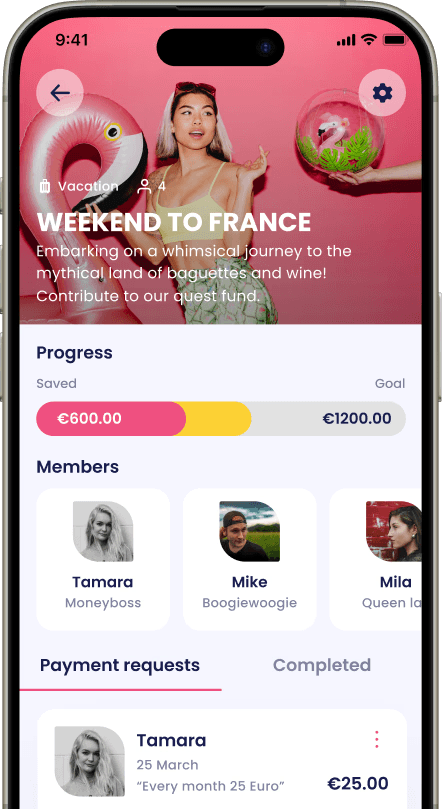
Potje is built entirely around this psychological shift. Instead of relying on individuals to pay you back, it provides the group with a shared digital money account where contributions happen upfront, and everything is completely visible.
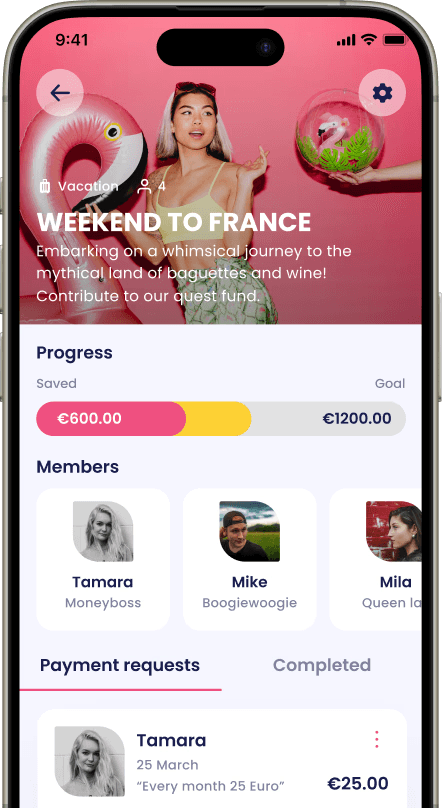
You simply create a money pot around a specific goal and invite your group. From there, everyone contributes to the exact same space. The group sees the funding progress in real-time, completely eliminating the need for manual tracking or spreadsheets. Potje handles all the payment requests and automated reminders, entirely removing the awkward follow-ups from your plate.
Most importantly, the group's money does not sit mixed inside one person's personal checking account. It lives in its own dedicated space, removing confusion and making the budget infinitely easier to manage.
Real-World Scenarios Solved by Upfront Contributions
Booking a Vacation: Without structure, one person maxes out their credit card and prays for quick reimbursements while flight prices surge. With upfront contributions, the cash is already pooled, and the booking happens immediately at the best price.
Splitting Large Group Bills: Without structure, everyone is doing mental math at the dinner table, and settling up later becomes a massive chore. With a shared system, all spending is drawn from one central pot, meaning absolutely zero post-trip calculations.
Overcoming Common Misconceptions
"They just don't care." Most people do care; they just do not prioritize repayment over their daily lives.
"Sending reminders fixes it." Reminders are a temporary band-aid. They do not fix the broken structural system.
"It's just a few bucks." Small amounts still create significant social friction, especially when they stack up over multiple group outings.
Frequently Asked Questions
Why do people forget to pay you back?
People forget because paying off an IOU is rarely urgent for them. It lacks a firm deadline and immediate consequences, pushing it down their priority list. In busy group chats, payment requests are easily overlooked. Without a visible, structured system, forgetting becomes the default psychological outcome.
How do you collect shared funds without sending constant reminders?
The most effective method is to collect the funds before any spending occurs. When contributions are required upfront in a centralized digital pool, there is no need to chase anyone later. The system keeps everyone aligned naturally.
Are apps like Venmo or Zelle enough for group payments?
While P2P apps are excellent for quick, individual transfers, they do not solve group coordination. You are still completely reliant on individuals remembering to send the cash. For group situations, a dedicated pooling system works far better because it removes the dependency on individual behavior.
What makes Potje different from standard expense trackers?
Most tools either track debts after they happen or simply move cash between individuals. Potje is designed for proactive group saving. It allows groups to pool their contributions upfront, keep everything in one transparent space, and make purchasing decisions based on actual available cash, entirely removing the need for awkward reimbursements.

Social Accountability and Saving: The Missing Link to Financial Freedom
Ondersteuning voor verschillende inhoudstypes zoals artikelen, blogs, video's en meer. Rijke tekstverwerker met opmaakopties voor verbeterde.
17 november, 2025

Group Saving Apps Compared: What's Easiest, Safest, and Most Transparent?
Ondersteuning voor verschillende inhoudstypes zoals artikelen, blogs, video's en meer. Rijke tekstverwerker met opmaakopties voor verbeterde.
17 november, 2025

Group Money Platforms Compared: What’s Safe, Regulated, and Fair?
Ondersteuning voor verschillende inhoudstypes zoals artikelen, blogs, video's en meer. Rijke tekstverwerker met opmaakopties voor verbeterde.
17 november, 2025