30 March 2026



We often view money as a deeply private affair. In the Netherlands, while we are famous for our financial prudence and the ability to "Go Dutch" (splitting the bill down to the last cent), the act of saving has traditionally been a solo activity.
But behavioural economics tells a different story. The "lone wolf" approach to saving relies entirely on individual willpower—a resource that is easily depleted. Conversely, the psychology of saving together taps into deep-seated human instincts for cooperation, tribal bonding, and social validation.
Whether it is chipping in for a colleague’s farewell gift, funding a group holiday to Ibiza, or managing a sports team’s treasury, pooling resources changes how our brains process financial pain and reward. This is why platforms like Potje.tech are changing the way groups manage money. Here is the science behind why saving together is not just more fun—it is significantly more effective.
The "Watcher Effect": The Power of Social Accountability
The primary reason group saving works better than individual saving is social accountability.
When you set a savings goal for yourself, the only person you let down if you fail is you. It is easy to negotiate with yourself: "I will skip the deposit this month and double it next month."
However, when you enter a group dynamic, a psychological phenomenon known as the social commitment contract kicks in. We are hardwired to care what others think of us. We want to be seen as reliable, trustworthy, and generous members of our "tribe."
The Hawthorne Effect: In psychology, this describes how individuals modify an aspect of their behaviour in response to their awareness of being observed.
Application in Finance: When you know 10 other friends are watching the progress bar on a shared Potje, you are statistically more likely to make your contribution on time.
Dopamine and the Gamification of Savings
Saving money can feel like a loss. You are taking resources available now and locking them away for later. This triggers the pain centres in the brain associated with loss aversion.
Saving together flips this script.
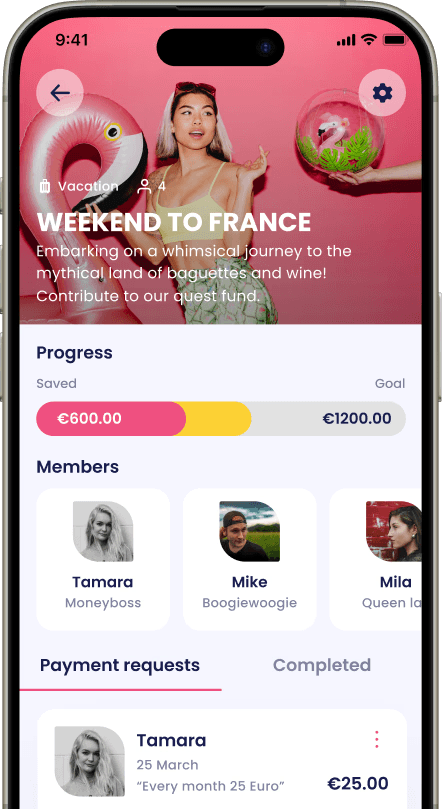
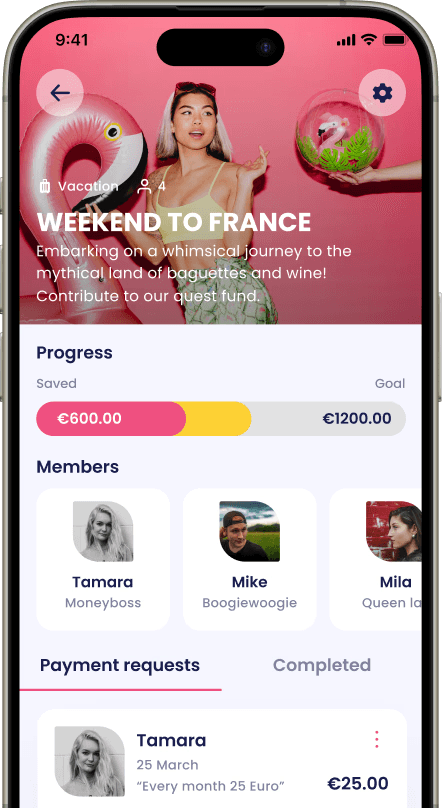
When a group saves toward a shared goal, the process becomes gamified. Every time a notification pops up saying "Thijs has contributed €20," or the percentage bar on your Potje app moves from 80% to 90%, the brain releases dopamine.
This is the same chemical released when we level up in a video game or receive a like on social media. By turning the abstract concept of "saving" into a visual, collective achievement, the brain associates the act with pleasure rather than deprivation.
"Going Dutch" 2.0: From Splitting Bills to Building Pots
The Netherlands has a unique financial culture. We are comfortable with transparency when it comes to settling debts (the "Tikkie" culture). However, the psychology is shifting from reactive payments (paying someone back) to proactive accumulation (saving together).
This is where Potje.tech modernises the tradition. Instead of chasing people for money after the event, you build the fund beforehand.
The Shift from Transactional to Relational
Paying someone back is a transaction; it closes a loop. Saving together is relational; it opens a future possibility.
Shared Vision: When a group creates a pot for a bachelor party, they aren't just moving money; they are engaging in collective efficacy. This is the group's shared belief in its conjoint capabilities to organise and execute the courses of action required to produce given levels of attainments.
Anticipatory Joy: The act of contributing becomes linked to the anticipation of the event. The psychological reward starts the moment the money is deposited into the Potje, not just when the money is spent.
5 Psychological Triggers That Make Group Saving Effective
If you are struggling to save alone, understanding these triggers explains why joining forces works.
1. Positive Peer Pressure (Nudge Theory)
Peer pressure is often viewed negatively, but in behavioural economics, it is a powerful tool for good. If you see three friends contribute to the holiday fund, a "normative influence" pushes you to conform. You do not want to be the outlier who is holding the group back.
2. The Endowment Effect
Once we contribute to a collective goal, we value it more highly because we have invested in it. This makes us more committed to seeing the goal through to completion. We don't want to "break the chain" or dissolve the pot because we feel a sense of ownership over the group's success.
3. Reduced Cognitive Load
Managing finances is stressful. When saving for a large expense alone, the entire mental burden rests on you. In a group, the cognitive load is shared. The anxiety of "can I afford this?" is replaced by the reassurance of "we can afford this."
4. Trust and Oxytocin
Trusting someone with your money is a vulnerable act. However, when that trust is validated—using a secure platform like Potje.tech where funds are visible and safe—it strengthens social bonds. This release of oxytocin (the bonding hormone) makes the group feel tighter and more connected.
5. Goal Visualisation
Abstract goals are hard to hit. Group saving apps focus heavily on visualising goals—naming the pot, adding a picture, and showing a progress ring. This turns a number (e.g., €500) into a concrete reality (e.g., "The Weekend in Ardennes"), making the motivation to save tangible.
Overcoming the Barriers: The Fear of "Freeriding"
The psychology of saving together isn't without its hurdles. The biggest barrier is the fear of the "freerider"—the person who benefits from the group effort without contributing their fair share.
This is why transparency is the antidote to anxiety.
In the past, one person collected cash in an envelope or held it in a private bank account. This opacity bred suspicion. "Did everyone pay? Is the organiser using the money for groceries?"
Modern digital tools mitigate this through financial transparency. With Potje.tech, everyone can see who has paid and how much is in the total pot. The fear of freeriding diminishes, and trust in the collective process is restored.
Conclusion
The psychology of saving together proves that we are better when we collaborate. By leveraging social accountability, turning saving into a dopamine-fuelled game, and sharing the cognitive load, we can achieve financial goals that would be difficult or stressful to tackle alone.
In a culture like the Netherlands, where efficiency and reliability are prized, the evolution from simply splitting bills to proactively building funds together is the next logical step. It transforms money from a source of stress into a tool for social connection.
Ready to experience the benefits of social saving? Create your group pot today and start reaching your goals together.

Social Accountability and Saving: The Missing Link to Financial Freedom
Ondersteuning voor verschillende inhoudstypes zoals artikelen, blogs, video's en meer. Rijke tekstverwerker met opmaakopties voor verbeterde.
17 november, 2025

Group Saving Apps Compared: What's Easiest, Safest, and Most Transparent?
Ondersteuning voor verschillende inhoudstypes zoals artikelen, blogs, video's en meer. Rijke tekstverwerker met opmaakopties voor verbeterde.
17 november, 2025

Group Money Platforms Compared: What’s Safe, Regulated, and Fair?
Ondersteuning voor verschillende inhoudstypes zoals artikelen, blogs, video's en meer. Rijke tekstverwerker met opmaakopties voor verbeterde.
17 november, 2025
