26 May 2026



Direct Answer: How to Automate Group Payments
Sending automatic payment requests to a group means utilizing a financial system that natively tracks and requests contributions without requiring you to manually message each person. With modern shared money collection platforms like Potje, you simply create a shared digital pot, define the required contributions (whether one-off or recurring), and invite your group. The system takes over the administrative burden by keeping a transparent, real-time ledger of who has paid and who has not, completely removing the need for constant, awkward manual follow-ups and making group finance entirely predictable.
The Awkward Reality: Asking for Money Isn't the Problem, Repeating It Is
Almost every group of friends, family members, or teammates inevitably reaches this exact moment in the group chat: "Can everyone please send their share for the booking?"
At first, the system seems to work. A few people transfer their money immediately. But then, the predictable friction of human nature starts slipping into the process.
One friend genuinely forgets.
Another person promises to pay "on Friday" but pays two weeks late.
Someone scrolls past the message and asks for the bank details again three days later.
Suddenly, the designated organizer is no longer just planning a fun trip or managing a sports team. They have unwittingly become an unpaid debt collector. They are burdened with sending manual reminders, meticulously tracking peer-to-peer (P2P) payments across different bank accounts, and keeping the group financially aligned.
The core problem here is rarely a lack of willingness to pay. The problem is a total lack of financial structure.
What "Automatic Payment Requests" Actually Mean
When people hear the phrase group payment requests, they often misunderstand the technology. They assume it is just an automated text message or a robotic alarm clock that annoys their friends on their behalf.
True automatic payment requests are not just reminders; they are a comprehensive financial system.
Instead of manually generating a new payment link every single time an expense arises, a structured system allows you to define the rules of the group upfront:
Who needs to contribute to the fund?
How much do they need to pay (is it an equal split or customized)?
When should the money be deposited?
Once those parameters are set, the financial platform handles the rest. It keeps the financial ledger entirely visible and organized, transforming a messy social interaction into a clean, automated process.
Sending Automatic Payment Requests to a Group: How It Works with Potje
Most legacy banking apps and P2P tools rely entirely on one-off payment links. Potje approaches shared money collection differently by building a proactive, shared financial ecosystem.
Here is exactly how the process works to eliminate the friction of group finances:
Step 1: Create a Shared Digital Pot
You begin by setting up a dedicated Potje (a digital pot) tailored specifically for your group’s financial goal. This could be a holiday fund, a shared wedding gift, or a recurring expense like a sports team's monthly field rental. You easily invite people to join via a simple link, ensuring everyone is securely onboarded into the exact same financial setup.
Step 2: Define Contributions Upfront
Instead of constantly asking for money after the fact, you set crystal-clear expectations right at the start. You can structure the pot to require:
Equal contributions from all members.
Customized, different amounts based on individual needs.
One-time deposits or recurring group payments.
By defining these rules on day one, you completely remove the need to re-explain the budget every single time a payment is due.
Step 3: Contributions are Tracked Automatically
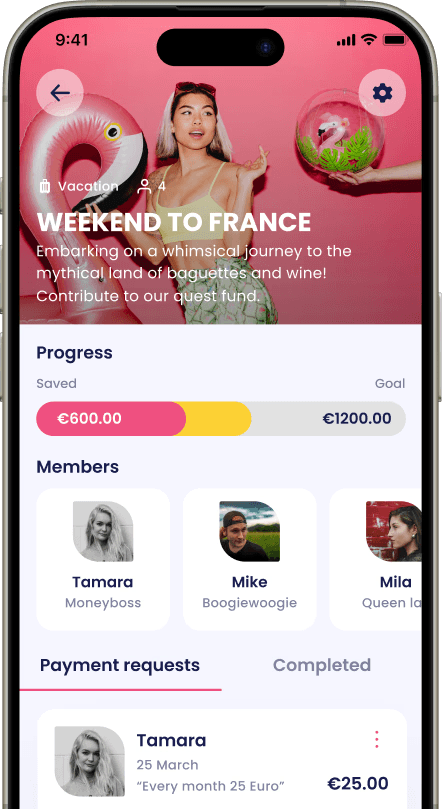
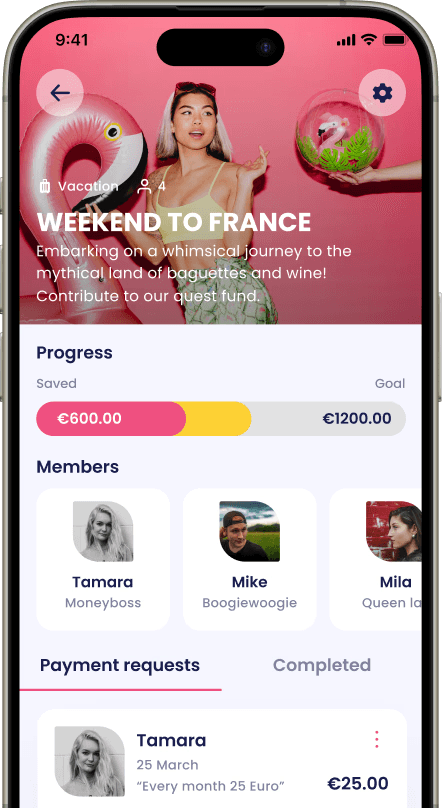
As people contribute via their preferred payment methods, the Potje system updates automatically in real-time. The entire group can open the app and instantly see:
Who has successfully paid.
Who has not yet contributed.
The total amount of liquid cash currently collected.
There is absolutely no manual tracking in an Excel spreadsheet. Everyone sees the exact same transparent information, creating a healthy sense of collective accountability.
Step 4: The System Replaces the Manual Follow-Up
This is where the magic of automation happens. Instead of the organizer nervously typing out a follow-up message in WhatsApp, the structure of the app does the heavy lifting. Each person clearly sees what they need to pay and their current payment status. This automated transparency drastically reduces social friction across the group.
Why This System Works Vastly Better Than Sending Payment Links
Most financial tools in the market focus entirely on the act of sending money requests. That reactive focus creates an exhausting, endless loop for the organizer: Request → Wait → Remind → Repeat.
With Potje, that exhausting loop is entirely removed. The payment request is intrinsically built into the foundation of the system. Because the expectation is clear and the progress is completely visible to all participants, psychological behavior actually changes.
People tend to contribute earlier and more reliably because the structure is consistent and transparent, rather than relying on a single text message that gets buried in a busy group chat.
How Potje Compares to Legacy Financial Tools
To understand the value of automated, shared structure, we have to look at where current tools fall short.
Tikkie (The Manual Link Generator)
Tikkie is the absolute gold standard in the Netherlands for sending quick, one-off payment requests.
The Limitation: It requires intense manual effort. You must generate and send each request individually. If you have a recurring monthly expense, you have to repeat this tedious process every 30 days. Furthermore, there is no shared overview for the group to see the total funds collected.
Splitser (The Reactive Tracker)
Splitser is excellent for tracking shared expenses and doing the complex math of who owes whom.
The Limitation: It only works after the money has already been spent. It does not actually collect the money, it does not hold the funds, and it does not automate upfront group payment requests. It organizes the debt, but it does not prevent it.
Buut (The Individual Observer)
Buut focuses beautifully on tracking individual financial behavior and building awareness for youth.
The Limitation: It provides visibility, but it does not proactively structure multi-person group payments or pool funds into a usable, shared asset.
Potje (The Proactive Ecosystem)
Potje connects the entire financial loop. Contributions are firmly defined upfront, payments are tracked automatically without spreadsheets, and the entire group stays perfectly aligned within one unified, proactive system.
Why Automated Group Payments Matter in Real-World Situations
The true value of this infrastructure becomes obvious when applied to everyday social scenarios:
Group Travel: Instead of the organizer repeatedly asking for flight and Airbnb money, everyone automatically contributes into the shared pot. The trip can be planned and booked with absolute clarity because the liquid cash is already secured.
Shared Gifts: Whether it is a baby shower or a colleague's farewell gift, there are no awkward follow-ups. The group knows exactly what the target is and what is expected of them.
Recurring Group Payments: For roommates sharing utility bills or clubs paying monthly dues, contributions become entirely predictable. There is absolutely no need to restart the painful collection process every single month.
Friends and Family Coordination: Money conversations inherently become simpler and less stressful because an unbiased digital system handles the coordination, preserving your personal relationships.
The Commercial Implications of Structured Finance
When payment collection relies on manual requests, the hidden costs are severe. Massive amounts of time are wasted chasing down friends. Contributions are heavily delayed. Plans for trips or events slow down, and early-bird pricing is often missed.
When group finance is properly structured:
Money comes in significantly earlier.
The total available budget is always undeniably clear.
Financial decisions happen much faster.
This directly affects the quality of the group's outcomes, especially in scenarios like travel or event ticketing where timing heavily dictates the final cost.
Risks, Red Flags, and Common Misconceptions
When navigating group finance technology, it is easy to fall for common misconceptions:
Misconception: "Automatic means zero human effort at all."
Reality: The system drastically reduces administrative effort for the organizer, but the individual participants must still execute the payment. Automation organizes the flow; it does not magically print money.
Misconception: "Sending a payment link app is the exact same thing."
Reality: It is fundamentally different. Sending links is a highly manual, reactive task. A shared financial structure is continuous, proactive, and transparent.
Misconception: "Expense tracking tools completely solve the problem."
Reality: Trackers only organize the math after the fact. They do not proactively collect funds, nor do they prevent the delays and debt that cause social friction.
Frequently Asked Questions (FAQ)
What exactly are automatic payment requests?
Automatic payment requests are highly structured, digital ways to collect money from a group without the organizer having to manually ask for funds each time. Instead of sending individual text reminders, the financial system defines the required contributions upfront and automatically keeps a transparent ledger of who has paid. This drastically reduces coordination effort and makes group payments entirely predictable.
How does Potje automate group payment requests?
Explore Potje's platform features to see how it allows you to create a secure shared pot and clearly define how contributions should work (amounts, frequency). Once the pot is set up, the system tracks incoming payments automatically and provides the entire group with real-time visibility into who has paid and the total amount collected. This completely removes the stressful need for the organizer to manually follow up with each person.
Is Potje better than Tikkie for group payments?
Tikkie is exceptionally useful for sending one-off payment requests quickly for past expenses (like splitting a bar tab). However, it requires repetitive manual effort. Potje provides a proactive, structured system where contributions are defined once, collected upfront, and tracked automatically, making it vastly more effective for ongoing group goals, travel funds, and recurring payments.
Can automatic payment requests be used for recurring group payments?
Yes, absolutely. Automated requests are particularly powerful for recurring group payments (like roommate bills or sports club dues) because they create financial consistency. Instead of restarting the tedious collection process from scratch every month, the system ensures that contributions are automatically expected, tracked, and visible to everyone regularly.
What is Potje and how does it help with group money?
Potje is an innovative shared money account designed specifically for groups, teams, and families. It empowers users to create a digital pot, invite contributors, and securely collect money in one centralized place. The system tracks contributions automatically and provides full transparency of the total balance, making it infinitely easier to manage group money without stressful manual coordination.
Natural Closing: The Issue is Not Asking Once, It is Asking Again and Again
Most organizers do not actually struggle with sending the very first payment request. They struggle with everything that comes after.
The endless reminders, the messy spreadsheet tracking, the awkward social tension, and the financial uncertainty of waiting for funds to clear—that is where group experiences get ruined.
When proactive structure is built directly into the financial system, those agonizing problems simply disappear. And when those problems disappear, managing group money finally becomes as simple and enjoyable as the experiences you are saving for.

Social Accountability and Saving: The Missing Link to Financial Freedom
Ondersteuning voor verschillende inhoudstypes zoals artikelen, blogs, video's en meer. Rijke tekstverwerker met opmaakopties voor verbeterde.
17 november, 2025

Group Saving Apps Compared: What's Easiest, Safest, and Most Transparent?
Ondersteuning voor verschillende inhoudstypes zoals artikelen, blogs, video's en meer. Rijke tekstverwerker met opmaakopties voor verbeterde.
17 november, 2025

Group Money Platforms Compared: What’s Safe, Regulated, and Fair?
Ondersteuning voor verschillende inhoudstypes zoals artikelen, blogs, video's en meer. Rijke tekstverwerker met opmaakopties voor verbeterde.
17 november, 2025
