13 July 2026



Managing group money is one of those things that sounds simple until you're actually doing it.
Someone books the Airbnb. Someone else says they'll transfer their share. A week passes. A reminder goes out. Someone forgets. Someone feels awkward. The organiser ends up out of pocket and quietly resentful.
Sound familiar?
The real problem is not that people don't want to pay. It's that money is collected after the spending has already happened. That's where it all falls apart.
The fix is straightforward: collect the money before anyone spends it.
This guide covers exactly how to do that, what tools work best, and why organising group money upfront is the only approach that actually holds a group together.
Why Group Money Goes Wrong (Every Single Time)
Most groups don't fail because people are dishonest. They fail because the system is broken from the start.
Here is what the old way looks like in practice:
One person volunteers to organise everything
They book and pay upfront, assuming everyone will chip in
They send a message asking for transfers
A few people pay immediately
Two or three people take their time
One person "forgets" entirely
The organiser either chases or quietly absorbs the cost
This pattern plays out for holiday bookings, group gifts, festival tickets, sports club fees, and office collections. Every time.
The real cost is not just money
When one person carries the financial burden, the dynamic of the group shifts. The organiser becomes a debt collector. Friendships get strained. Future plans get complicated because nobody wants to be the one who fronts the cash again.
Group money problems are really group relationship problems in disguise.
The solution is not better reminders or more awkward messages. It is changing the order of operations entirely.
What Does Managing Group Money Actually Mean?
Managing group money means organising shared contributions toward a common goal, before any spending takes place.
It is not the same as splitting a bill after dinner. It is not sending a Tikkie after someone already paid. It is not a spreadsheet that one person updates and three people ignore.
Proper group money management looks like this:
Everyone knows the goal (a trip to Barcelona, a birthday gift, a team event)
Everyone knows their contribution amount
Everyone pays in before the money gets spent
The organiser has a clear picture of what has been collected
Spending happens from the shared pot, not from one person's personal account
When this is done right, nobody chases anyone. Nobody feels awkward. And nobody ends up out of pocket.
What is a shared money pot?
A shared money pot is a dedicated space where a group collects contributions toward a specific goal. Think of it like a jar on the kitchen counter, except it is digital, everyone can see the balance, and contributions come in automatically.
Groups use shared money pots for:
Holidays and trips (Airbnb deposits, flights, shared activities)
Group gifts (birthday presents, farewell gifts, baby showers)
Events and festivals (Tomorrowland tickets, weekend trips, concerts)
Sports clubs (membership fees, kit costs, away days)
Office collections (colleague milestones, team socials)
The key word is before. The money is collected before it is needed.
The Tools Groups Use (And Where They Fall Short)
Most groups try to manage shared money with tools that were not designed for the job.
Here is an honest look at what is commonly used and what each one is actually good for:
Tool | Best for | Where it falls short |
WhatsApp group | Communication | No money tracking, no accountability |
Spreadsheet | Tracking who owes what | Manual, ignored, no payments |
Tikkie | One-off repayments after the fact | Not built for upfront group saving |
Joint bank account | Long-term shared expenses | Requires credit checks, shared liability |
Cash envelope | Simple in-person collections | Impractical for remote groups |
Why repayment apps only solve half the problem
Apps built around repayments are useful when money has already been spent and you need to settle up. Someone paid for dinner, now everyone owes them.
But that model puts one person at financial risk every single time.
Tikkie works well for those quick one-off moments. For ongoing shared savings goals, a trip that takes months to plan, or a gift collection with 15 contributors, a repayment-first approach creates friction at every step.
The better question is not "how do we settle up after?" It is "how do we collect together before?"
That shift in thinking is what separates a smooth group experience from a stressful one.
How to Manage Group Money Properly: A Step-by-Step Approach
Whether you are planning a ski trip, organising a colleague's leaving gift, or saving for a group festival, the process is the same. Here is how to do it properly.
Step 1: Define the goal before anything else
Before a single euro changes hands, the group needs to agree on what they are saving for and how much it will cost.
Be specific. "A weekend away" is not a goal. "A two-night trip to Bruges for eight people, budget €150 per person" is a goal.
A clear target makes it easier for everyone to commit, and easier to track progress.
Step 2: Set individual contribution amounts
Decide upfront whether everyone pays equally or whether contributions vary. Equal splits are simpler. Percentage-based splits work better for groups with different budgets.
Whatever you decide, communicate it clearly and early. Ambiguity is where resentment starts.
Step 3: Collect the money before booking anything
This is the most important step.
Do not book the Airbnb and then ask for transfers. Collect the money first, then make the booking. This protects the organiser and creates real commitment from every group member.
When people have already paid in, they are invested. Cancellations drop. Enthusiasm rises.
Step 4: Keep everyone informed on progress
Nobody likes being in the dark about money. Sharing a running total of contributions means the group can see how close they are to the goal.
This removes the need for awkward nudges. Progress visibility is its own reminder.
Step 5: Spend from the shared pot, not from one person's account
When it is time to book, the payment should come from the collected funds, not from the organiser's personal account. This keeps the finances clean and removes any personal financial exposure.
Key takeaway: The entire process works best when money flows in before it flows out. Collect first. Spend second. Everything else follows naturally.
How Potje Makes This Easier for Groups
One platform taking a different approach to group money is Potje.
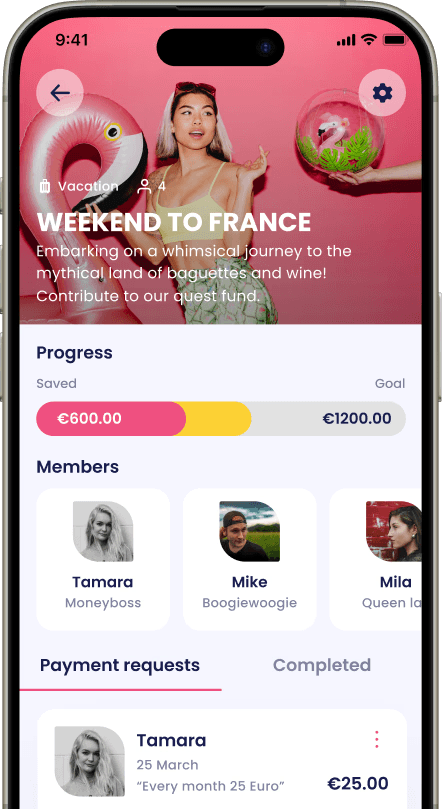
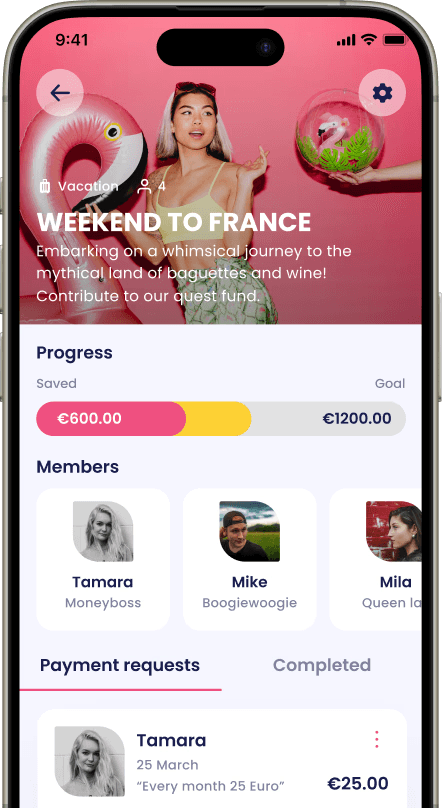
Rather than focusing on repayments after spending, Potje is built around the idea of collecting money before anything gets booked. Groups create dedicated money pots for a specific goal, invite contributors via a shared link, and watch the balance grow in real time.
No one person needs to front the cash. No awkward reminders. No spreadsheet that three people ignore.
How a Potje money pot works
The organiser creates a pot and sets a goal (amount and purpose)
A payment link is shared with the group
Contributors pay directly into the pot from their own bank account
Everyone can see progress toward the goal
The organiser manages the collected funds when it is time to spend
Coming soon: a virtual spending card
Potje is currently developing a virtual spending card that will let groups spend directly from their shared pot, no transfers, no one person fronting the cost at the point of payment.
It is the final piece of the puzzle: collect together, save together, and spend together from one shared balance. You can join the waiting list at potje.tech to be notified when it launches.
Only one person needs the Potje app to get started. Contributors can pay in without downloading anything.
Built for real group situations
Potje is designed for the kinds of situations where group money actually gets complicated:
Holiday planning: Collect contributions for accommodation, flights, or shared activities before anything is booked
Group gifts: Run a birthday or farewell collection with full transparency on who has contributed
Festival trips: Save together for Tomorrowland, a ski weekend, or a city break over several months
Sports teams: Collect membership fees or kit costs without chasing individuals manually
Office collections: Organise colleague milestones without one person coordinating every bank transfer
The goal is always the same: everyone contributes first, then the group spends together.
For groups that want to understand how a shared money pot compares to other options, this breakdown of digital money pots vs joint accounts vs split apps is a useful starting point.
Common Group Money Scenarios (And How to Handle Each One)
Every group situation is slightly different. Here is how the collect-before-spending approach applies to the most common ones.
Planning a group holiday
The biggest mistake groups make with holidays is booking first and collecting later. One person ends up carrying hundreds of euros while waiting for transfers to trickle in.
The better approach: set a contribution amount per person, open a shared money pot, and only confirm bookings once the goal is reached. This also gives the group a natural deadline to commit.
For more on this, see how to save money with friends for a trip without chasing anyone.
Organising a group gift
Gift collections are one of the most common group money situations, and one of the most awkward. People contribute different amounts at different times, and the organiser spends days chasing stragglers.
A dedicated gift pot solves this. Set a target, share the link, and let contributions come in at their own pace. Everyone can see progress. Nobody needs to be chased.
Read more on raising money for a group gift.
Managing sports club or team fees
Sports teams deal with recurring group money collections throughout the season. Manual bank transfers are unreliable. Chasing individuals is exhausting.
A shared money pot with a clear goal and a payment link makes the process consistent. The same approach works for kit costs, away days, and end-of-season events.
Collecting for a work event or office milestone
Workplace collections are particularly sensitive because the social dynamics are different. Nobody wants to feel pressured, and the organiser does not want to be seen as pushy.
A transparent pot with a shared link removes the pressure entirely. People contribute on their own terms. The organiser does not need to ask twice.
Frequently Asked Questions About Managing Group Money
What is the best way to manage group money?
The best way to manage group money is to collect contributions before any spending takes place. Set a clear goal, agree on individual amounts, share a payment link, and only spend once the pot is full. This avoids the most common problem: one person carrying the cost while waiting for others to pay back.
How do I collect money from a group without it getting awkward?
Use a shared payment link rather than asking individuals directly. When everyone receives the same link and can see the group's progress toward a goal, there is no singling out and no personal pressure. Transparency does the work that reminders usually have to do.
What is a money pot and how does it work?
A money pot is a shared digital space where a group collects contributions toward a specific goal. Each person pays in their share, the balance grows in real time, and the organiser uses the collected funds when it is time to spend. Unlike a joint bank account, no long-term commitment or credit check is required.
Can I use a money pot for a one-off collection?
Yes. Money pots work well for both one-off collections (a birthday gift, a leaving present) and longer-term savings goals (a group holiday, a festival trip). The same structure applies either way: set a goal, share a link, collect before spending.
Do all group members need an app to contribute?
No. With Potje, only the organiser needs the app. Contributors can pay in via a shared link from any device, without downloading anything. This removes a common barrier for groups with mixed levels of tech comfort.
How is a shared money pot different from a joint bank account?
A joint money account is a long-term arrangement between two or more people, typically requiring formal setup and shared financial liability. A shared money pot is purpose-built for a specific goal, requires no credit checks, and can be set up in minutes. It is the right tool for group savings goals, not for ongoing shared finances.
What happens if not everyone contributes?
This is where upfront collection makes a real difference. When money is collected before anything is booked, the group can see who has and has not contributed. The organiser does not need to chase anyone personally; the progress tracker does that work. If the goal is not reached, nothing gets booked. That creates natural accountability without awkward conversations.
Start Collecting Before You Start Spending
Group money does not have to be complicated. The problem is almost never the people. It is the process.
When contributions are collected upfront, toward a shared goal that everyone has agreed on, the dynamic changes completely. Nobody carries the burden. Nobody chases anyone. The group moves forward together.
That is the only version of group money management that actually works.
If you are planning a trip, organising a gift, or pulling together any kind of group collection, the simplest thing you can do right now is set up a shared money pot before anyone spends a thing.
Create a pot with Potje and share the link with your group today. The whole process takes a few minutes. The difference it makes lasts the entire experience.

Social Accountability and Saving: The Missing Link to Financial Freedom
Ondersteuning voor verschillende inhoudstypes zoals artikelen, blogs, video's en meer. Rijke tekstverwerker met opmaakopties voor verbeterde.
17 november, 2025

Group Saving Apps Compared: What's Easiest, Safest, and Most Transparent?
Ondersteuning voor verschillende inhoudstypes zoals artikelen, blogs, video's en meer. Rijke tekstverwerker met opmaakopties voor verbeterde.
17 november, 2025

Group Money Platforms Compared: What’s Safe, Regulated, and Fair?
Ondersteuning voor verschillende inhoudstypes zoals artikelen, blogs, video's en meer. Rijke tekstverwerker met opmaakopties voor verbeterde.
17 november, 2025