18 May 2026


How do you get a transparent group card?
To successfully figure out how to get a group card that shows a complete spending overview, you must utilize a fintech platform that natively connects a shared digital group fund to a dedicated virtual debit card. Most current financial tools force you to choose: they either track expenses after the fact (like Splitwise), or they offer payment cards strictly for individuals (like Revolut). A true shared group card requires upfront collective funding, real-time transaction tracking, and mobile wallet compatibility. While legacy banking apps fall short, innovative platforms like Potje are actively building a shared system where an Apple Pay group card connects directly to collective money, allowing groups to spend seamlessly without the need for manual tracking or post-purchase reimbursements.
The Illusion of the Modern "Group Card" Setup
A massive number of friend groups, sports teams, and roommates believe they already have a functional group card setup.
But when you analyze the mechanics, what they actually have is incredibly flawed. They simply have one person’s personal credit or debit card being used for group expenses.
In this outdated scenario, that one generous person instantly becomes:
The Financier: Fronting hundreds or thousands of euros for the group.
The Accountant: Manually tracking every single receipt.
The Debt Collector: Awkwardly chasing down friends to get paid back.
Even if your group religiously uses peer-to-peer (P2P) tracking apps, you inevitably end up trapped in the same exhausting conversation: "Who paid for the Airbnb?" or "Who still owes money for the rental car?"
The physical payment card is not the actual problem. The underlying financial system powering that card is what is fundamentally broken.
What a Real Group Card Actually Requires to Function
For a group card to operate flawlessly without leaving one individual holding the financial liability, two distinct financial components must be intimately connected:
1. A Natively Shared Group Fund
The money must legally and technically sit in one centralized, transparent pool.
Everyone in the group contributes their share upfront (via iDEAL, bank transfer, etc.).
The money legally belongs to the collective group, not one specific individual.
The total available balance is entirely visible to all participants.
2. A Dedicated Virtual Card Linked Directly to That Fund
Apple Pay and Google Wallet do not connect directly to raw bank accounts; they connect to 16-digit payment cards.
Therefore, the shared fund must issue a virtual debit card.
The card must draw funds only from the shared balance, ensuring nobody's personal checking account is ever touched.
When both of these critical elements are combined, you finally achieve the holy trinity of group finance: One source of truth. One collective balance. One unified system. That is exactly what enables a flawless, completely transparent spending overview.
What a "Complete Spending Overview" Actually Means
Many financial tools boast about visibility, but they usually only offer partial, delayed insights. In the context of group finances, a complete spending overview means absolute, unwavering transparency.
It must include:
Real-Time Transaction Updates: Every single payment must appear instantly on everyone's device. No waiting for banking days to clear, and no manual spreadsheet updates.
Democratic Shared Visibility: Everyone in the group sees the exact same information. There is no hidden ledger, meaning no one ever has to ask, "How much have we spent so far?"
Automated Contribution Tracking: The system must clearly display who has paid their share into the pot and who is lagging behind—completely removing the need for the organizer to act as a debt collector.
Live Remaining Balance: The group must always know exactly what budget is left before making the next collective purchasing decision.
This level of radical transparency removes financial confusion. And in group dynamics, confusion is exactly what causes arguments, slows down decision-making, and ruins shared experiences.
Where Current Fintech Tools Fall Short
While the European financial technology market is incredibly advanced, a closer look reveals that almost every major tool solves only one part of the group spending equation.
Splitwise (The Tracking Tool)
Splitwise and similar apps are exceptional at tracking shared expenses. They do complex math to show exactly who owes what at the end of a trip.
The Limitation: It does not actually hold your money. It does not provide a payment card. It does not enable real-time spending at a physical terminal. You are still 100% reliant on messy, retroactive reimbursements.
Revolut (The Individual Tool)
Revolut offers phenomenal virtual cards, zero hidden foreign transaction fees, and flawless Apple Pay integration.
The Limitation: It is brilliantly built, but strictly for individuals. Even with features like "Group Vaults," group coordination still happens outside the primary spending system. One person still has to use their personal Revolut card at the checkout, meaning the group debt still exists.
Joola (The Coordination Tool)
Joola focuses heavily on group payments and organizing the collection of funds.
The Limitation: It does not provide a full, frictionless shared spending system at the point of sale. The payment card and the collected fund are not seamlessly connected for real-time, tap-to-pay use.
The Bottom Line: Each of these tools solves one specific administrative headache. None of them provide the full, closed-loop solution required for a true shared group card.
Step-by-Step: How to Actually Get a Group Card That Works
The process of migrating your group to a proactive spending model is conceptually simpler than it sounds, but it absolutely requires adopting the correct financial infrastructure.
Step 1: Create a Shared Group Fund: You must start by collecting the money upfront. By funding a centralized pot before the event begins, you completely eradicate the need for post-event reimbursements.
Step 2: Connect a Virtual Card to That Fund: The designated organizer must generate a virtual debit card that draws exclusively from the shared balance, ensuring personal funds are never mixed with group money.
Step 3: Enable Real-Time Tracking: Ensure push notifications and live ledgers are active so the entire group knows exactly where they stand financially at any given second.
This is the profound difference between stringing together a clunky workaround (WhatsApp + Tikkie + Splitwise) and utilizing a true, unified financial system.
How Potje is Building the Ultimate Group Spending Solution
Potje is actively bridging the massive gap between passive expense tracking and active group purchasing.
The Foundation is Already Live
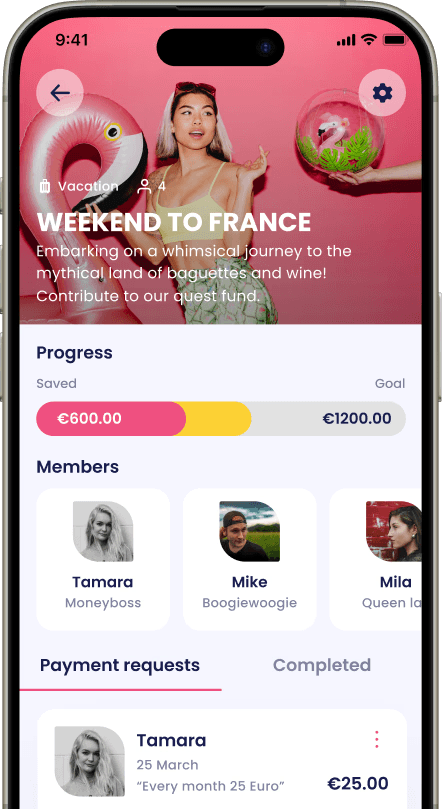
Potje already successfully provides the ultimate shared digital savings account where:
Everyone in the group or team contributes securely.
Incoming payments are tracked automatically.
The entire group sees one transparent, unified balance in real time.
The Next Evolution: The Apple Pay Group Card
The final, crucial step is connecting that beautifully organized shared money to the point of sale.
Potje is actively developing a proprietary group card solution that will:
Connect directly and exclusively to the shared Potje fund.
Provide an uncompromising, real-time spending overview to all contributing members.
Work flawlessly with Apple Pay and Google Wallet for tap-to-pay convenience.
This means the group can finally pay together, track everything automatically, and avoid splitting costs entirely.
(Important Note for Transparency: The group card and Apple Pay functionality are currently in active development and are not live just yet. Once launched, users will be able to add the card to Apple Wallet, pay in stores globally, and see every transaction instantly. Forward-thinking organizers can join the Potje waitlist here to secure early access).
Why This Proactive System Changes How Groups Behave
Right now, the standard operating procedure for group money is entirely reactive. Someone pays a massive bill, and everyone else reacts to the subsequent payment requests.
With a proper group card system, the flow becomes entirely proactive: The Group Funds Upfront → The Group Spends Together.
This elegant, paradigm-shifting flow removes:
Crushing financial pressure and credit card debt placed on one single person.
Delays in peer-to-peer payments clearing between different national banks.
Hours of manual tracking and tedious spreadsheet management.
It replaces social anxiety and awkwardness with democratic, shared financial control.
Practical Use Cases for a Complete Spending Overview
The versatility of a shared group card extends to almost any multi-person financial scenario:
1. Seamless Group Travel
Use the shared Apple Pay card to book Airbnb accommodations, rental cars, and excursions directly from the pre-funded pot. Everyone in the travel group sees the spending in real time, ensuring the vacation stays perfectly on budget without anyone maxing out their personal credit limit.
2. Shared Events and Festivals
Whether it is a music festival or a massive birthday dinner, the shared virtual card can cover the VIP table or the rounds of drinks at the bar without the group awkwardly trying to split the receipt with the waiter at the end of the night.
3. Recurring Group Expenses
Amateur sports teams, university clubs, or roommates can effortlessly manage ongoing monthly costs (like referee fees, tournament entries, or the shared internet bill) with consistent transparency that satisfies all members.
4. Flawless Multi-Person Coordination
Because the system automatically shows everything, there is absolutely no need to check personal bank statements to see who paid for what. The centralized ledger is the ultimate source of truth.
Commercial Implications: Speeding Up Group Decisions
When communal spending is hidden or opaque, group decision-making grinds to an agonizing halt.
Groups hesitate to book non-refundable flights. They delay committing to expensive dinner reservations. They lose momentum because they simply do not know the real financial situation of the collective.
With a complete spending overview, budgets are undeniably clear. Spending is rigorously controlled. Decisions happen significantly faster. This directly impacts the quality of the outcomes, especially in travel scenarios where hesitation heavily affects pricing and availability.
Risks, Red Flags, and Common Misconceptions
When navigating group finance technology, avoid these common misconceptions:
Misconception: "Any standard debit card can be used as a group card."
Reality: Only if that card is natively connected to a centralized pool of shared funds. If you designate a personal credit card as the "group card," one person is still carrying 100% of the financial liability.
Misconception: "Expense tracking apps are enough."
Reality: Tracking apps only help after the spending has occurred. They organize the debt, but they do absolutely nothing to prevent the friction of creating that debt in the first place.
Misconception: "A real-time overview is an optional luxury."
Reality: It becomes an absolute, non-negotiable essential the moment the group grows beyond three people or the total shared budget exceeds a few hundred euros. Trust requires total transparency.
Frequently Asked Questions (FAQ)
What exactly is a group card and how does it work?
A group card is a digital or physical payment card natively connected to a shared group fund. Instead of one person paying upfront and relying on others to reimburse them later, everyone contributes to a central pot beforehand. The card is then used exclusively for shared expenses, allowing the group to spend collectively while tracking every transaction in real time.
Why do most casual "group card" setups ultimately fail?
Most setups fail because the card being used is legally linked to one person’s private checking account. This means that specific person carries the entire financial responsibility and credit risk, while others must reimburse them later. Without a natively shared fund and real-time visibility, the system relies entirely on manual tracking, which inevitably leads to friction and errors.
Can I actually use Apple Pay with a shared group card?
You can only use Apple Pay if the group card is issued as a supported virtual debit card. Apple Pay works exclusively through cards, not raw bank accounts. Most current legacy group setups do not offer this functionality. However, innovative new systems (like Potje) are actively building technology to connect shared funds to Apple Pay through virtual cards, enabling frictionless real-time group spending.
How is a true group card different from Splitwise or Revolut?
Splitwise is a reactive tool; it tracks expenses after spending has occurred and does not provide a card or hold shared funds. Revolut is a proactive tool, but it is built strictly for individual use; one person still takes on the payment liability. A true shared group card solution natively combines upfront shared funds, a dedicated payment card, and real-time ledger tracking into one unified system.
What is Potje and how will its group card work?
Potje is a highly secure shared money account designed specifically for groups. It empowers users to transparently collect, track, and manage money together in one centralized dashboard. The highly anticipated upcoming group card will connect directly to the shared pot, provide an uncompromising real-time spending overview, and support Apple Pay natively. This feature is currently in active development, and users can join the waitlist today to access it the moment it becomes available.
Conclusion: The Difference is Not the Card, It is the System
Most friend groups operating today mistakenly believe they just need a better, shinier payment card with better rewards.
What they actually need is a vastly superior financial system.
A group card only truly functions when it is intrinsically connected to proactively funded, shared communal money. And it only maintains trust when every single contributor can see exactly what is happening in real time.
That is the profound shift that turns group spending from a reactive, stressful administrative chore into a controlled, proactive, and seamless experience. And that is exactly what makes managing group money actually work for everyone involved.

Social Accountability and Saving: The Missing Link to Financial Freedom
Ondersteuning voor verschillende inhoudstypes zoals artikelen, blogs, video's en meer. Rijke tekstverwerker met opmaakopties voor verbeterde.
17 november, 2025

Group Saving Apps Compared: What's Easiest, Safest, and Most Transparent?
Ondersteuning voor verschillende inhoudstypes zoals artikelen, blogs, video's en meer. Rijke tekstverwerker met opmaakopties voor verbeterde.
17 november, 2025

Group Money Platforms Compared: What’s Safe, Regulated, and Fair?
Ondersteuning voor verschillende inhoudstypes zoals artikelen, blogs, video's en meer. Rijke tekstverwerker met opmaakopties voor verbeterde.
17 november, 2025
