16 April 2026


Using a single person’s personal bank account to handle a collective travel budget feels like the easiest option, but it instantly creates a highly flawed financial system. This setup completely lacks transparency, shared control, and structure. When you guarantee Trust, Safety & Money Legitimacy, you remove the heavy burden from the designated organizer and give the entire group complete visibility and control over how their funds are managed.
The Default Setup: Why Relying on One Checking Account Fails
It usually starts innocently enough in a group chat. Someone says, “Just Venmo or Zelle me, and I’ll handle the bookings.” Everyone enthusiastically agrees, the cash starts rolling in, and suddenly, one person’s personal checking account transforms into the unofficial group bank.
Because everyone is already familiar with standard bank transfers and peer-to-peer apps, there is zero setup required. It feels incredibly fast and convenient. While this might work for a quick $20 pizza order, it completely falls apart for larger events. Trips, bachelor parties, and shared plans involve massive budgets, shifting timelines, and multiple coordinated payments. That is exactly where the informal system begins to break down.
The Hidden Group Money Risks You Cannot Ignore
The fundamental group money risks associated with this informal setup are rarely obvious upfront; they slowly compound over time, leading to major frustration.
A Complete Lack of Financial Transparency
Once the cash lands in the designated organizer's personal account, the rest of the group is completely blind. They cannot see the total pooled balance, what has already been spent, or what funds remain available. Everyone is forced to blindly trust sporadic text message updates from one person, creating unnecessary financial uncertainty.
Mixing Personal and Shared Funds
This is where the accounting gets incredibly messy. Group funds are now sitting directly next to someone's personal rent money, grocery budget, and daily coffee purchases. Transactions overlap, mental math becomes required, and tracking everything becomes a stressful, manual spreadsheet nightmare.
One Person Carries the Entire Burden
The account holder is suddenly responsible for tracking every contribution, answering endless questions about the budget, and taking on the financial liability of making large purchases. This immense pressure is one of the primary reasons why planning a vacation often turns into a highly stressful chore rather than a fun experience.
The Problem With Traditional Apps for Shared Expenses With Friends
Different financial tools attempt to solve the headache of shared expenses with friends, but most only address half of the equation.
Tracking Apps (like Splitwise or Tricount): These tools are fantastic for calculating who owes what after the money has been spent. They drastically improve visibility, but they do not manage actual cash. The real funds are still sitting in one person’s personal account, leaving them waiting to be reimbursed.
Digital Wallets & Joint Accounts: Some platforms offer joint vaults with shared balances, which addresses control and visibility. However, they often require every single member of the group to sign up for that specific banking platform, adding massive friction to the onboarding process.
Most solutions either just track IOUs, act as simple payment gateways, or require incredibly complex banking setups. Very few are built from the ground up for collaborative pooling.
Managing Group Funds Safely: The Three Core Pillars
To completely eliminate the awkwardness and financial liability, managing group funds safely requires three essential elements:
Shared Visibility: Every member must be able to open an app and instantly see the total funds, individual contributions, and categorized spending. No more guessing.
Shared Structure: The system itself—not a single person—must dictate how the cash is collected and distributed.
Strict Separation from Personal Finances: Shared money should never touch a personal checking account. It requires a dedicated, neutral digital space.
Ensuring Group Trip Money Safety Made Easy With Potje
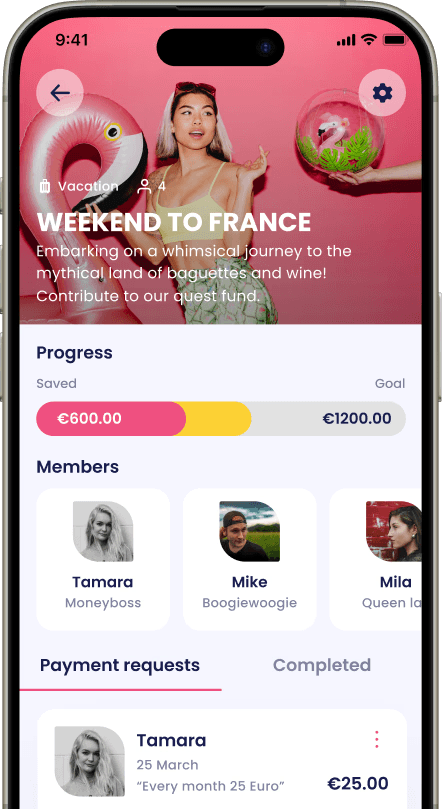
Potje was built explicitly to solve these structural failures. It provides groups with a dedicated, shared digital account designed specifically to ensure group trip money safety from day one.
Instead of forcing one friend to hold the bag and manually track every incoming transfer, your group creates a dedicated "money pot" centered around a specific goal. Everyone contributes directly into that pot, and every single transaction is visible to the entire group. That means no more guessing who paid, no more digging up old screenshot receipts, and no more relying on a single person for updates.
Potje also automates the most awkward part of the planning process. Payment requests and automated reminders are built seamlessly into the platform. The organizer no longer has to act like a debt collector, and the funds are kept strictly separate from personal bank accounts, ensuring total clarity when it is time to officially book the flights or the Airbnb.
Real-World Scenarios for Collecting Money From Friends
The friction of collecting money from friends disappears when you implement a structured system:
The Big Group Vacation: Without structure, one person maxes out their credit card to hold the Airbnb and manually hunts down reimbursements. With a shared system, the cash is pooled upfront. Everyone sees the exact same dashboard, and there is zero confusion or individual financial risk.
Large Event Planning: For weddings or massive birthday bashes, payments tend to trickle in at different times. Without a dedicated pot, tracking gets lost in chaotic group chats. A shared account keeps contributions visually clear and progress highly trackable.
Frequently Asked Questions
Is it safe to use one person’s personal bank account for a group travel budget?
While it works for very small, immediate purchases, it carries significant risks for larger plans. The primary issues are a severe lack of visibility, zero shared control, and the dangerous mixing of group funds with personal finances. It places all the pressure and liability on one individual.
What are the biggest risks of managing shared cash informally?
The most critical risks are delayed booking decisions, manual accounting errors, and rising social tension. When visibility is limited, confusion breeds hesitation. Over time, missing funds or forgotten IOUs can severely impact the group's dynamic.
How do you make group money management safer?
You make it safer by moving away from personal checking accounts and utilizing a dedicated, shared digital pooling system. Everyone should have real-time visibility into the balance, and the funds should be strictly isolated to guarantee absolute transparency.
What makes Potje a safer alternative?
Potje gives your group a neutral, shared money account designed specifically for collaborative saving. It completely separates the pooled funds from personal finances and provides every member with full visibility. By automating the collection process, it removes manual tracking errors and eliminates the financial burden placed on a single organizer.

Social Accountability and Saving: The Missing Link to Financial Freedom
Ondersteuning voor verschillende inhoudstypes zoals artikelen, blogs, video's en meer. Rijke tekstverwerker met opmaakopties voor verbeterde.
17 november, 2025

Group Saving Apps Compared: What's Easiest, Safest, and Most Transparent?
Ondersteuning voor verschillende inhoudstypes zoals artikelen, blogs, video's en meer. Rijke tekstverwerker met opmaakopties voor verbeterde.
17 november, 2025

Group Money Platforms Compared: What’s Safe, Regulated, and Fair?
Ondersteuning voor verschillende inhoudstypes zoals artikelen, blogs, video's en meer. Rijke tekstverwerker met opmaakopties voor verbeterde.
17 november, 2025