9 September 2026



Ten people. One shared goal. A €500 pot for a group trip, a birthday gift, or a team event.
Sounds simple. But the moment you ask yourself "how do we actually collect this money?" things get complicated fast. Someone opens a spreadsheet. Someone else suggests bank transfers. A third person says "just use [a payment app]." And before long, the organiser is chasing half the group while quietly wondering how much this is all going to cost.
Here is the honest answer: the method you choose makes a bigger difference than most people realise.
This is a real numbers breakdown of what it actually costs to collect €500 from ten people, using the most common approaches available to groups across Europe.
Method 1: Bank Transfers to One Person's Account
This is still the most common approach. One person volunteers their bank account. Everyone else transfers their share of €50.
On the surface, it looks free. SEPA bank transfers within the eurozone are free for consumers at most major banks. So the actual transaction cost is €0.
But free is not the same as costless.
The hidden costs nobody counts
Time spent chasing: The organiser typically sends 2-4 reminder messages per non-paying member. With 10 people, that can mean 15 to 20 individual follow-ups before the pot is full.
Confusion over amounts: People pay the wrong amount, forget the reference, or transfer at the wrong time.
No visibility for the group: Nobody except the organiser knows who has paid. This creates awkwardness and mistrust.
Personal liability: The organiser's personal account holds group money. If something goes wrong, there is no separation between their funds and the group's.
Real cost of bank transfers for €500 across 10 people: €0 in transaction fees, but significant time and social friction for the organiser.
For more on why this method creates problems, read Why Group Money Management Always Gets Messy (And How to Fix It).
Method 2: Payment Request Apps (Like Tikkie)
Payment request apps are popular across Europe for splitting costs after the fact. You pay for dinner, send a request, and everyone settles up.
For a one-off repayment, this works fine. But for collecting money upfront for a shared goal, it has real limitations.
What the numbers look like
Using a payment request app to collect €50 from each of 10 people:
Transaction fees: Typically free for domestic transfers within the same country
International transfers: Fixed fees apply when group members are in different European countries (around €1.99 per transfer in Europe, according to PayPal's European consumer fee schedule)
Partial collections: No structured way to track progress toward a goal
Payout control: The organiser still holds the money in a personal account
The bigger issue is that these apps are designed for repayment, not collection. There is no pot. There is no goal. There is no shared visibility.
Real cost of payment request apps for €500 across 10 people: low transaction fees domestically, but zero infrastructure for managing a shared goal.
If your group is spread across different European countries, check out Group Travel Money Management: The Best Group Savings Apps That Work in Multiple European Countries.
Method 3: Crowdfunding or Donation Platforms
Some groups try crowdfunding platforms for private collections. It seems logical: there is a goal, a progress bar, and a link to share.
The problem is the fee structure.
What platforms typically charge
Most crowdfunding and donation platforms charge a percentage of the total collected. This ranges from 2% to 8% depending on the platform and payment method.
For a €500 collection:
Platform type | Typical fee | Cost on €500 |
Crowdfunding (standard) | 4-5% | €20-25 |
Donation platform | 5-8% | €25-40 |
Payment processing on top | 1.5-3% | €7.50-15 |
That means your group could lose €30 to €55 just to collect money that was always meant to stay within the group. That is not a donation. That is a tax on organising.
These platforms are built for public fundraising, not private group collections. Using them for a holiday fund or a birthday gift means paying fees designed for charities and campaigns.
Real cost of crowdfunding for €500 across 10 people: up to €55 in combined fees, with no ongoing group money management.
For a full comparison, read Potje vs Crowdfunding: Which Option Is Suitable for You?
Method 4: Potje, a Shared Money Pot
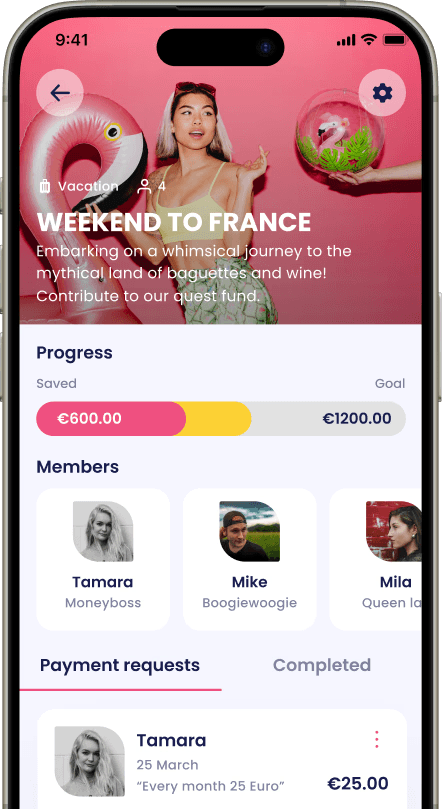
Potje is built specifically for this. A shared money pot where everyone contributes upfront, the group tracks progress together, and the organiser can pay out instantly when the goal is reached.
Here is what the real numbers look like for a group of ten collecting €500.
The actual cost breakdown
Potje costs €5.00 per month in total for an active money pot. That fee is shared automatically across the entire group.
For a group of 10 people:
What you pay | Amount |
Total pot fee per month | €5.00 |
Your share (per person) | €0.50 per month |
Contribution to the €500 goal | €50 per person |
Transaction fees on contributions | €0 |
Fee on partial payouts | €0 |
Instant payout fee | €0 |
Total cost to collect €500 from 10 people: €5.00 shared across the group, or €0.50 per person.
That is it. No percentage cut. No fee per transaction. No charge when you withdraw.
What you get for that €0.50
A dedicated shared money account, separate from any personal bank account
Automated payment reminders so you stop chasing people manually
Full group visibility: everyone sees progress toward the goal
Instant payouts of any amount, at any time
No fee on partial payouts, so you can access funds before the goal is fully reached
Your first month completely free
"Everyone contributes first. The group reaches its goal together. Then the money gets spent."
This is the model Potje is built on. It removes the awkwardness of chasing, the confusion of who has paid, and the risk of one person holding all the group's money in their personal account.
To understand how this compares to managing everything manually, read Potje vs Manual Transfers: The Price of the Old Method Explained.
The Full Comparison: What €500 Actually Costs Your Group
Here is everything side by side.
Method | Transaction fees | Group visibility | Instant payout | Organiser effort | Total cost on €500 |
Bank transfers | €0 | None | No | High | €0 + significant time |
Payment request apps | €0-19.90 | None | No | Medium | €0-20 |
Crowdfunding platforms | 5-8% | Partial | Delayed | Low | €25-55 |
Potje | €0 per transaction | Full | Yes, any amount | Very low | €5 shared (€0.50 pp) |
The bank transfer route looks free on paper. But the organiser absorbs all the work, all the risk, and all the social friction. That has a real cost, even if it does not appear in a fee schedule.
Crowdfunding platforms charge the most, and they are genuinely the wrong tool for private group collections.
Payment request apps sit somewhere in the middle. They are better than nothing, but they are designed for splitting costs after the fact, not collecting money before the event.
Potje is the only method that gives the group a proper shared home for their money, with full transparency, zero transaction fees, and instant access to funds.
The first month is free. There is no risk in trying it.
Create your first money pot at potje.tech and see how different it feels when everyone contributes upfront.
Frequently Asked Questions
What does it cost to collect money from a group with Potje?
Potje costs €5.00 per month in total for an active money pot. In a group of 10, that is €0.50 per person per month. There are no transaction fees when people contribute, no fees on partial payouts, and no charge for instant withdrawals.
Is the first month really free?
Yes. Your first month with Potje is completely free. You can create a money pot, collect contributions, and pay out funds without paying anything during that first month.
Can I withdraw money before the goal is reached?
Yes. Potje supports instant payouts of any amount at any time. There is no fee on partial payouts, so you are not locked in until the goal is fully met.
What happens if someone in the group does not pay?
Potje sends automated payment reminders on your behalf. Every group member can also see the progress toward the goal, which naturally encourages timely contributions. You stop being the one chasing people.
Is Potje safe for group money?
Yes. Potje is a regulated platform. Group funds are held in a dedicated shared account, completely separate from any personal bank account. This protects both the organiser and the group.
How is Potje different from a bank transfer or a payment request app?
Bank transfers and payment request apps put one person's personal account in the middle of the group's money. Potje gives the group its own shared money account. Everyone contributes to the same pot, everyone can see progress, and the organiser can pay out instantly when needed.

Social Accountability and Saving: The Missing Link to Financial Freedom
Ondersteuning voor verschillende inhoudstypes zoals artikelen, blogs, video's en meer. Rijke tekstverwerker met opmaakopties voor verbeterde.
17 november, 2025

Group Saving Apps Compared: What's Easiest, Safest, and Most Transparent?
Ondersteuning voor verschillende inhoudstypes zoals artikelen, blogs, video's en meer. Rijke tekstverwerker met opmaakopties voor verbeterde.
17 november, 2025

Group Money Platforms Compared: What’s Safe, Regulated, and Fair?
Ondersteuning voor verschillende inhoudstypes zoals artikelen, blogs, video's en meer. Rijke tekstverwerker met opmaakopties voor verbeterde.
17 november, 2025
