9 October 2026



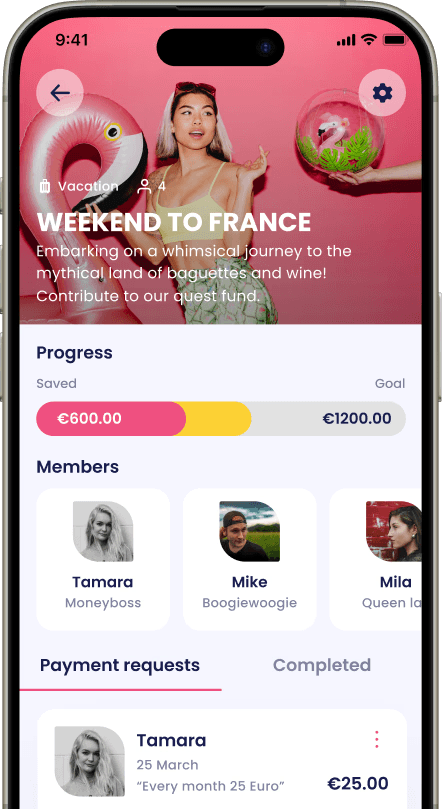
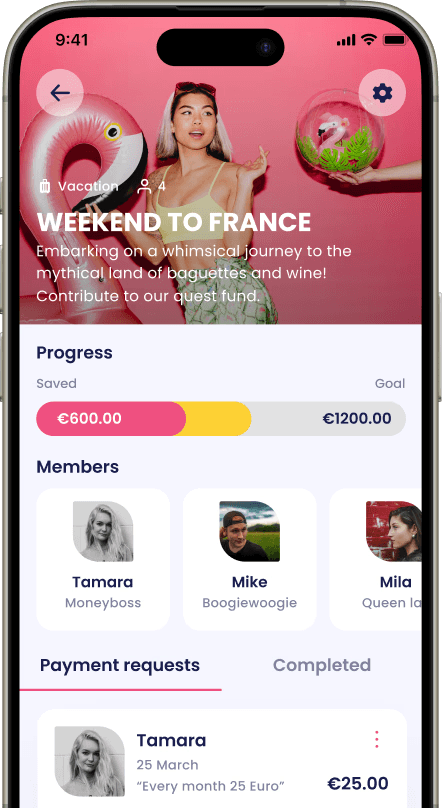
Managing public funds or welfare budgets is not the same as splitting a dinner bill.
When a municipality allocates money to a community programme, or a social organisation distributes support funds to participants, the stakes are different. Accountability matters. Transparency matters. And the wrong tool creates more problems than it solves.
More organisations across Europe are turning to controlled spending pots as a structured, transparent way to manage earmarked money. Before you set one up, here is what you need to know.
Key takeaway: A controlled spending pot works best when it is purpose-built for group accountability, not adapted from a personal finance tool.
What Is a Controlled Spending Pot?
A controlled spending pot is a dedicated digital money account where funds are collected, held, and spent under agreed rules. Unlike a personal bank account used for group purposes, a controlled pot keeps money separate, visible to all relevant parties, and tied to a specific goal or programme.
For municipalities and social organisations, this typically means:
Welfare support funds distributed to individuals or families for specific needs
Community programme budgets managed across multiple contributors and spending categories
Participant savings schemes where beneficiaries contribute alongside organisational top-ups
Project-based collections where money is gathered before spending begins
The core principle is simple: collect first, spend with oversight, report clearly.
This approach aligns with how the European Commission promotes digital financial tools for public administrations, encouraging transparent, interoperable systems that public bodies can trust.
5 Things to Check Before You Set One Up
Most problems with group money management do not come from bad intentions. They come from choosing the wrong structure at the start. Here are the five questions every organisation should answer before launching a controlled spending pot.
1. Who controls the money?
This sounds obvious, but it is the question most teams skip. In a controlled pot, there should be a clear administrator: someone who can see all contributions, approve payouts, and generate a spending record. Without a designated controller, money becomes nobody's responsibility.
2. Can participants see their own balance?
Transparency is not just good governance. It builds trust with the people you serve. Participants in a welfare programme or savings scheme should be able to see how much is in their pot, what has been paid out, and what remains. Visibility reduces disputes and increases engagement.
3. How are payouts handled?
This is where many organisations hit friction. Some tools require large minimum withdrawal amounts or batch payouts on a fixed schedule. For social programmes, that is not always practical. Look for a platform that supports instant payouts of any amount, so funds can reach participants exactly when they are needed.
4. Are partial withdrawals fee-free?
Partial payouts are common in welfare and community programmes. A participant might need part of their support fund this week and the rest next month. Any platform that charges a fee on partial payouts will quietly erode the value of the funds you are distributing. This is a detail worth checking before you commit.
5. What does it cost to run?
Administrative overhead matters. A platform that charges per transaction, per participant, or per payout quickly becomes expensive at scale. Look for simple, predictable pricing. Potje, for example, costs €5.00 per month in total for the entire pot, shared automatically across all contributors. At 10 participants, that is €0.50 each per month.
And right now, the first month is completely free.
Why the Old Way Creates Risk
Many municipalities and social organisations still rely on one of three approaches: a shared personal bank account, manual spreadsheets, or cash envelopes. Each carries real risk.
Method | Risk |
Shared personal bank account | Legal liability for the account holder; no separation of funds |
Spreadsheets | No audit trail; errors go undetected; chasing contributions is manual |
Cash | No record of who paid what; theft risk; impossible to report on |
The problem is not the people managing these systems. The problem is that these tools were never designed for group accountability.
A dedicated money pot changes the structure entirely. Money is held separately from any individual's personal finances. Every contribution is recorded automatically. Every payout is logged. And the organiser never has to chase anyone or reconcile a spreadsheet at the end of the month.
For organisations that need to demonstrate responsible use of community funds, this kind of built-in transparency is not optional. It is essential.
How Potje Supports Municipalities and Social Organisations
Potje was built for exactly this kind of structured group money management. It is not a personal payment app repurposed for organisations. It is a shared money account designed around the principle of collecting before spending. For programmes that require closer supervision, Potje also delivers this through a dedicated partnership with Kredietbank Nederland's SUN programme.
Here is what that looks like in practice for a social programme:
The organisation creates a dedicated money pot for the programme or participant group.
Funds are collected into the pot, whether from the organisation itself, from participant contributions, or both.
The pot administrator has full visibility of balances and can approve payouts at any time.
Participants access their funds through a dedicated Visa card with spending limits set by the administrator, rather than receiving direct cash payouts.
Partial payouts carry no additional fee, so the full value of the fund reaches the people it is intended for.
Potje also works for community fundraising and group savings goals, making it a flexible tool across different programme types.
"Group money should be organised before it becomes a problem." That is the principle Potje was built on, and it applies as much to a municipal welfare fund as it does to a group holiday.
The pricing is straightforward for individual and small group pots: the entire pot costs €5.00 per month, shared across all contributors, with the first month free. Institutional and municipal deployments are typically priced separately through a negotiated agreement rather than this flat consumer rate.
For organisations managing multiple programmes, each programme can have its own dedicated pot, keeping budgets clean and reporting simple.
Frequently Asked Questions
What is a controlled spending pot for organisations?
A controlled spending pot is a dedicated digital money account used by a group, organisation, or programme to collect, hold, and distribute funds under agreed rules. It keeps money separate from personal accounts, provides full visibility to administrators, and creates an automatic record of every contribution and payout.
Can a municipality or social organisation use Potje for welfare fund distribution?
Yes. Potje is designed for structured group money management. Organisations can create dedicated pots for specific programmes, manage contributions, and give participants a dedicated Visa card with spending limits set by the administrator, along with an oversight dashboard for social workers to monitor spending.
Are there fees on partial payouts?
No. Potje charges no fee on partial payouts. Participants can receive part of their fund at any time without any deduction from the payout amount.
How quickly are payouts processed?
For municipal and institutional programmes, participants can spend within their approved limit immediately via the linked Visa card, with no waiting period.
What does Potje cost for an organisation?
For individual and small group pots, the entire pot costs €5.00 per month, shared automatically across all contributors, with the first month completely free. For municipalities and larger institutional deployments, pricing is normally negotiated separately rather than billed at this flat consumer rate.
Is Potje suitable for multiple programmes at once?
Yes. Organisations can create separate pots for each programme or participant group, keeping budgets clearly separated and reporting straightforward.
Where can I learn more about Potje's approach to debt prevention and social programmes?
Visit the Potje debt prevention page to see how Potje works with social organisations, schools, and municipalities to support responsible money management.
Ready to Set Up Your First Controlled Spending Pot?
The right structure makes group money management simple, transparent, and trustworthy. Whether you are running a welfare support programme, a community savings scheme, or a project-based budget, a controlled spending pot removes the friction and the risk.
Potje gives municipalities and social organisations a purpose-built platform with instant payouts, no partial payout fees, and a first month completely free.
Start your free month on Potje today and see how much simpler controlled spending can be.

Social Accountability and Saving: The Missing Link to Financial Freedom
Ondersteuning voor verschillende inhoudstypes zoals artikelen, blogs, video's en meer. Rijke tekstverwerker met opmaakopties voor verbeterde.
17 november, 2025

Group Saving Apps Compared: What's Easiest, Safest, and Most Transparent?
Ondersteuning voor verschillende inhoudstypes zoals artikelen, blogs, video's en meer. Rijke tekstverwerker met opmaakopties voor verbeterde.
17 november, 2025

Group Money Platforms Compared: What’s Safe, Regulated, and Fair?
Ondersteuning voor verschillende inhoudstypes zoals artikelen, blogs, video's en meer. Rijke tekstverwerker met opmaakopties voor verbeterde.
17 november, 2025