23 September 2023


Most group money apps don't actually show you a real balance. They just help you chase people after the money is already spent.
That's a frustrating distinction to discover mid-trip. You open the app expecting to see how much the group has collectively saved toward the Airbnb, and instead you get a list of who owes whom from last weekend's dinner.
There are two very different types of apps in the group money space. Understanding which category an app falls into will save you a lot of awkward conversations.
In this post, we break down the difference, look at how popular tools compare, and explain why collecting money upfront changes everything.
The Two Types of Group Money Apps
Not all group money apps work the same way. There is a fundamental split in how they handle your group's finances.
Type 1: Payment Request Apps
These apps work reactively. Someone pays for something, then requests money back from the group. The "balance" you see is actually a running tally of who owes what, not a real pot of shared money.
Examples of this approach include apps focused on bill splitting and expense tracking. They are great for one-off dinners or splitting a taxi. But they don't hold any actual money. When you look at your balance, you're looking at a debt record, not a savings pot.
The problem: someone always ends up fronting the cash. And someone always ends up chasing.
Type 2: Real-Time Shared Balance Apps
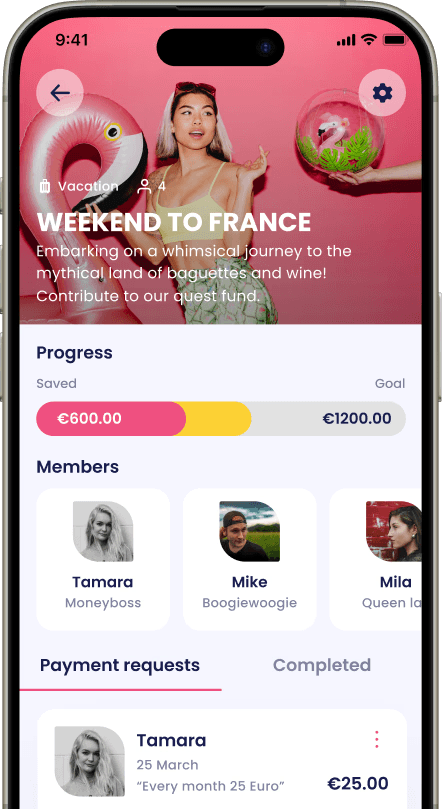
These apps work proactively. Everyone contributes to a shared pot before spending happens. The balance you see is a live figure that reflects real money sitting in a shared account.
This is a fundamentally different model. The group reaches its goal together. Nobody carries the financial burden alone. And when it's time to spend, the money is already there.
Key difference: Payment request apps track who owes what. Real-time balance apps hold actual shared funds that everyone can see grow in real time.
How Popular Group Money Apps Compare
Here is an honest breakdown of where common apps sit across both categories.
App | Shows Real-Time Balance | Holds Shared Funds | Collects Upfront | Best For |
Potje | Yes | Yes | Yes | Shared goals, group trips, events |
Splitwise | Debt tracking only | No | No | Long-term expense tracking |
Tricount | Debt tracking only | No | No | Simple one-off group trips |
Tikkie | No | No | No | Quick one-off payment requests |
Splid | Debt tracking only | No | No | Travel expense splitting |
What "Debt Tracking" Actually Means
Apps like Splitwise and Tricount are popular across Europe, and they do a solid job of calculating who owes what. According to independent comparisons of European bill-splitting apps, Tricount is widely used for group travel because it handles multi-currency and calculates the minimum number of transactions needed to settle up.
But here is the catch: none of that money exists in one place. It is a ledger, not a pot. When you look at your "balance," you are looking at a promise, not a payment.
For a group holiday, that distinction matters enormously. If the Airbnb deposit is due on Friday and three people haven't transferred yet, the organiser is stuck.
Why Payment Requests Create Friction
Payment request tools like Tikkie work well for splitting a dinner bill between two friends. Send a request, get paid, done.
For groups planning something bigger, the friction compounds quickly:
One person pays the deposit and waits to be reimbursed
Others forget, delay, or pay the wrong amount
The organiser becomes the unofficial debt collector
The group chat fills with awkward reminders
This is the old way. And it creates tension in even the closest friend groups.
How Potje Shows a Real-Time Shared Balance
Potje takes a completely different approach. Rather than tracking debts after spending, it collects contributions before spending begins.
Here is how it works in practice.
Create a money pot for your shared goal, whether that's a group holiday, a birthday gift, a festival, or a sports club fund.
Share the link with your group. No spreadsheets, no individual bank transfers to coordinate.
Everyone contributes their share upfront. The pot balance updates in real time as contributions come in.
The group watches the balance grow together, toward the shared goal.
When the goal is reached, pay out instantly, in any amount, with no fee on partial payouts.
Every member of the group can see the live balance at any time. There is no guessing, no chasing, and no one person carrying the financial weight while they wait for everyone else to transfer.
This is the difference between organising money and chasing money.
What Makes Potje Different From Other Shared Balance Tools
Potje is purpose-built for groups. The cost is €5 per month total, shared automatically across everyone in the pot. For a group of five, that works out to €1 per person per month. For a group of ten, it's just €0.50 each.
Key features worth knowing:
Your first month is completely free so you can try it with your group before committing
Instant payouts of any amount, whenever the group is ready to spend
No fee on partial payouts, so you can withdraw part of the pot without penalty
Automated payment reminders that handle the chasing for you, politely
Full transparency so everyone sees exactly how much has been collected and who has contributed
You can read more about how Potje compares to traditional split apps and why groups are increasingly choosing a shared money pot over a shared spreadsheet.
Which App Should Your Group Use?
The right tool depends on what your group is actually trying to do.
Situation | Best Approach |
Splitting a restaurant bill between 2-3 people | Payment request app |
Tracking who paid what on a group trip after the fact | Expense tracker |
Saving together for a holiday, festival, or gift | Shared money pot (Potje) |
Collecting contributions for a sports club or event | Shared money pot (Potje) |
Buying a group gift for a colleague or friend | Shared money pot (Potje) |
If your group is planning something together, collecting money upfront is almost always the better approach. It removes the awkwardness of chasing, eliminates the risk of one person being out of pocket, and gives everyone a clear view of progress toward the shared goal.
You can also explore how a digital money pot compares to a joint bank account if you're weighing up your options more broadly.
Frequently Asked Questions
Do group money apps actually hold real money?
Most do not. Apps like Splitwise and Tricount are expense trackers. They calculate who owes what but do not hold any actual funds. Potje is different. It is a regulated shared money account where contributions are collected and held in a real pot before spending happens.
What is the difference between a payment request and a real-time balance?
A payment request asks someone to send money after an expense has occurred. A real-time balance shows the actual amount of money your group has collectively saved at any given moment. One is reactive, the other is proactive.
Can everyone in the group see the balance in Potje?
Yes. Every member of the pot can see the live balance, who has contributed, and how close the group is to its goal. There are no surprises and no need for the organiser to give updates manually.
Is Potje free to use?
Your first month is completely free. After that, the cost is €5 per month total, shared automatically across the whole group. For a group of five people, that is €1 each per month.
Can I withdraw money from Potje before the goal is reached?
Yes. Potje offers instant payouts of any amount. There is no fee on partial payouts, so you can withdraw part of the pot at any time without penalty.
Which group money apps work in Europe?
Potje works across Europe and is designed for groups saving together for shared goals. Tricount and Splid are popular for expense splitting across European trips. For upfront group saving with a real shared balance, Potje is the strongest option available in Europe.
Stop Chasing. Start Saving Together.
Group money becomes messy when people pay at different times and someone always ends up keeping score.
The apps that show real-time balances, where actual shared money is collected before spending begins, solve a completely different problem than the apps that just send payment requests afterward.
If your group is planning something together, Potje gives everyone a live view of the shared balance, handles the reminders automatically, and lets you pay out instantly with no fees on partial withdrawals.
Your first month is completely free. No commitment, no complicated setup. Just create a pot, share the link, and watch the balance grow together.
Start your free month at potje.tech and see why more groups across Europe are choosing to collect before they spend.

Social Accountability and Saving: The Missing Link to Financial Freedom
Ondersteuning voor verschillende inhoudstypes zoals artikelen, blogs, video's en meer. Rijke tekstverwerker met opmaakopties voor verbeterde.
17 november, 2025

Group Saving Apps Compared: What's Easiest, Safest, and Most Transparent?
Ondersteuning voor verschillende inhoudstypes zoals artikelen, blogs, video's en meer. Rijke tekstverwerker met opmaakopties voor verbeterde.
17 november, 2025

Group Money Platforms Compared: What’s Safe, Regulated, and Fair?
Ondersteuning voor verschillende inhoudstypes zoals artikelen, blogs, video's en meer. Rijke tekstverwerker met opmaakopties voor verbeterde.
17 november, 2025