23 July 2026



Someone sends a payment link to the group chat.
A few people pay. A few people ignore it. One person says they already paid but nobody can verify that.
Sound familiar?
Payment links have become the default tool for collecting group money across Europe. They are quick to create, easy to share, and they work. But they only solve half the problem.
The real problem is not collecting money. It is knowing where the money stands.
When a group is saving for a holiday, splitting the cost of a shared gift, or pooling funds for a weekend away, everyone needs to see the same picture. How much has been collected? Who has contributed? How far are we from the goal?
A payment link cannot answer those questions. A transparent shared balance can.
This is why the next generation of group money tools is moving beyond payment links, and why transparent balances are becoming the standard that groups actually need.
What Is a Payment Link and What Does It Actually Do?
A payment link is exactly what it sounds like. Someone creates a link, shares it with the group, and people click it to send money.
It is useful for quick, one-off collections. Splitting a restaurant bill. Collecting for a leaving gift. Getting reimbursed for a taxi.
But here is what a payment link does not do:
It does not show the group how much has been collected in total
It does not track who has paid and who has not
It does not show progress towards a shared goal
It does not send reminders to people who have not contributed
It does not keep everyone aligned on the same number
Once the money lands in one person's account, it disappears from the group's view entirely. From that moment on, the organiser becomes the single point of truth. And that is where things start to break down.
A payment link is a collection tool. It is not a group money account.
For anything more than a one-off transaction, that distinction matters enormously.
Why Transparency Is the Missing Piece in Group Payments
Think about the last time your group organised something together.
A trip to Barcelona. A colleague's birthday. A festival weekend. A shared Airbnb.
Someone stepped up to manage the money. They collected payments, tracked contributions in a WhatsApp message or a notes app, and tried to keep everyone informed. It worked, kind of. But it was exhausting for the organiser and unclear for everyone else.
This is the transparency problem.
What transparency actually means for a group
Transparency in group money management means every member of the group can see:
The current balance in the shared pot at any moment
Who has contributed and how much each person has paid
The goal amount and how close the group is to reaching it
Pending contributions from people who have not yet paid
When everyone sees the same information, the dynamic shifts completely. Nobody needs to ask the organiser for an update. Nobody can claim they paid when they did not. Nobody is left guessing whether the trip is actually happening.
Transparency removes the awkward conversations before they start.
This is not a minor convenience. For groups planning anything that costs real money, it is the difference between a smooth experience and a stressful one.
The trust problem with payment links
When money goes into one person's personal account via a payment link, the rest of the group has to trust that person completely. They cannot see the balance. They cannot verify contributions. They are relying on someone else to keep an accurate record and report back honestly.
For most friend groups, that trust exists. But the burden on the organiser is unfair. And when things go wrong, whether it is a miscalculation, a forgotten contribution, or a genuine dispute, there is no shared source of truth to refer back to.
A transparent shared balance solves this at the root. The money is not in anyone's personal account. It lives in a dedicated group pot that everyone can see.
The Old Way vs. The Better Way
Most groups still manage shared money the same way they did five years ago. One person collects. Everyone else hopes for the best.
Here is what that usually looks like in practice.
The Old Way | The Better Way |
One person collects via payment link | Money goes into a shared group pot |
Balance is only visible to the organiser | Everyone sees the live balance |
Contributions tracked in WhatsApp or notes | Contributions tracked automatically |
Reminders sent manually by the organiser | Automated reminders for pending contributors |
Disputes resolved by memory | Disputes resolved by the shared record |
Goal progress unclear until the organiser updates | Goal progress visible to everyone in real time |
The difference is not just convenience. It is accountability.
When everyone can see the balance, people contribute more reliably. There is no hiding. There is no ambiguity. The group moves towards its goal together, rather than one person dragging everyone else along.
Collect before spending. That is the principle that changes everything.
Shared goals work better when the money is organised before anyone starts spending. Not after. Not during. Before.
How Potje Solves This With a Transparent Money Pot
One platform taking a different approach is Potje.
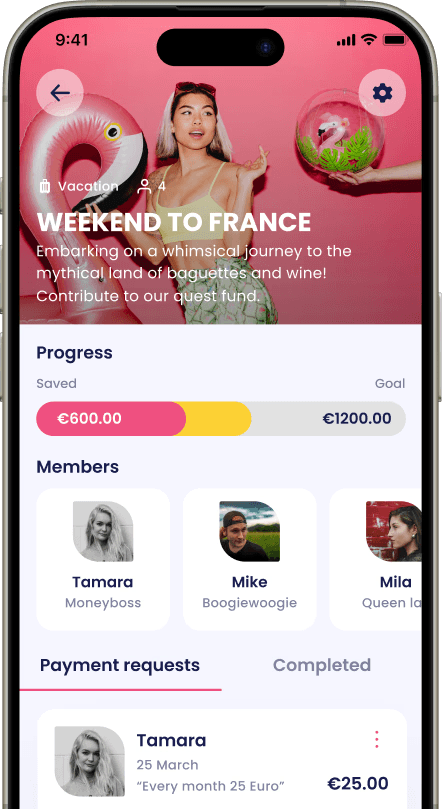
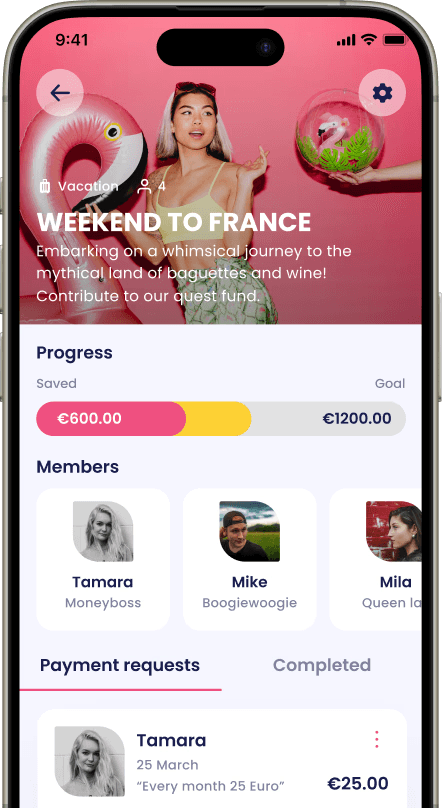
Rather than focusing on payment links and individual repayments, Potje helps groups collect money upfront into a dedicated, transparent money pot. Every member of the group can see the live balance, track who has contributed, and follow the progress towards the shared goal.
There is no spreadsheet. No WhatsApp thread. No one person keeping score.
What makes Potje different
A shared money pot that is separate from anyone's personal account
Real-time balance visibility for every member of the group
Automated payment reminders so the organiser does not have to chase manually
Upfront contributions before spending begins, not after
A clear goal amount that everyone works towards together
The cost is shared too. An active money pot costs €5.00 per month in total, split automatically across the group. With five people, that is €1.00 each. With ten people, €0.50 each.
The organiser does not carry the burden alone. The group shares everything, including the cost of staying organised.
Potje is built for the groups that actually exist. Friends planning a ski trip. Colleagues saving for a team event. Families pooling money for a shared holiday. People who want to do things together without the financial awkwardness that usually follows.
Whether you are collecting for a group holiday, a birthday gift, or a festival, the money sits in one transparent place that everyone trusts.
When a Payment Link Is Enough (and When It Is Not)
Payment links are not the wrong tool. They are just the wrong tool for the wrong job.
Use a payment link when:
You need a quick, one-off reimbursement
The group is small and the amount is simple
There is no ongoing goal to track
The transaction is complete once the money is received
Use a transparent shared balance when:
The group is saving towards a specific goal
Multiple people need to contribute over time
Everyone should be able to see the current balance
You want automated reminders instead of manual chasing
The money needs to stay separate from anyone's personal account
The size of the group matters less than the complexity of the goal.
Even two people planning a weekend trip benefit from a shared pot where both can see what has been saved. The transparency is the point. Not the technology.
Frequently Asked Questions
What is the difference between a payment link and a shared balance?
A payment link lets people send money to one person. A shared balance is a group money account where everyone can see contributions, track the total, and follow progress towards a goal. Payment links are transactional. Shared balances are collaborative.
Why do group payment apps need transparent balances?
Because payment links only solve the collection problem. They do not solve the visibility problem. When a group is saving for something together, every member needs to see how much has been collected, who has contributed, and how close they are to the goal. Without transparency, the organiser carries all the information, and the group has to trust one person's account of the money.
What is a money pot?
A money pot is a dedicated shared account for a group. Instead of money going into one person's personal bank account, it sits in a separate pot that all members can see. Contributions, balances, and progress are visible to everyone in real time.
How does Potje handle transparent group balances?
Potje gives every group member access to a live view of the shared money pot. You can see the current balance, who has contributed, and how far the group is from its goal. Automated reminders handle chasing, so the organiser does not have to do it manually. The cost of the pot is split across the group automatically.
Is Potje only for large groups?
No. Potje works for any group size. Even two people planning a trip together benefit from having a shared, transparent pot rather than one person holding all the money and tracking contributions manually.
What does Potje cost?
An active money pot costs €5.00 per month in total, shared automatically across all members. With two people, that is €2.50 each. With five people, €1.00 each. With ten people, €0.50 each.
Stop Sending Links. Start Sharing a Balance.
Group money is messy by default. People pay at different times, forget to follow through, or simply assume someone else has it covered.
Payment links make it slightly less messy. But they do not fix the underlying problem.
The underlying problem is that everyone in the group needs to see the same thing at the same time.
A transparent shared balance does that. It turns a fragmented, trust-based collection process into something the whole group can see, track, and contribute to together.
If your group is planning something together, whether it is a holiday, a birthday, a team event, or a shared experience, start with the money organised. Not as an afterthought.
Create your first money pot with Potje and let the whole group see exactly where things stand.

Social Accountability and Saving: The Missing Link to Financial Freedom
Ondersteuning voor verschillende inhoudstypes zoals artikelen, blogs, video's en meer. Rijke tekstverwerker met opmaakopties voor verbeterde.
17 november, 2025

Group Saving Apps Compared: What's Easiest, Safest, and Most Transparent?
Ondersteuning voor verschillende inhoudstypes zoals artikelen, blogs, video's en meer. Rijke tekstverwerker met opmaakopties voor verbeterde.
17 november, 2025

Group Money Platforms Compared: What’s Safe, Regulated, and Fair?
Ondersteuning voor verschillende inhoudstypes zoals artikelen, blogs, video's en meer. Rijke tekstverwerker met opmaakopties voor verbeterde.
17 november, 2025
