18 August 2026



You planned the trip. You booked the Airbnb. You told everyone what they owe.
Then you waited.
One friend said they'd pay you back at the weekend. Another went quiet in the group chat. A third sent half the amount with a message that said "rest to follow" and never followed up.
Sound familiar?
Group money breaks down not because people are dishonest, but because no one owns the process.
There is no agreed system. There is no clear timeline. There is no single place where everyone can see what has been collected and what is still missing. Someone ends up carrying the full financial burden while the group carries on planning.
This is one of the most common and most avoidable problems in shared finances. And it happens every single day across Europe, in friend groups, sports teams, colleague collections, and family trips.
The Real Reason Group Payments Fail
Most people assume group payment problems come down to one person being difficult or forgetful. But the research tells a different story.
A 2026 report by Zelle found that 76% of people have fronted money for a group trip and were not fully repaid. Nearly half went into debt to cover shared costs they expected to be reimbursed for. And 69% said repayment issues had damaged a friendship, family relationship, or romantic partnership.
The problem isn't the people. It's the process, or rather, the complete absence of one.
When a group plans something together, no one explicitly agrees on how the money works. Everyone assumes someone else is keeping track. The organiser assumes people will pay when asked. The group assumes the organiser will chase. Nobody agrees on a deadline. Nobody sets up a shared view of contributions.
The "Pay You Back Later" Trap
The most common failure pattern is also the most predictable.
One person pays upfront. The group promises to reimburse. Life gets busy. The conversation shifts from "we owe you" to silence. The organiser feels awkward chasing. The group feels awkward being chased.
This is what researchers call "payment avoidance." It is not malicious. It is human. People are pulled in multiple directions, and paying back a friend sits lower on the priority list than it should.
The result is that the organiser ends up out of pocket, quietly resentful, and less likely to volunteer to organise the next trip.
The Invisible Imbalance
There is a second, less visible problem.
Even when people do eventually pay, the contributions rarely land at the same time or in the same amounts. Someone pays half upfront. Someone else pays a week later. Someone asks for a discount because they couldn't make the full trip. Now you have a spreadsheet problem layered on top of a communication problem.
Nobody has a clear view of where the group actually stands. The organiser is doing mental accounting in the background while trying to enjoy the experience they planned.
This is not a fair position to put one person in.
What "Owning the Process" Actually Means
When group payments work well, it is almost always because one person took ownership of the financial structure before any money moved.
Owning the process does not mean doing all the work. It means making sure the group has agreed on three things before the event begins:
Who contributes what, and by when
Where the money is collected and stored
What happens if someone has not paid before the deadline
Without these three agreements in place, every group payment becomes a negotiation after the fact. And post-event negotiations are the hardest kind, because the experience is already over and the goodwill has already been spent.
Why the Group Chat Is Not a Payment System
Most groups default to the chat. Someone posts an amount. People react with thumbs up. A few send money. Others don't.
The problem is that a chat thread is not a financial system. It has no memory of who paid, no visibility into the total collected, and no mechanism to follow up automatically. The organiser has to manually track every payment, cross-reference bank notifications, and chase stragglers by hand.
This is time-consuming, awkward, and entirely unnecessary in 2026.
The Difference Between Collecting Upfront and Chasing Afterwards
Here is the key insight that most groups miss.
Collecting money before an event is completely different from chasing people after one.
When you collect upfront, the dynamic is collaborative. Everyone is contributing to a shared goal. The progress is visible. There is a clear target, and reaching it feels like a win for the group.
When you chase afterwards, the dynamic flips. Now one person is asking others to pay for something they have already enjoyed. The urgency is gone. The leverage is gone. The goodwill is wearing thin.
This is why the sequence matters so much. Collect first. Spend together. Never chase.
How a Shared Money Pot Fixes the Process Problem
A shared money pot is not just a convenient place to store group funds. It is a process solution.
When everyone contributes to a single, visible pot before the event, the entire dynamic of group money changes. There is no one person carrying the financial risk. There is no ambiguity about who has paid and who hasn't. There is no awkward chase after the fact.
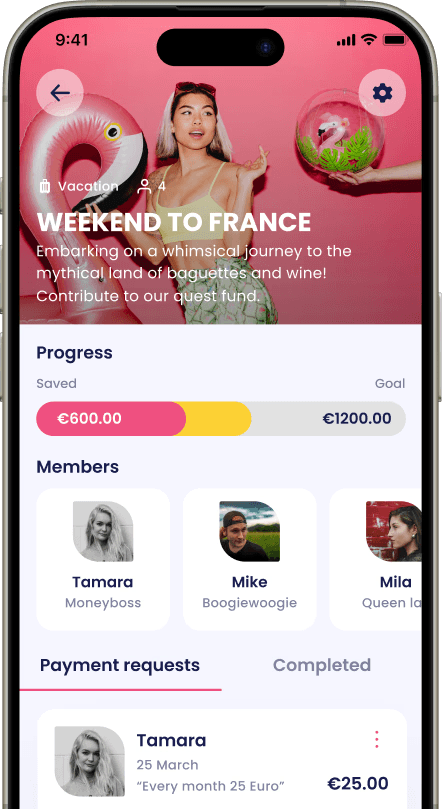
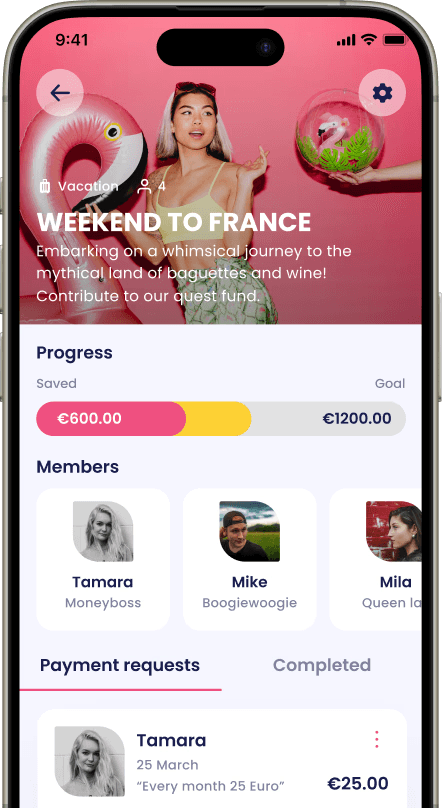
One platform that takes this approach seriously is Potje. Rather than focusing on repayments after spending, Potje helps groups collect money before spending begins. Everyone contributes to a shared money pot, progress is visible to the whole group, and automated reminders handle the follow-up so the organiser doesn't have to.
What This Looks Like in Practice
Say your group of eight is planning a ski trip to Austria. The Airbnb costs €1,600 and needs to be confirmed within a week.
Without a process:
One person books it on their card
Everyone says they'll pay them back
Three weeks later, only five people have transferred their share
The organiser is €480 out of pocket and starting to feel resentful
The group chat goes quiet when the topic comes up
With a shared money pot:
The organiser creates a Potje with a goal of €1,600 and a deadline
Everyone gets a link and contributes their share upfront
Progress is visible to the whole group
Automated reminders go out to anyone who hasn't paid yet
The Airbnb only gets booked once the pot is full
The second version is not just more organised. It is more fair. No one carries the risk. No one has to chase. The trip starts with everyone already invested, literally.
The Cost of Getting It Wrong
Group payment failures are not just inconvenient. They can be genuinely expensive.
Research from Fortune shows that 46% of people currently owe friends or family more than €1,000 from shared expenses. Nearly half have gone into debt covering group costs they expected to be reimbursed for. And 14% say a money dispute has ended a friendship outright.
These are not edge cases. They are the predictable outcome of a process that was never defined in the first place.
The good news is that the fix is straightforward. Set up a shared money pot before the planning begins. Agree on the goal. Share the link. Let the system do the rest.
Frequently Asked Questions
Why do group payments always end up being one person's problem?
Because groups default to informal systems: a chat message, a verbal agreement, or a promise to sort it later. None of these have accountability built in. When no one explicitly owns the process, it falls to whoever cares most, usually the organiser. A shared money pot with a clear goal and deadline removes that imbalance by making contributions visible and automatic from the start.
What is the best way to collect money from a group before an event?
The most effective approach is to set up a shared money pot with a defined goal and a contribution deadline before any bookings are made. Share the link with the group, let everyone contribute at their own pace, and use automated reminders to follow up with anyone who hasn't paid. Potje is built specifically for this, allowing groups to save together in one shared account without anyone needing to front the full amount. You can also read more about how group savings work on the Potje blog.
How much does Potje cost for a group?
A Potje money pot costs €5.00 per month in total, shared automatically across the whole group. For a group of five, that works out to €1.00 per person per month. For ten people, it is just €0.50 each. The cost scales down as the group grows, so it stays affordable regardless of group size.
Can group payment problems actually damage friendships?
Yes, and the data is clear on this. Research published in Fortune found that 69% of people say repayment issues have affected a friendship, family relationship, or romantic relationship, and 14% say a dispute has ended a friendship entirely. The fix is not confrontation. It is building a process upfront so the awkward conversations never need to happen.
Is a group chat enough to manage shared money?
No. A group chat has no memory, no tracking, and no accountability. It is a communication tool, not a financial system. Using a chat to manage group money means the organiser has to manually track every payment, follow up individually, and reconcile contributions by hand. A dedicated shared money pot handles all of that automatically.
Stop Chasing. Start Collecting.
The next time your group starts planning something, resist the urge to book first and sort the money later.
Set up a shared money pot before anything gets confirmed. Give everyone a link. Set a goal and a deadline. Let the contributions come in automatically, with reminders going out to anyone who hasn't paid yet.
The organiser should be the person who makes the trip happen, not the person who funds it.
Create your group money pot with Potje and collect before you spend. Your friendships will thank you for it.

Social Accountability and Saving: The Missing Link to Financial Freedom
Ondersteuning voor verschillende inhoudstypes zoals artikelen, blogs, video's en meer. Rijke tekstverwerker met opmaakopties voor verbeterde.
17 november, 2025

Group Saving Apps Compared: What's Easiest, Safest, and Most Transparent?
Ondersteuning voor verschillende inhoudstypes zoals artikelen, blogs, video's en meer. Rijke tekstverwerker met opmaakopties voor verbeterde.
17 november, 2025

Group Money Platforms Compared: What’s Safe, Regulated, and Fair?
Ondersteuning voor verschillende inhoudstypes zoals artikelen, blogs, video's en meer. Rijke tekstverwerker met opmaakopties voor verbeterde.
17 november, 2025