31 March 2026



Saving money is often portrayed as a lonely battle—a test of individual willpower against the temptation of immediate spending. Yet, data suggests that the "lone wolf" approach is frequently the least effective way to build wealth.
In the Netherlands, where financial prudence is culturally ingrained, a shift is happening. From traditional spaarpotjes (savings jars) to high-tech digital communities, group saving is proving to be a superior strategy. But why exactly does saving together yield better results than saving alone?
The answer lies at the intersection of behavioural psychology, modern fintech, and smart economics.
The Psychology: Why We Save Better Together
The primary driver behind the success of group saving is social reinforcement. When you save in isolation, the only person you disappoint by skipping a month is your future self—a person who feels abstract and distant.
The Power of Social Accountability
When you join a savings circle or use a shared digital pot, you introduce an accountability partner. This leverages a psychological concept known as "reputational capital." We are wired to care about how our peers perceive us.
Positive Peer Pressure: Knowing that 5 other people will see if you miss your €100 contribution creates a "nudge" that willpower alone cannot replicate.
Transparency: In a group setting, financial progress is visible. This visibility transforms saving from a private chore into a public performance.
Beating "Hyperbolic Discounting"
Humans suffer from a cognitive bias called hyperbolic discounting. We value immediate rewards (a dinner out today) significantly more than future rewards (a house deposit in 5 years).
Group saving acts as a commitment device. By locking yourself into a social contract, you raise the "cost" of spending money today. The immediate pain of letting the group down outweighs the immediate pleasure of an impulse purchase.
The "Dutch Way": Digital Tools & Spaarpotjes
The Netherlands is a global leader in fintech adoption, making it one of the easiest places to implement group saving strategies. The days of physical cash envelopes are gone; today, it’s about automated IBAN transfers and app integrations.
Gamifying Finance with Fintech
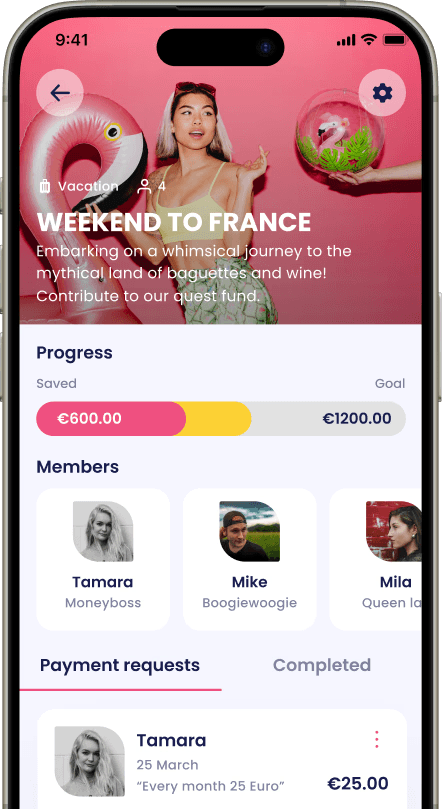
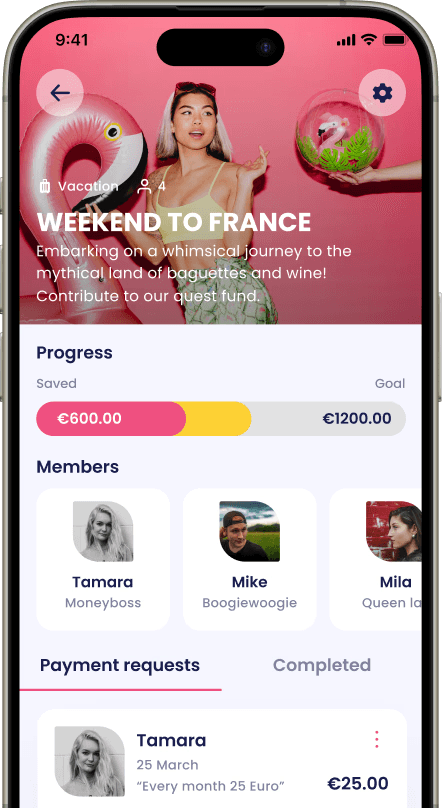
Dutch banking apps have mastered the art of gamification. While traditional banks can be rigid, Potje allows users to create digital sub-accounts specifically designed for group goals without the hassle of opening a formal bank account.
Visual Progress: Seeing a progress bar fill up as friends contribute triggers a dopamine release similar to levelling up in a video game.
Simplicity: Unlike complex banking apps, Potje focuses entirely on the social aspect of saving, making it easier to invite friends and track who has contributed.
Beyond Tikkies: Structured Joint Saving
While sending a Tikkie is great for settling a one-off lunch bill, it isn't a strategy. Tikkie is for repayment; group saving is for accumulation.
True group saving involves a dedicated "money pot" where funds accumulate over time. This is where Potje shines, allowing you to collect money upfront for a shared goal. This structure is essential for couples, roommates, or friend groups planning a trip. It moves the dynamic from repaying debt (which feels negative) to building assets (which feels positive).
Economic Advantages of Pooling Resources
Beyond the psychological hacks, there are hard economic reasons why group saving works.
Higher Interest Potential & Lower Fees
In some banking structures, pooling capital can unlock higher tiers of interest or reduce administrative fees. Furthermore, sharing the cost of a premium banking subscription among a household reduces individual overhead.
Safety Nets and Risk Mitigation
A group emergency fund serves as a robust financial buffer. For families or close-knit communities, this acts as informal insurance. If one member faces an unexpected crisis, the liquidity of the group pot can prevent them from falling into high-interest debt, such as credit card overdrafts.
How to Start a Group Savings Circle in the Netherlands
Ready to test this theory? Here is a practical framework to get started:
Define the Goal: Is it a holiday, a wedding gift, or a team event? Specificity fuels motivation.
Choose the Platform:
Formal: A joint account (en/of rekening) at banks like ING or ABN AMRO (often requires paperwork and fees).
Flexible & Fast: The Potje App. This is ideal for groups who want to start collecting money immediately without administrative hurdles. You simply create a pot and share the link.
Set the Rules: Determine the contribution amount and the deadline.
Automate: Encourage everyone to make their contributions as soon as they receive the payment link.
Conclusion
Group saving works because it acknowledges a fundamental truth: we are social creatures. By outsourcing our willpower to the group and leveraging digital tools that make saving frictionless, we bypass our own psychological flaws.
Whether you are saving for a home in Amsterdam or a summer trip with friends, the fastest way to get there is together.
Start your first Potje for free today and turn your shared goals into reality.

Social Accountability and Saving: The Missing Link to Financial Freedom
Ondersteuning voor verschillende inhoudstypes zoals artikelen, blogs, video's en meer. Rijke tekstverwerker met opmaakopties voor verbeterde.
17 november, 2025

Group Saving Apps Compared: What's Easiest, Safest, and Most Transparent?
Ondersteuning voor verschillende inhoudstypes zoals artikelen, blogs, video's en meer. Rijke tekstverwerker met opmaakopties voor verbeterde.
17 november, 2025

Group Money Platforms Compared: What’s Safe, Regulated, and Fair?
Ondersteuning voor verschillende inhoudstypes zoals artikelen, blogs, video's en meer. Rijke tekstverwerker met opmaakopties voor verbeterde.
17 november, 2025