15 September 2026



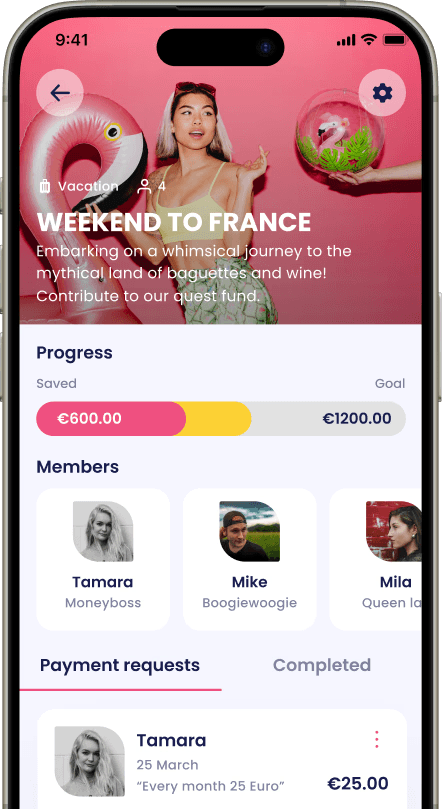
You've done everything right.
Everyone contributed. The shared money pot hit the target. Now you need to pay the Airbnb deposit, cover the festival tickets, and reimburse the person who already paid for the train.
Three separate payments. Three different amounts.
And then you discover the app only lets you withdraw everything at once.
That is the lump sum problem. And it affects more group money tools than most people realise.
The gathering part is solved. The spending part is where most apps fall short.
This article explains why payout flexibility matters, how different group money apps handle it, and why Potje is built differently from the ground up.
Why Payout Flexibility Matters More Than You Think
Group spending is never one transaction.
Think about a holiday with friends. You might need to:
Pay the accommodation deposit weeks before the trip
Book activities as they become available
Cover a last-minute restaurant reservation on the night
Reimburse whoever fronted the fuel money
Real group spending happens in stages. It is unpredictable. It rarely adds up to one clean total at one clean moment.
When an app forces you to withdraw everything at once, you are left with two bad options.
Option 1: Wait until you need every euro at the same time. That rarely happens.
Option 2: Withdraw the full pot, put it in someone's personal account, and then manually manage every payment from there.
Option 2 is exactly what group money apps were supposed to replace. You are back to one person carrying the financial burden, everyone else waiting, and trust becoming a quiet background issue.
Why Some Apps Lock You Into a Lump Sum
Most group collection tools were designed with one goal: gather money from a group.
The withdrawal side was an afterthought. The architecture was built around collection, not distribution. So when it came time to pay out, the simplest solution was: take everything, all at once, to one account.
This works fine for certain use cases. A rotating savings circle, for example, is designed to deliver a lump sum to one person at a time. That is the whole point of the model.
But for groups saving towards a shared goal, a holiday, a birthday gift, a team event, the lump sum model creates friction at exactly the wrong moment.
The money is there. The group is ready. And the app is the bottleneck.
Some platforms also charge a fee on withdrawals. Which means every time you try to access your own group's money, you pay for the privilege.
What Flexible Payouts Actually Look Like in Practice
Flexible payout means you can take out exactly what you need, when you need it, without touching the rest.
Here is a real scenario. Your group of seven is saving for a ski trip. You have collected €1,400. But right now, you only need €350 for the ski hire deposit. The rest stays in the pot until you need it for the chalet and the lift passes.
With a lump sum model, you would need to withdraw everything and manage it manually.
With a flexible payout model, you take out €350. The remaining €1,050 stays in the shared pot, visible to everyone, ready for the next payment.
The difference is not just convenience. It is trust.
When money stays in a transparent shared account and only leaves when it needs to, nobody has to wonder where it went. There are no awkward conversations. No one person is holding the group's money in their personal account.
For a deeper look at why this matters, see why group money management always gets messy and how to fix it.
How Potje Handles Payouts Differently
Potje was built for groups that spend together, not just save together.
That means the payout experience was designed with real group spending in mind.
Instant payouts of any amount
With Potje, the organiser can withdraw any amount from the shared pot at any time. Not a fixed percentage. Not a minimum threshold. Any amount, instantly.
Need €120 for the group dinner? Take €120. The rest stays in the pot.
Need €800 for the villa deposit? Take €800. No waiting period. No processing delay.
No fee on partial payouts
Some apps charge a withdrawal fee every time you access your funds. Potje does not.
There is no fee on partial payouts. You keep every euro your group contributed.
The only cost is the pot itself: €5 per month in total, shared automatically across the whole group. For a group of five, that is €1 each per month. For ten people, just €0.50 each.
Your first month is free
Potje now offers your first month completely free. That means your group can set up a shared pot, collect contributions, and make your first payout without paying anything.
Start your first money pot for free at potje.tech
Lump Sum vs Flexible Payout: A Quick Comparison
Feature | Lump Sum Model | Potje (Flexible Model) |
Withdraw partial amounts | No | Yes |
Instant payouts | Sometimes | Yes, always |
Fee on each withdrawal | Often | No |
Money stays transparent | No (moves to personal account) | Yes |
First month free | No | Yes |
When a Lump Sum Model Does Make Sense
To be fair: the lump sum model is not always wrong.
If your group is running a rotating savings circle where each person receives the full pot in turn, lump sum payouts are exactly what you need. The structure of that model depends on it.
If you are collecting money for a single gift with a single purchase, withdrawing everything at once is perfectly reasonable.
The problem arises when groups try to use lump sum tools for ongoing shared expenses. That is where the mismatch creates real friction.
For more on choosing the right approach, read digital money pot vs joint bank account vs split app: which should your group use.
Frequently Asked Questions
Can I withdraw just part of my group pot with Potje?
Yes. Potje allows the organiser to withdraw any amount at any time. There is no minimum, no maximum, and no requirement to take everything at once.
Does Potje charge a fee for partial withdrawals?
No. There is no fee on partial payouts. The only cost is the shared monthly pot fee of €5 in total, split automatically across all group members.
How quickly does a payout arrive?
Payouts with Potje are instant. There is no processing delay or waiting period.
Is the first month really free?
Yes. Potje now offers your first month completely free. You can set up your shared pot, collect contributions, and make payouts without any cost in month one.
What happens to the money that stays in the pot after a partial withdrawal?
It stays exactly where it is: in the shared pot, visible to all group members, ready for the next payment. Nothing changes for the rest of the group.
What kinds of groups use Potje?
Potje works for any group saving towards a shared goal. Common uses include holiday funds, birthday collections, festival budgets, sports club fees, team events, and school trip collections. See what is a digital money pot: meaning, examples and when to use one for more.
The Bottom Line
Most group money apps were designed to solve the collection problem.
Potje was designed to solve the whole problem: collecting, tracking, and spending together, flexibly, transparently, and without friction.
If your group needs to pay for things at different times and in different amounts, you need a tool that works the way group spending actually works.
Try Potje free for your first month and see the difference for yourself.

Social Accountability and Saving: The Missing Link to Financial Freedom
Ondersteuning voor verschillende inhoudstypes zoals artikelen, blogs, video's en meer. Rijke tekstverwerker met opmaakopties voor verbeterde.
17 november, 2025

Group Saving Apps Compared: What's Easiest, Safest, and Most Transparent?
Ondersteuning voor verschillende inhoudstypes zoals artikelen, blogs, video's en meer. Rijke tekstverwerker met opmaakopties voor verbeterde.
17 november, 2025

Group Money Platforms Compared: What’s Safe, Regulated, and Fair?
Ondersteuning voor verschillende inhoudstypes zoals artikelen, blogs, video's en meer. Rijke tekstverwerker met opmaakopties voor verbeterde.
17 november, 2025