10 August 2026



Every informal sports team has the same person.
The one who sends the payment request.
They ping the group chat. They follow up. They send a polite reminder on Tuesday. A less polite one on Thursday. By Saturday morning, three people still haven't paid and the pitch booking is sitting on their personal card.
Sound familiar?
The problem isn't that your teammates are bad people. The problem is that payment requests are the wrong tool for the job.
Informal sports teams across Europe, from five-a-side football groups in Amsterdam to padel clubs in Barcelona, are running their finances the same way they did ten years ago. Someone pays upfront. Everyone promises to sort it. The chasing begins.
There is a better way. And it starts before the money gets spent.
What Informal Sports Teams Actually Need to Pay For
Before we talk about solutions, it helps to name the real scope of the problem.
Informal sports teams are not just splitting a round of drinks. The costs are ongoing, recurring, and often significant.
Here is what most teams are managing every season:
Pitch or court hire - weekly bookings that need to be paid in advance
Kit and equipment - jerseys, bibs, balls, cones, first aid kits
Tournament entry fees - registration costs that fall weeks before the event
Away trips and travel - transport, accommodation, meals for overnight games
End-of-season events - meals, drinks, trophies, presentations
Referee fees - often cash in hand, collected on the day
That is a lot of money moving around. And most of it lands on one person's account first.
The EU's own study on grassroots sports funding highlights that informal and community-level sports groups consistently struggle with financial organisation, not because they lack commitment, but because they lack the right tools.
This is not a motivation problem. It is a system problem.
Why Payment Requests Keep Failing Your Team
Payment requests feel like a solution. They are not.
They are a reaction to a problem that has already happened.
By the time you send a payment request, someone has already fronted the money. The social awkwardness has already started. The group chat is already a mix of "paid!" messages and conspicuous silence.
The three ways payment requests break down
1. They put the burden on one person
Someone has to pay first. That person carries the financial risk while they wait for everyone else to catch up. For a weekly pitch booking, that could mean hundreds of euros sitting on one personal account across a season.
2. They create a debt dynamic
Once money is owed, the relationship changes. The person who paid becomes a creditor. Their teammates become debtors. Nobody signed up for that when they joined a football team.
3. They do not work for recurring costs
Payment requests make sense for a one-off split. They break down completely when you need to collect money every week, every month, or every season. The admin never stops.
The real issue: Payment requests treat the symptom. A shared money pot treats the cause.
If you want to understand why this pattern keeps repeating, the psychology behind it is worth reading about. We explored it in depth in our piece on the hidden psychology behind collecting money from friends.
The Smarter Approach: Collect Before You Spend
The teams that handle group money well all do the same thing.
They collect first. Then they spend.
It sounds obvious. But it requires a shift in how you think about team finances. Instead of one person absorbing costs and chasing reimbursement, the whole group contributes to a shared pot before any money goes out.
What this looks like in practice
Imagine your team needs €600 for the season. That covers pitch hire, a set of training bibs, and entry to one local tournament.
Old way:
The team captain pays for the pitch booking
They send payment requests to 11 people
Eight pay within a week
Two pay after a reminder
One never pays
The captain is out of pocket and quietly annoyed
New way:
The team creates a shared money pot with a €600 goal
Everyone contributes €50 before the season starts
The pot reaches its goal
Costs are paid directly from the shared fund
Nobody chases anyone. Nobody owes anyone.
The difference is not the amount. The difference is the timing.
When everyone contributes upfront, the financial burden disappears. There is no creditor. There is no debtor. There is just a team with a shared goal and the money to reach it.
This is exactly how a digital money pot works, and why it is a fundamentally different solution from a payment request app.
How Potje Works for Sports Teams
Potje is a shared money pot built for exactly this kind of situation.
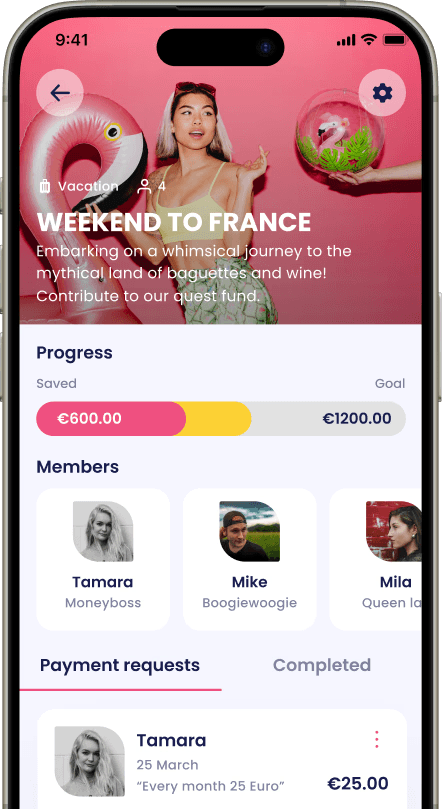
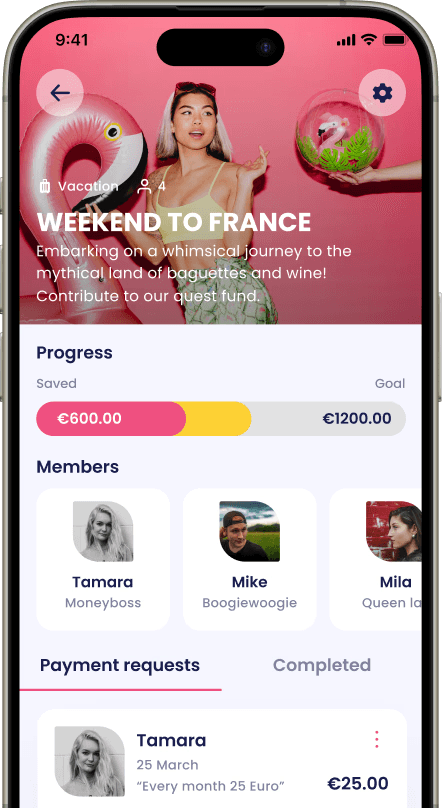
One platform taking a different approach to group money is Potje. Rather than asking people to pay back after the fact, Potje helps groups collect money before spending begins.
Here is how a sports team would use it:
Create a pot - Set a goal amount and a deadline. "€600 for the season. Everyone in by 1 September."
Share the link - Send it to the group chat. Each teammate contributes their share directly through the app.
Track progress - Everyone can see how much has been collected and who has contributed. Transparent. No awkward conversations needed.
Spend from the shared fund - When costs come up, they are covered from the pot. No one person carries the bill.
What does it cost?
Potje costs €5.00 per month in total for the entire group, shared automatically across all members.
Group size | Cost per person per month |
5 people | €1.00 |
10 people | €0.50 |
15 people | €0.33 |
For a team of ten, that is fifty cents each per month. Less than a coffee. And it replaces hours of chasing, spreadsheets, and awkward group chat messages.
You can read more about how the shared cost model compares to percentage-based alternatives in our breakdown of fixed amount vs percentage pricing for group money apps.
Payment Requests vs Shared Money Pot: A Quick Comparison
Still weighing up the options? Here is the honest breakdown.
Payment requests | Shared money pot (Potje) | |
When money is collected | After spending | Before spending |
Who carries the risk | One person | Nobody |
Chasing required | Yes, every time | No |
Recurring costs | Gets messy fast | Handled automatically |
Transparency | Limited | Everyone sees progress |
Best for | One-off splits | Ongoing team costs |
Payment requests work fine when you are splitting a single dinner between four people who all pay immediately.
They are not built for a team of twelve managing costs across a full season.
For a deeper look at how different group money tools compare, our guide on group money management: shared expense tracker vs shared savings account breaks it down clearly.
Frequently Asked Questions
Can any sports team use Potje?
Yes. Potje is designed for any group that needs to collect and manage shared money. That includes informal football teams, padel groups, running clubs, volleyball teams, cycling groups, and any other sport where costs are shared across a group of people.
Does everyone in the team need to download the app?
No. Only the organiser needs to set up the pot. Teammates can contribute via a shared link, making it easy for everyone to participate without a complicated setup.
What happens if the team does not reach its savings goal?
Contributions are held securely in the shared pot. If plans change, the organiser can manage the pot accordingly. Potje is a regulated platform, so your group's money is always protected.
How is Potje different from just sending a payment request?
A payment request asks someone to pay back money that has already been spent. Potje collects money before any spending happens. That means no one person carries the financial burden, and there is nothing to chase after the fact.
Is Potje only available in the Netherlands?
Potje is available across Europe and is designed to work for groups in multiple countries. You can read more about how it works for cross-border groups in our guide to group travel money management across European countries.
Stop Chasing. Start Collecting.
Your team shows up every week.
They train together, compete together, and celebrate together.
The money side of it should not be the thing that causes friction. It should not fall on one person. And it should not require a Tuesday reminder, a Thursday follow-up, and a Saturday morning panic.
Set up a shared money pot before your next season starts. Everyone contributes. Nobody chases. The team stays focused on what actually matters.

Social Accountability and Saving: The Missing Link to Financial Freedom
Ondersteuning voor verschillende inhoudstypes zoals artikelen, blogs, video's en meer. Rijke tekstverwerker met opmaakopties voor verbeterde.
17 november, 2025

Group Saving Apps Compared: What's Easiest, Safest, and Most Transparent?
Ondersteuning voor verschillende inhoudstypes zoals artikelen, blogs, video's en meer. Rijke tekstverwerker met opmaakopties voor verbeterde.
17 november, 2025

Group Money Platforms Compared: What’s Safe, Regulated, and Fair?
Ondersteuning voor verschillende inhoudstypes zoals artikelen, blogs, video's en meer. Rijke tekstverwerker met opmaakopties voor verbeterde.
17 november, 2025