3 June 2026


Before initiating a virtual VISA card sign up, you must evaluate how the card functions, the specific financial infrastructure it connects to, whether it supports native Apple Pay integration, and how transactions are managed. While industry-standard digital banking platforms design virtual cards strictly for individual personal spending, innovative fintech systems like Potje are transforming the market by launching virtual payment cards directly tied to pre-funded, shared group accounts.
The shift toward completely digital, branchless finance has turned virtual payment methods into an everyday essential. However, rushing into an account creation screen without knowing what to look for can leave you with unneeded bank charges, bad user interfaces, or an inflexible card structure. Here is everything you need to check before setting up your first digital card.
Why People Are Switching to Virtual VISA Cards
The universal appeal of digital banking tools is undeniable. Consumers are moving away from legacy banks because they refuse to navigate outdated barriers. When you choose a virtual layout, you eliminate standard pain points:
No waiting for postal delivery: Skip the 5-to-10 business day shipping window entirely.
No physical wallet required: Reduce clutter and eliminate the risk of a card being physically lost or skimmed.
No traditional banking delays: Avoid the paperwork and rigid underwriting windows of brick-and-mortar financial institutions.
The onboarding journey is simple: you sign up via a mobile application, complete your mandatory verification, instantly generate a virtual card, and start purchasing products from your phone. For iOS users especially, adding these credentials directly to a smartphone app creates an entirely frictionless transaction loop.
Yet, speed at checkout is merely the first layer of modern financial tools. The foundational element to research before your virtual VISA card sign up is simple: What exact type of underlying money system is funding your virtual numbers?
What a Virtual VISA Card Actually Is
Technically speaking, a virtual VISA card is a digital-only payment credential issued by a certified fintech provider or financial institution. It possesses the standard processing information required to complete a transaction securely over the global VISA network:
A unique 16-digit card number (PAN)
A designated expiration date (MM/YY)
A 3-digit CVV/CVC security code
The structural departure from legacy banking is that it exists entirely inside a secure app interface or your smartphone's native mobile wallet. It functions identically to a traditional plastic card, allowing you to pay online, link to an Apple Pay virtual card setup, and execute contactless payments in physical storefronts using your phone or smartwatch.
What to Check Before Signing Up: 5 Crucial Factors
Most prospective users sign up based on visual aesthetics or short-term convenience. To select a card provider that scales with your financial habits, examine these five core elements:
1. Does It Support Apple Pay?
Not every virtual VISA card works natively with Apple Pay. Before creating an account, look at the platform's documentation to ensure it supports native Apple Wallet tokenization. Without this, your digital card is permanently trapped behind a screen, limiting its utility to online desktop purchases and rendering it useless at standard physical cash registers. Check for broad regional compatibility across Dutch retail networks.
2. Is the Card Issued Instantly?
While many digital providers guarantee instant virtual card generation, some institutions place temporary holds on card creation until advanced identity verification checks (KYC) are completed. If your primary objective is immediate spending, choose applications engineered to deploy your virtual parameters the exact moment your basic account setup is verified.
3. What Account Infrastructure Funds the Card?
This is where the real structural divisions emerge in the fintech ecosystem. Historically, virtual cards are mapped in a 1:1 ratio to a personal bank account or an individual prepaid balance. This works flawlessly for solo transactions—like buying your morning coffee or paying your personal cloud subscription. However, it creates immediate logistical bottlenecks when applied to collaborative, multi-person spending.
4. Can You Control Spending and Security Safely?
A premier digital VISA card provider should equip you with a comprehensive control dashboard. Prioritize applications that offer:
Real-time transaction visibility via immediate push alerts.
Adjustable dynamic spending limits (e.g., setting maximum daily or monthly limits).
Instant freezing and unfreezing capabilities directly within the interface to combat unexpected fraud.
5. Is It Structured for Individual or Shared Spending?
This is the hidden detail that most consumers completely overlook during sign up. Standard virtual VISA cards are engineered around individual ownership. If a group of friends, roommates, or coworkers needs to purchase something collectively, one person is forced to carry the primary line of credit, pay the upfront balance, and spend days manually tracking down reimbursements.
How the Major Providers Compare
To help you choose the best platform for your virtual VISA card sign up, look at how the dominant market competitors position their digital card features.
Fintech Provider | Card Issuance Speed | Primary Funding Source | Group Coordination Capabilities |
Revolut | Instant | Individual Account | Manual / Post-Expense Splitting |
Wise | Instant | Individual Multi-Currency Account | Limited to Solo Cross-Border Use |
Current | Instant | Individual Checking Account | Individual Budget Tracks Only |
Potje | Coming Soon (Launch Q3 2026) | Pre-Funded Shared Group Pot | Full Upfront Group Automation |
Revolut
Revolut stands out for its high-speed onboarding, instant virtual card deployments, and reliable Apple Pay integration. It provides a robust suite of personal safety parameters and temporary "disposable" virtual cards for safe online shopping. However, its framework remains individual-first. If you use it for group trips or shared flat bills, you are still bound to the legacy model of paying out-of-pocket and sending bill-split requests afterward.
Wise
Wise is highly regarded for its cross-border currency accounts and fair mid-market exchange rates. Its digital VISA card setup works great for international travel or buying from global online stores. However, Wise builds its software architecture entirely around individual international accounts, leaving no native space for shared, collaborative group funds.
Current
Current delivers a smooth, mobile-first banking experience with quick access to virtual credit and debit frameworks. While it offers excellent individual tracking metrics and responsive alerts, it contains no features engineered to resolve payment friction for multi-person event budgets.
The Overarching Industry Deficit: Every major incumbent optimizes for individual wallet share. They refine the speed of the payment itself, but completely ignore the complex group social dynamics that occur before and after the physical payment terminal is tapped.
Why Shared Spending Changes the Conversation
The core operational issue with group transactions is never the payment terminal; it is the human coordination surrounding it.
Consider a standard Dutch studentenhuis (student house) or a group holiday. When the underlying financial layout is individual-first, a cycle of administrative friction occurs:
One individual is designated as the accidental "money boss."
That person drains their own personal checking account to cover the group's upfront costs.
They must open an external shared expense tracking app to input the bill parameters manually.
They waste time sending payment requests, tracking bank balances, and chasing people who forgot to pay.
An Apple Pay virtual card makes the initial checkout faster, but it doesn't solve the problematic layout behind it. True payment innovation requires restructuring who owns the capital before the card touches the terminal.
How Potje Is Approaching Virtual VISA Cards Differently
Potje, a specialized Dutch fintech platform operating safely under the strict regulatory oversight of De Nederlandsche Bank (DNB), has flipped this financial model completely. Potje starts by optimizing the shared money system first, introducing a virtual payment card layer on top.
The Automated Group Funding Model
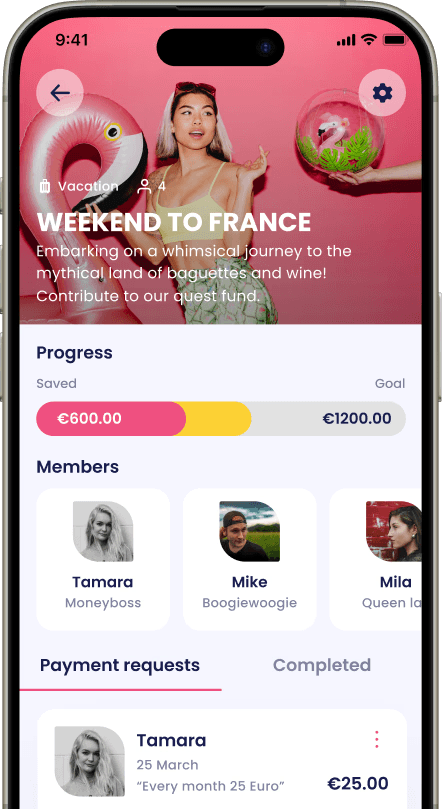
With Potje, groups form a centralized digital money pot where every participant contributes their fair share upfront. The cumulative balance is perfectly transparent to every single member, and Potje’s system tracks contributions automatically. The app handles automated smart reminders, meaning the organizer never has to act as a debt collector.
Next Step: Virtual Cards for Your Group Pot
To bridge the gap between shared funds and real-world checkout terminals, Potje is developing dedicated virtual VISA payment cards.
[Image diagram showing a group contributing to a Potje shared money pot which directly funds a single Virtual VISA card used via Apple Pay]
This forthcoming feature transforms the group transaction cycle:
The virtual card links directly to the collective pot balance, not a private bank account.
The card connects to Apple Pay or Google Pay for seamless physical or online transactions.
Every group member receives immediate clarity as funds are deducted directly from the shared pool.
Important Note: This specialized functionality is coming soon, with an official launch slated for Q3 2026. Currently, users can maximize the app's advanced pool saving features and securely reserve their place on the card release waitlist via the official Potje platform.
Practical Everyday Use Cases
A digital VISA card setup thrives across several practical scenarios:
Group Holidays and Travel: Pool your holiday funds into a shared pot. When your group lands, use an Apple Pay virtual card to cover group meals, activities, and transport out of the shared balance without messy cash splitting. Learn more about choosing a group card solution with real-time spending tracking.
Secure E-Commerce Purchases: Generate distinct digital card details dedicated solely to specific online subscriptions. If a platform suffers a data breach, delete that specific virtual card instantly without affecting your main account.
Roommate and Flatmate Expenses: Keep household grocery, utility, and maintenance spending entirely open and fair. Roommates tap the shared digital card at the local Albert Heijn, drawing from funds everyone contributed to at the start of the month.
Joint Financial Goals: For partners seeking a modern alternative to a joint savings account, pre-funding a digital pot offers transparency without the red tape of standard banks.
Risks, Misconceptions, and Digital Card Safety
Before completing your virtual VISA card sign up, make sure you understand these common industry misconceptions:
Misconception 1: “Virtual cards are strictly for online shopping.”
Reality: Historically true, but completely outdated. Modern virtual cards integrate perfectly with Apple Wallet, giving you full access to physical NFC contactless terminals globally.
Misconception 2: “As long as a card supports Apple Pay, the group experience will be perfect.”
Reality: Apple Pay is just the encryption and presentation layer at checkout. It does not control group tracking, upfront split math, or collective pool balances.
Misconception 3: “All virtual VISA cards offer identical security.”
Reality: Security depends on your provider's software. Look for platforms that let you dynamically adjust spending limits, block specific merchant categories, and delete or regenerate card numbers instantly.
FAQ Section
What is a virtual VISA card?
A virtual VISA card is a non-physical payment card that contains a unique 16-digit card number, CVV code, and expiration date. It resides completely within a digital banking application or smartphone wallet. It performs exactly like a physical debit or credit card, allowing you to complete e-commerce checkouts and execute contactless in-store payments.
Can I use a virtual VISA card with Apple Pay?
Yes, provided your card issuer officially supports Apple Wallet integration. During or after your virtual VISA card sign up, you can typically tap an "Add to Apple Wallet" button within your fintech app to enable instant smartphone payments at contactless retail terminals.
Are virtual VISA cards safe to use?
Virtual VISA cards are widely considered safer than traditional plastic cards. Because they are entirely digital, they cannot be physically stolen or cloned at an ATM. Advanced providers allow users to freeze their credentials instantly, modify daily transaction limits, or generate single-use burner numbers for untrusted online storefronts.
What should I check before completing a virtual VISA card sign up?
You should verify that the provider offers instant card deployment, native Apple Pay/Google Pay support, robust security controls (like instant freezing), and transparent fee schedules. Crucially, verify whether the card connects exclusively to an individual bank account or if it can link to a collaborative group fund.
What is Potje and when will its virtual card feature launch?
Potje is an innovative shared money app designed to help groups collect, manage, and save money transparently in one central place. Operating under the security standards of De Nederlandsche Bank (DNB), Potje is launching an advanced virtual VISA payment card in Q3 2026. This card will link directly to shared pots, allowing groups to spend together via Apple Pay without manual post-event tracking. Users can join the card waitlist today via the app.
The Card Itself Is No Longer the Differentiator
Sourcing a standard virtual VISA card has become a basic commodity; nearly any international digital bank can generate a set of random numbers on a screen. The real point of competition is how the capital behind those numbers is organized.
When your financial tools remain strictly individual, managing group activities will always be a source of administrative stress. But when you move to a shared money system, the entire experience becomes simple and transparent. Keep that shift in mind before you click sign up on your next digital card.

Social Accountability and Saving: The Missing Link to Financial Freedom
Ondersteuning voor verschillende inhoudstypes zoals artikelen, blogs, video's en meer. Rijke tekstverwerker met opmaakopties voor verbeterde.
17 november, 2025

Group Saving Apps Compared: What's Easiest, Safest, and Most Transparent?
Ondersteuning voor verschillende inhoudstypes zoals artikelen, blogs, video's en meer. Rijke tekstverwerker met opmaakopties voor verbeterde.
17 november, 2025

Group Money Platforms Compared: What’s Safe, Regulated, and Fair?
Ondersteuning voor verschillende inhoudstypes zoals artikelen, blogs, video's en meer. Rijke tekstverwerker met opmaakopties voor verbeterde.
17 november, 2025