9 June 2026



The best option ultimately depends on how your group manages money. At their core, a split app, a traditional joint bank account, and a digital money pot all solve completely different financial problems.
Split apps help groups calculate exactly who owes what after the spending happens.
Traditional joint accounts allow multiple committed people to access and spend shared funds over the long term.
A digital money pot beautifully combines shared upfront contributions, complete spending visibility, and collaborative group money management without the heavy commitment of a bank.
For most modern groups organising trips, events, gifts, and shared financial goals, a digital money pot offers the most flexibility, transparency, and peace of mind. Let’s explore each option in detail so you can choose the best financial tool for your group.
Why Group Money Has Become More Complicated
Managing money as a group used to be relatively straightforward. One person generously paid the bill, everyone handed them cash or sent their share via a quick bank transfer, and the problem was solved.
Today, group spending is far more frequent and complex. Friends, families, and colleagues regularly share costs for:
Group holidays and weekend getaways
Festival weekends and concert tickets
Sports team costs (pitch rentals, tournaments, equipment)
Birthday gifts and coworker farewell presents
Apartment expenses and roommate supplies
Shared digital subscriptions
Travel budgets and Airbnb bookings
The challenge is that most traditional money tools were designed either for single individuals or for married households. Friend groups operate entirely differently. People join and leave plans, budgets frequently change, and contributions happen gradually over weeks or months.
That is why many groups are now actively comparing digital money pots, traditional joint accounts, and split apps to find the best fit for their shared group finances.
What Is a Split App?
Apps like Wie Betaalt Wat and similar expense-sharing tools focus on one main, highly specific function: calculating repayments.
When you use a split app, the group logs every single expense during a trip or event. The app then acts as a ledger, doing the complex math at the end to determine exactly who owes whom, effectively simplifying reimbursements so that the fewest number of transactions are needed to settle all debts.
Best for:
Restaurant bills: Splitting the cost of dinner when everyone ordered different things.
Weekend trips: Logging expenses on the go when different people pay for gas, groceries, and drinks.
Shared taxis: Quickly dividing the cost of an Uber.
One-off casual expenses: When a friend spots you for a coffee or movie ticket.
The Challenges: The main limitation of a split app is that the spending happens first. The app only helps organise repayments afterwards. Someone in the group still needs to be willing to cover the cost upfront, which can be thousands of euros for a group holiday. Furthermore, it creates a dynamic where the person who paid becomes a "debt collector" chasing friends for money weeks after the event has ended.
What Is a Traditional Joint Account?
A traditional joint bank account gives multiple people equal access to a pool of shared money. Modern banking apps like Revolut have made creating joint accounts easier, allowing two people to merge their finances and track shared spending via a mobile app.
Best for:
Long-term shared finances: Married couples or long-term partners merging their incomes.
Ongoing household expenses: Paying monthly rent, mortgages, or utility bills.
Permanent financial arrangements: Where complete financial transparency between two parties is required daily.
The Challenges: While the advantage is simplicity for couples—money sits in one shared place and is used collectively—traditional joint accounts are often highly unsuitable for casual groups. They require formal identification, financial linking (which can impact credit scores in some countries), and are usually limited to just two people.
Many groups do not want a permanent shared financial arrangement just for a weekend away or a colleague's birthday collection. It is simply too much commitment for what is essentially a temporary shared expense. For these scenarios, groups need a flexible alternative to a standard joint bank account.
What Is a Digital Money Pot?
A digital money pot is built entirely around a shared goal. Instead of waiting until expenses happen and calculating repayments later (like a split app), contributors add money toward a shared purpose from the very beginning. Platforms like Collctiv allow for simple money collection, but a true digital money pot goes further by acting as a collaborative hub for your group’s budget.
Best for:
Group holiday funds: Collecting €50 a month from each friend to fund a summer trip.
Festival budgets: Securing the cash for VIP tickets before they sell out.
Team celebrations: Building a fund for the end-of-season sports gala.
Shared apartment costs: Roommates paying into a pot for groceries and cleaning supplies.
Group gifts: Coworkers anonymously chipping in for a maternity leave present.
Family savings goals: Relatives pooling money for an anniversary cruise.
A digital money pot helps groups organise money proactively rather than reactively. That crucial behavioural difference is exactly why digital money pots have become increasingly popular for modern social spending. You secure the bag first, eliminating the stress of collecting money later.
Comparing All Three Options: A Side-by-Side Breakdown
To make the best decision for your group, here is a clear summary of how these three financial tools stack up against each other:
1. Split Apps (e.g., Wie Betaalt Wat)
Best for: Calculating repayments, tracking individual expenses, and casual social spending.
How it works: Spend first, calculate later.
Biggest Advantage: Eliminates the need to do complex math to settle debts.
Biggest Challenge: Someone must front the money initially; repayments can be delayed or forgotten, leading to awkward conversations. Budget visibility is limited until the end.
2. Traditional Joint Accounts (e.g., Revolut Joint Accounts)
Best for: Long-term shared finances, ongoing household expenses, and permanent arrangements.
How it works: Both parties have full access to a single bank account and debit cards.
Biggest Advantage: Deep financial integration for couples.
Biggest Challenge: Far too much commitment for casual groups; usually restricted to two people; not designed specifically for temporary social spending or friend groups.
3. Digital Money Pots (e.g., Potje, Collctiv)
Best for: Group holidays, shared savings goals, team activities, event planning, and group gifts.
How it works: Collect money first, spend from the shared pool later.
Biggest Advantage: Money is collected before spending begins, meaning nobody has to front the cost. Shared goals remain completely visible, resulting in zero repayment stress.
Biggest Challenge: Requires the group to plan and contribute ahead of time rather than spontaneously spending.
For many modern groups, the digital money pot creates a significantly smoother, stress-free experience.
Why More Groups Are Choosing Digital Money Pots
Most group money problems happen because the organisation starts far too late.
People spend first. Then they try to figure everything out afterwards. That reactive approach creates a perfect storm of financial friction:
Forgotten repayments: People genuinely forget to transfer the money.
Budget uncertainty: Nobody knows exactly how much the trip is going to cost until it's over.
Confusion: Receipts get lost, and WhatsApp chats get cluttered with payment links.
Awkward conversations: The dreaded "Hey, can you please send me your share?" text.
Digital money pots completely flip this process. Groups organise their money before the spending begins. By requiring upfront contributions, a digital money pot helps everyone understand:
The total available budget
The specific financial goal
Who has made their contributions (and who hasn't)
The remaining available balance
That transparency and upfront visibility create much less friction, allowing the group to actually enjoy the event or holiday without worrying about money.
Why Potje Takes the Digital Money Pot Further
While many platforms help you easily collect money, Potje was built to help groups actively manage money together.
Potje operates as a modern joint money account designed specifically around shared experiences, blending the best parts of a money pot and a shared bank account, while remaining flexible for groups of any size.
Instead of focusing only on collecting one-off payments, Potje allows groups to:
Create dedicated shared money pots for any custom goal.
Invite contributors via a simple, shareable link.
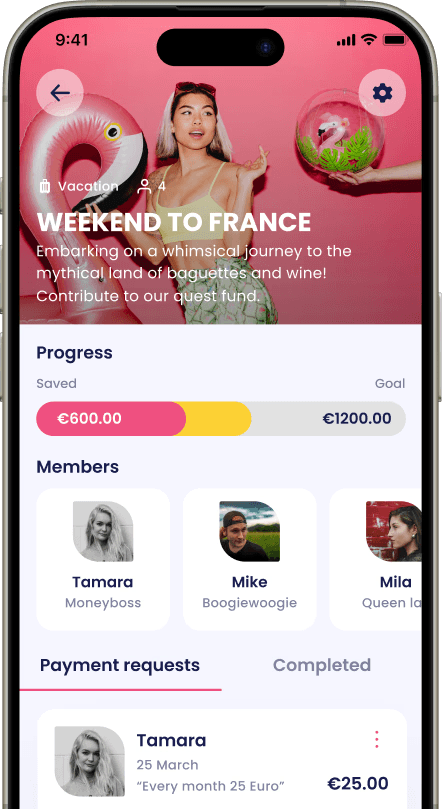
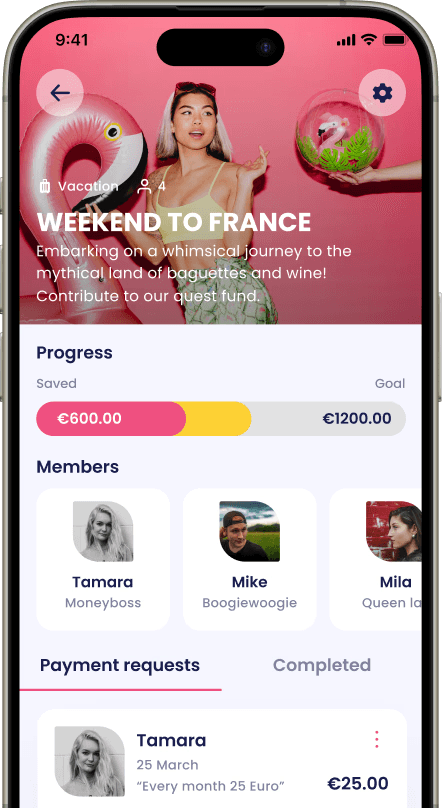
Track visual progress toward the group's financial targets.
Organise group spending with complete transparency.
Coordinate recurring contributions for ongoing expenses.
Use automated payment reminders so the organiser never has to awkwardly chase anyone for cash.
This comprehensive approach makes Potje particularly useful for:
Group holidays: Friends contribute monthly over time rather than scrambling for massive repayments after the trip begins.
Group gifts: Everyone contributes into one shared pot seamlessly, and the organiser can focus their energy on choosing the perfect gift instead of auditing spreadsheets.
Sports teams: Teams can securely collect money for equipment, tournaments, travel, and social events throughout the entire season.
Shared living arrangements: Housemates can organise recurring shared expenses—like internet bills and communal groceries—without relying on messy group chats.
The goal is remarkably simple. Instead of asking: "Who still owes money?" Groups can finally focus on: "Are we ready for the experience?"
Potje's unique joint money account structure was intentionally designed around how people naturally organise money today: collaboratively, socially, and focused around shared goals rather than sterile banking transactions. Furthermore, Potje is highly secure, as funds are supervised in compliance with strict Dutch and European financial regulations (De Nederlandsche Bank), ensuring your group's money is always safe.
Common Misconceptions About Group Money Apps
"Split apps and digital money pots do the exact same thing." Not exactly. Split apps focus entirely on calculating repayments after the spending occurs. Digital money pots help groups collect, pool, and organise money before the spending happens. One is reactive; the other is proactive.
"Joint bank accounts are always the best option for shared money." Not for every group. While excellent for married couples, many friend groups need flexibility rather than permanence. A short weekend trip, a festival budget, or a birthday collection rarely justifies the heavy administration of opening a formal, long-term shared banking arrangement.
"Digital money pots are only for large groups." This is a common myth. Many digital money pots are used efficiently by small groups of three or four people. Whether you are three friends splitting an Airbnb or twenty coworkers buying a gift, any shared financial goal can massively benefit from organised, transparent contributions.
Coming Soon: Apple Pay Spending From Your Joint Money Account
To make group spending even more seamless, Potje is developing virtual VISA debit cards that connect directly to your shared money pots. These highly anticipated cards will fully support Apple Pay and Google Pay, and can be used globally anywhere VISA is accepted.
This massive feature upgrade will allow groups to:
Save together securely
Organise money together transparently
Spend directly from shared balances (no more transferring to a personal account first!)
Track group spending dynamically and automatically
While this feature has not launched just yet, it represents the future of group finances. Join the waitlist here: https://www.potje.app
FAQ Section
What is the difference between a digital money pot and a split app?
A split app (like Wie Betaalt Wat) focuses on calculating repayments and settling debts after the spending occurs. A digital money pot (like Potje) helps groups collect and organise money before the spending begins. This proactive approach creates better budgeting, clearer contribution tracking, and absolutely no repayment stress.
When should a group use a traditional joint account?
Traditional joint accounts (like Revolut Joint Accounts) are most useful for long-term shared financial arrangements, such as families, married couples, or households with ongoing, permanent expenses. For temporary groups, friend trips, one-off events, or shared social goals, many people prefer more flexible, lower-commitment alternatives like a digital money pot.
Why are digital money pots becoming more popular?
Modern groups increasingly want better visibility and organisation around their shared money. Rather than relying on one person to front the cash and awkwardly manage repayments, digital money pots allow contributors to work toward a shared goal together from the beginning, entirely removing the friction of debt collection.
What is Potje?
Potje is a modern digital money pot and joint money account that helps groups effortlessly organise, collect, and manage money together. Users can create shared money pots for holidays, gifts, sports teams, events, and family goals while keeping all contributions and progress clearly organised in one secure place.
Will Potje support Apple Pay?
Yes. Potje's upcoming virtual VISA debit cards are expected to fully support both Apple Pay and Google Pay. Groups will soon be able to spend directly from their shared digital balances in stores and online, while maintaining complete, real-time visibility over all group spending.
Key Takeaways
There is no single financial solution that fits absolutely every group.
Split apps are excellent for doing the math on repayments after a casual night out.
Traditional joint accounts work best for long-term shared finances between couples.
Digital money pots are rapidly becoming the preferred option for groups that want to proactively collect, organise, and manage money together around a shared goal.
For holidays, events, gifts, teams, and shared experiences, a digital money pot creates the most organised, transparent, and collaborative financial experience.
Start your digital money pot with Potje today and take the stress out of group spending: https://www.potje.tech/en/
If you're saving up as a group for a trip, event, or gift, Potje makes it easy to collect money into one shared digital pot instead of chasing people for their share. Start a pot through this link and get your first month free. After that it's €5 a month per pot, taken straight from the pot balance, so there's nothing to pay upfront to start saving together.

Social Accountability and Saving: The Missing Link to Financial Freedom
Ondersteuning voor verschillende inhoudstypes zoals artikelen, blogs, video's en meer. Rijke tekstverwerker met opmaakopties voor verbeterde.
17 november, 2025

Group Saving Apps Compared: What's Easiest, Safest, and Most Transparent?
Ondersteuning voor verschillende inhoudstypes zoals artikelen, blogs, video's en meer. Rijke tekstverwerker met opmaakopties voor verbeterde.
17 november, 2025

Group Money Platforms Compared: What’s Safe, Regulated, and Fair?
Ondersteuning voor verschillende inhoudstypes zoals artikelen, blogs, video's en meer. Rijke tekstverwerker met opmaakopties voor verbeterde.
17 november, 2025
