30 October 2026



Every group has different ideas of what makes a trip special. For some, it’s a five-star hotel; for others, it’s finding a place that feels right without stretching the budget. Being mindful of everyone’s comfort and budget helps make sure everyone can enjoy the experience.
Mixed budgets are normal. What's not normal is talking about them openly before anyone books anything. Most groups skip that conversation entirely, and then spend the whole trip doing the awkward dance of who pays for what.
Here's the short answer: agree the budget before you book, and split shared costs in a way the whole group accepts upfront. Then collect everyone's share into a shared Potje pot before anything is booked. Do that, and fairness mostly takes care of itself.
The rest of this guide shows you exactly how.
Key takeaway: The money conversation needs to happen before flights, hotels or anything else is booked. Not on day two when someone orders the expensive wine. Before.
How to Raise Budget Differences Without Anyone Feeling Singled Out
The reason this conversation feels awkward is that most people frame it wrong. Asking "how much do you want to spend?" forces someone to name a number and feel judged for it.
There's a much easier way.
Use budget brackets, not direct questions
Instead of asking individuals to state what they can afford, present three options to the whole group at once. Something like:
Lean trip: €250-400 per person all-in
Comfortable trip: €400-700 per person
Generous trip: €700+ per person
Ask everyone to privately message the organiser which bracket works for them. If the group clusters around one range, you have your number. If there's a wide spread, you know early, not halfway through the booking process.
This approach is group-level, not individual. Nobody is singled out. Nobody has to explain their salary.
Frame it as planning, not prying
The way you open the conversation matters. A simple message in the group chat works well:
"Quick money question before we book anything: rough budget per person? I'll share three options privately so we can find what works for everyone."
That's it. No spreadsheet, no interrogation. Just a two-minute check-in that prevents a week of tension.
The real problem isn't that budgets differ. It's that groups find out too late. YouGov's UK travel research found that 71% of British holidaymakers find at least one part of the booking process stressful. Add a group with different budgets to the mix, and skipping the money conversation only makes it harder.
Raise the conversation early and it stays practical. Raise it after someone's already booked a suite, and it becomes personal.
Four Ways to Split Group Trip Costs: Compared
Once the group has agreed a rough budget, the next decision is how to split costs. There's no single right answer. The method that works depends on how well you know each other, how different your budgets are, and how much admin you're willing to do.
Here's how the four main approaches compare:
Method | How it works | Best for | Budget flexibility | Admin effort |
Equal shared core | All shared costs (accommodation, transport, group activities) split equally | Groups with similar budgets | Low | Low |
Tiered room prices | Everyone pays a base rate; those who want upgrades pay the difference | Mixed budgets, different room preferences | Medium | Medium |
Opt-in extras | Core trip is fixed; pricier activities are optional and paid individually | Any group size | High | Low |
Pay by usage | Track everything individually; settle up at the end | Groups with very different spending habits | High | High |
Which method is actually fairest?
For most European friend groups, a hybrid approach works best: split fixed costs equally (the Airbnb, the train, the group dinner on night one), and let personal spending be individual from there.
The equal shared core is the simplest and creates the least friction. Everyone pays the same for the things everyone uses. Nobody is subsidising someone else's upgrade.
Tiered room prices make sense when accommodation costs vary significantly. If three friends want the double room and two are fine with the bunk beds, price accordingly. Agree the tiers before booking, not after.
Opt-in extras are the most flexible. Set a core trip cost that everyone can afford, then let the group decide individually on the €80 wine tour or the spa day. Nobody misses out on the trip because of one expensive activity.
Pay by usage is the most precise but the most exhausting. It works for small groups who are comfortable with detailed tracking, but it can make a holiday feel like an accounting exercise.
The rule that makes any method work: decide before you leave, not during the trip. The method matters less than the agreement.
A Worked Example: Six Friends, Three Different Budgets
Let's make this concrete. Here's how a real group might handle a four-night trip to Lisbon with mixed budgets.
The group: six friends. Two are students, two are in early careers, two have more disposable income.
The agreed approach: equal shared core, tiered rooms, opt-in extras.
Step 1: Agree the core costs
The group agrees on the following shared costs, split equally six ways:
Airbnb (whole apartment, 4 nights): €720 total, €120 per person
Return flights (booked together): €480 total, €80 per person
Group welcome dinner: €180 total, €30 per person
Airport transfers (both ways): €120 total, €20 per person
Core cost per person: €250
This is the number everyone commits to before booking. The students can afford it. The higher earners are happy with it. Nobody is asked to stretch beyond what they agreed.
Step 2: Tiered rooms
The Airbnb has one large en-suite double, one standard double, a single room and a sofa bed. Rather than splitting the accommodation equally, the group prices by room:
En-suite room (2 people): +€10 each per night
Standard double and single room (3 people): no adjustment
Sofa bed (1 person): -€20 per night
The two friends who want the en-suite pay the difference. The friend on the sofa bed pays less. The extra €80 from the en-suite covers the €80 sofa bed discount, so the total stays at €720. Everyone agrees before booking.
Step 3: Opt-in extras
The group plans three optional activities:
Sintra day trip (€45 per person): four friends join
Fado dinner experience (€65 per person): three friends join
Surf lesson (€55 per person): two friends join
Nobody is pressured to join everything. Nobody feels guilty for skipping. Each person pays only for what they actually do.
The result
The two students end up spending around €250 core + €45 Sintra day trip = €295 total.
The higher earners who joined everything spent around €250 + €45 + €65 + €55 = €415 total, plus the en-suite supplement.
Everyone went on the same trip. Nobody felt financially stretched. Nobody felt like they were subsidising someone else's holiday.
That's what a fair trip looks like in practice.
The same logic applies when it comes to collecting money for a group trip without the awkward chasing: agree the number first, then collect it before anything gets booked.
Collect the Agreed Amount Into a Pot Before You Book
Here's where most groups fall apart. They agree on the budget, feel good about the plan, and then one person books the Airbnb on their card and spends the next three weeks chasing everyone for their share.
There's a better way.
Collect the agreed core amount before anyone books anything.
When the money is in a shared pot before the booking happens, the organiser isn't fronting their own cash. Nobody owes anyone anything mid-trip. The group reaches its goal together, then the spending begins.
This is exactly what Potje is built for.
How a shared money pot works for group trips
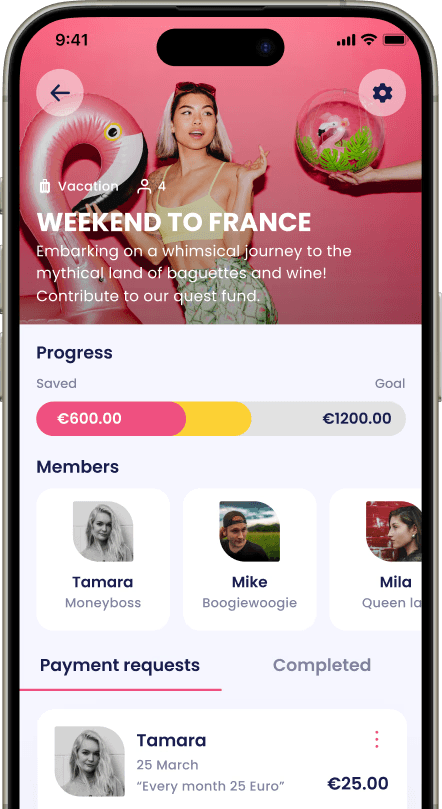
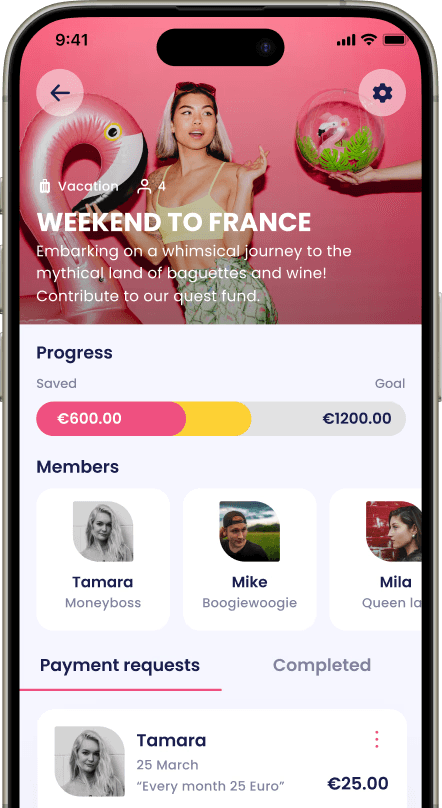
One person creates a money pot and sets the goal, for example €250 per person for the Lisbon trip. They share the link with the group. Everyone contributes their share directly into the pot before the flights or accommodation are booked.
No one person carries the financial risk. No manual chasing. No awkward "did you send it yet?" messages.
Once the pot reaches its goal, the organiser can pay out the money to cover the shared bookings. And if the group decides to split extras on the go, those can be handled individually without touching the core pot.
A few things worth knowing about Potje:
Your first month is free, so you can set up a trip pot with zero upfront cost
You can make instant payouts of any amount, whenever the group is ready to book
There are no fees on partial payouts, so you can release funds in stages as bookings are confirmed
The pot also gives everyone visibility. Every member can see the progress towards the goal. No spreadsheet. No chasing. Just a shared number that everyone is working towards.
If you want a step-by-step walkthrough, the Potje blog covers exactly how to set up a group money pot from scratch, including how to share the link and track contributions in real time.
Why collecting upfront changes the dynamic
When everyone contributes before the trip, the relationship to the money changes.
Old way: one person books everything, others promise to pay back. Someone forgets. Someone pays late. The organiser ends up keeping score for weeks.
New way: everyone contributes first. The group reaches its goal together. Then the money gets spent.
It's a small shift in sequence. The difference it makes to the group dynamic is significant. Research on payment dynamics in shared experiences found that how a group handles money before and during a shared activity directly affects how happy everyone feels about it. When the financial obligation is settled upfront, the experience itself is no longer shadowed by who owes what.
The same principles behind splitting holiday costs with friends without arguments apply here: clarity upfront removes almost all of the friction.
FAQ
Is it fair to split everything equally when budgets are different?
For shared costs like accommodation and group transport, equal splits are generally fair because everyone benefits the same. For personal spending such as individual meals, drinks, or optional activities, equal splits can feel unfair when one person orders more than another. The practical solution is to agree a shared core that everyone splits equally, and let personal spending be individual from there.
What if someone can't afford the agreed budget?
Raise it early, not after booking. If someone privately signals they're outside the budget bracket, the group can either adjust the core cost downward or find alternatives for specific line items. Optional activities are the easiest lever: make expensive extras opt-in so nobody has to decline the whole trip because of one pricey afternoon.
Should the person who organises the trip pay less?
Not necessarily, but it's a fair question. Organising a group trip takes real effort. Some groups offer the organiser a small discount, others simply rotate who organises each trip. Whatever the group decides, agree it upfront rather than assuming.
How do we handle it if someone cancels?
Agree a cancellation policy before anyone books. A simple rule: the person who cancels is responsible for their share of any non-refundable costs. If the group has collected money into a shared pot before booking, this is easier to manage because the funds are already separated from personal accounts.
Is it awkward to talk about money before a trip?
Less awkward than talking about it during one. A two-minute group chat message two to three weeks before departure is all it takes. Frame it as logistics, not a financial interrogation. Something like: "Quick budget check before we book anything. Three options below, let me know which works for you."
What's the easiest way to collect shared trip money without chasing people?
Set up a shared money pot before you book anything. Everyone contributes their agreed share upfront, the organiser can see progress in real time, and there's no need to front costs personally or chase repayments afterwards. Potje lets you do this with instant payouts and no fees on partial withdrawals, and your first month is free.
How do we split costs fairly for a group holiday in Europe?
The most practical approach for European group travel is: split fixed shared costs equally (flights, accommodation, group transport), use tiered pricing for rooms if the property has different room types, and make activities opt-in so nobody pays for experiences they didn't join. Agree all of this before booking and collect the core amount into a shared pot so the organiser isn't carrying the financial risk alone.
Plan Together, Travel Better
The trips that fall apart over money almost never fall apart because of the money itself. They fall apart because nobody agreed on anything before the booking was made.
Agree the budget first. Choose a splitting method the whole group accepts. Collect the shared amount before anyone books. Let personal spending be personal.
That's the whole framework. It's not complicated. It just requires one honest conversation at the start.
Ready to set up your group trip pot? Potje makes it easy to collect the agreed amount from everyone before you book, with instant payouts, no fees on partial withdrawals, and your first month completely free: Start your trip pot on Potje

Social Accountability and Saving: The Missing Link to Financial Freedom
Ondersteuning voor verschillende inhoudstypes zoals artikelen, blogs, video's en meer. Rijke tekstverwerker met opmaakopties voor verbeterde.
17 november, 2025

Group Saving Apps Compared: What's Easiest, Safest, and Most Transparent?
Ondersteuning voor verschillende inhoudstypes zoals artikelen, blogs, video's en meer. Rijke tekstverwerker met opmaakopties voor verbeterde.
17 november, 2025

Group Money Platforms Compared: What’s Safe, Regulated, and Fair?
Ondersteuning voor verschillende inhoudstypes zoals artikelen, blogs, video's en meer. Rijke tekstverwerker met opmaakopties voor verbeterde.
17 november, 2025