9 November 2026



Renting a holiday home with friends for New Year's Eve sounds simple until you actually try to do it.
The property you had in mind is already gone. The one still available costs twice what it did in October. The host wants a five-night minimum and full payment upfront. And you have not even started the group chat yet.
This guide covers when to book, how much prices actually jump, how to split the costs fairly, and what to do if someone drops out in December.
Key takeaway: The groups that have the best New Year's Eve sort the money out first. Not after the booking. Before it.
Why New Year's Eve Is a Different Beast
Most group holidays involve a bit of price comparison, a WhatsApp poll, and a booking. New Year's Eve is different. It has a set of structural problems that make it genuinely harder to organise than any other time of year.
Prices jump by 35 to 55 per cent overnight
Short-term rental rates across Europe surge dramatically around New Year's Eve. Data from D/AI Destinations covering 25 European capitals shows prices up nearly 8 per cent year-on-year for NYE 2024, with Madrid seeing a 43 per cent increase and London averaging £386 per night. The NYE window typically runs 35 to 55 per cent above the standard winter baseline.
On a €1,500 property, that is an extra €525 to €825 simply because the date ends in a zero.
Hosts impose minimum stay requirements
Most groups do not anticipate this. For popular holiday homes during NYE week, hosts routinely set minimums of five to seven nights, so you cannot just book 31 December and 1 January. A property at €200 per night suddenly requires a seven-night commitment: €1,400 total, or €175 each for a group of eight before any extras.
Smaller urban apartments often allow two to three nights, but larger countryside homes almost always require longer stays.
The best properties book out two to three months ahead
Holiday rental pricing guidance from Houfy suggests that New Year's Eve properties typically book out two to three months in advance. For ski chalets and large rural homes, that window can stretch to four or five months. The hosts who price well know this, and they hold their rates firm because the bookings come in early regardless.
By the time your group gets serious about it in November or December, the best options are gone.
When Should You Book a New Year's Eve Holiday Home?
September or October, at the latest. AirDNA's European market analysis found that demand for stays from 31 December to 2 January was up 8.6 per cent year-on-year for New Year's 2025, partly because New Year's Day fell on a Thursday and made a long weekend easy. This year New Year's Day falls on a Friday, so expect the same long-weekend rush.
Here is a practical timeline:
Month | What to do |
September | Agree on a destination and rough budget. Start browsing to understand pricing. |
October | Finalise the property shortlist. Confirm who is definitely in. Start collecting money. |
November | Book the property. All contributions should be collected or committed before this point. |
December | Handle extras: food, fireworks, activities. Chase any outstanding contributions. |
Why October is the real deadline
Wait until November and you are competing for leftovers at peak prices. Already November? You can still find a good property: widen the search to smaller towns, be flexible on the number of nights, and collect the money now so you can book as soon as the right place appears. You also need time to collect money from the group before you can book, and that process takes longer than people expect.
How to Split the Cost of the Holiday Home
Splitting the rental itself is usually the straightforward part. The total cost divided by the number of people. The complications come from the extras, the people who join late, and the ones who want a cheaper room.
Equal split or room-based split?
For most groups, an equal split is simplest. Everyone pays the same regardless of room.
A room-based split makes sense when there is a genuine quality difference, such as a master suite versus a twin with a shared bathroom. Assign a value to each room and split accordingly. Either way, agree before anyone claims a room, not after.
Collect the money before you book
This is the single most important thing your group can do. Do not let one person pay for the property and then spend the next month chasing everyone else for transfers.
Collect the money first. Book once the pot is full.
This approach protects the organiser from fronting a large sum personally. It also creates genuine commitment from everyone in the group. When people have already paid in, they do not drop out. When they have not paid yet, they might. That is why it pays to collect before you book, and our guide on how to collect money before booking an Airbnb with friends walks through a step-by-step approach that works even with the most disorganised groups.
Splitting the Extras: Fireworks, Food, and Drinks
The rental cost is only part of the budget. New Year's Eve always comes with extras, and those extras add up faster than anyone budgets for.
What to budget for beyond the rental
A realistic extras budget for a group of eight to ten people might look like this:
Extra | Estimated cost | Per person (10 people) |
Food shopping (3 days) | €300 to €500 | €30 to €50 |
Drinks and alcohol | €200 to €400 | €20 to €40 |
Fireworks (if permitted) | €100 to €200 | €10 to €20 |
New Year's Eve dinner | €150 to €300 | €15 to €30 |
Activities or day trips | €100 to €200 | €10 to €20 |
Total extras | €850 to €1,600 | €85 to €160 |
That is a meaningful addition on top of the rental itself. A group that budgets only for the property cost and then tries to split extras on the night will end up with confusion, uneven contributions, and someone feeling hard done by.
How to handle extras fairly
Agree on a shared extras budget upfront and collect it alongside the rental. The simplest approach: everyone contributes a fixed amount (say €100 each) into a shared pot for food, drinks, and activities. The organiser spends from the pot. Any leftover comes back to the group. Nobody has to remember who bought what.
Fireworks: check local rules first
Fireworks regulations vary significantly across Europe. In the Netherlands, a national ban on consumer fireworks applies from New Year's Eve 2026/27, so only small F1 items such as sparklers are allowed. In Germany, they are restricted to certain areas in many cities. In Belgium, some municipalities ban them entirely in residential areas.
Before budgeting for fireworks, check the rules for your specific destination. The last thing you want is to arrive with a boot full of fireworks and discover they are not permitted.
Agreeing Who Brings What
The group chat approach never works. Someone brings three bottles of wine, nobody brings the cheese, and nobody thought about breakfast for ten people on New Year's Day.
Assign a lead person to each category before anyone packs: food shopping, drinks, fireworks, entertainment, and practical items. Create a shared note, ask each person to claim one category, and review it at least two weeks before the trip.
Pro tip: One or two people doing a large supermarket run on arrival day, paid from the shared extras pot, beats everyone transporting groceries from home. Fewer duplicates, less stress.
Set a per-head food and drink budget before anyone shops. If someone wants to upgrade to nicer wine, that comes out of their own pocket, not the group pot.
What Happens If Someone Drops Out in December?
It happens. Every group has that person who confirms in September, goes quiet in November, and sends a "really sorry, something came up" message on 15 December.
The question is not whether someone might drop out. It is whether your group has a plan for when they do.
The problem with waiting until December
By December, the property is booked and paid for. The host is not refunding you because one person changed their mind. The remaining group absorbs the shortfall or finds a replacement.
This is why collecting money before the booking changes everything. When someone has already paid into a shared pot, dropping out is a different conversation. The money is there. The group decides whether to refund them, ask them to find a replacement, or keep the contribution. When nobody has paid yet and the organiser fronted the cost personally, they are now chasing someone who has already left.
How to protect the group
Set clear terms before anyone books:
Contributions are non-refundable after the booking is confirmed
Anyone who drops out is responsible for finding their own replacement
If a replacement is found, the original person gets their money back from the new person, not from the pot
Put this in the group chat, in writing, before money changes hands. It sounds formal, but it prevents a genuinely unpleasant situation in December.
What if you cannot fill the spot?
Two options: share the shortfall equally across the remaining group (on a €2,500 property split between ten, losing one person costs each of the nine remaining just €27.78), or explore whether the host will allow a booking change.
The most important thing: have this conversation before it happens. Groups that agree the rules in advance handle dropouts without drama.
How Potje Makes Group Money Simple
The tool built for exactly this problem is Potje.
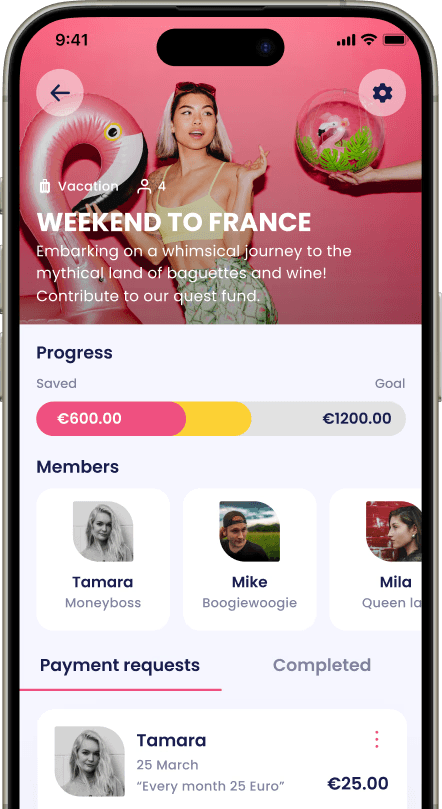
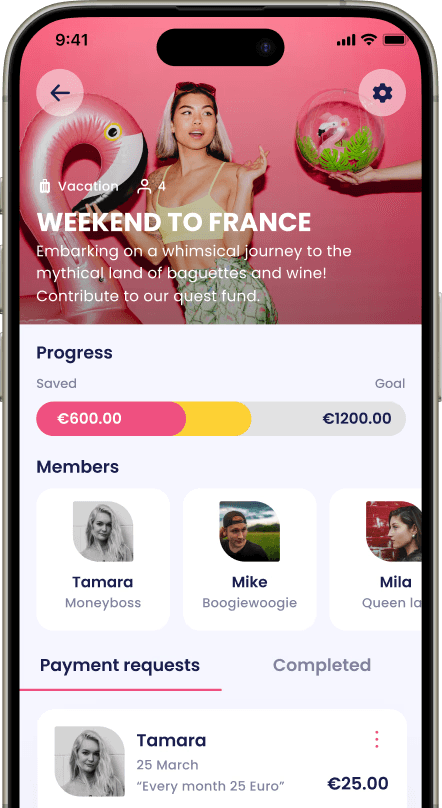
Rather than tracking who owes what after the fact, Potje is built around collecting money before anything gets spent. Groups create a shared money pot, set a goal, and share a payment link. Everyone contributes from their own bank account. The organiser sees progress in real time and pays out when the pot is ready.
For a NYE holiday home: one pot for the rental, a second for extras. No one person fronts the money.
What makes Potje different
Your first month is free. No cost to get started, so you can set up the pot and start collecting straight away.
Instant payouts of any amount. When the pot is ready, you can pay out immediately. No waiting, no minimum threshold.
No fee on partial payouts. If you need to pay out part of the pot while still collecting the rest, there is no penalty for doing so.
The cost is shared. Potje costs €5.00 per month in total, split automatically across the group. With ten people, that is €0.50 each per month.
Old way: one person books, everyone promises to pay back, someone forgets, the organiser spends December chasing. New way: everyone contributes first, the pot fills up, the organiser books. No chasing. No one person carrying the burden alone.
Start your New Year's Eve money pot on Potje
Frequently Asked Questions
How far in advance should I book a holiday home for New Year's Eve?
September or October. NYE properties book out two to three months in advance, with ski chalets and large rural homes going even earlier. Waiting until November means competing for what is left, at peak prices.
How much more expensive is a holiday home on New Year's Eve?
Short-term rental prices across Europe typically run 35 to 55 per cent above the standard winter baseline for the New Year's Eve period. In some cities, the increase is even steeper: Madrid saw a 43 per cent year-on-year increase in NYE rental prices in 2024, while London averaged £386 per night for short-term rentals.
What is a typical minimum stay for a New Year's Eve rental?
Minimum stay requirements vary by property type. Larger homes and ski chalets typically require five to seven nights, often running Saturday to Saturday across the Christmas and New Year's week. Smaller urban apartments may allow two to three nights. Always check the minimum stay before shortlisting a property.
How should a group of friends split the cost of a holiday home?
The simplest approach is an equal split: the total cost divided by the number of people. A room-based split works when there is a meaningful quality difference between rooms. Whichever method you choose, agree on it before anyone claims a room, and collect the money before the booking is made.
What is the best way to collect money from friends for a group holiday?
Use a shared money pot. Potje lets groups set a goal, share a payment link, and collect contributions before any booking is made. It protects the organiser and creates real commitment from the group.
What happens if someone drops out of the holiday after the booking is confirmed?
Agree in advance that contributions are non-refundable after booking, and that anyone who drops out is responsible for finding their own replacement. If no replacement is found, the remaining group shares the shortfall equally.
Can I do a partial payout from a group money pot?
With Potje, yes. You can pay out any amount at any time, with no fee on partial payouts. This is useful if you need to pay a rental deposit before the full pot is collected, or if you want to pay for extras separately from the main rental cost.
How much should we budget for extras on a New Year's Eve group holiday?
A realistic extras budget for a group of eight to ten people is €85 to €160 per person, covering food, drinks, fireworks, and activities over a three to five day stay. Agree on a per-person budget before the trip and collect it alongside the rental contribution to avoid on-the-night confusion.
Start Planning Now
New Year's Eve in a holiday home with friends is one of the best ways to see in the new year. It is also one of the most logistically demanding group trips you will plan all year.
The groups that pull it off without drama start early, agree on the money upfront, and collect contributions before anyone books anything.
Quick checklist:
Destination and rough budget agreed by September
Confirm who is definitely in before browsing properties
Shared money pot open and collecting by October
Book once the rental pot is full
Second pot for extras, collected separately
Dropout policy agreed in writing before anyone pays in
Responsibilities assigned at least two weeks before the trip
Sort the money first. Enjoy the rest.
Start your New Year's Eve money pot with Potje. Your first month is free.

Social Accountability and Saving: The Missing Link to Financial Freedom
Ondersteuning voor verschillende inhoudstypes zoals artikelen, blogs, video's en meer. Rijke tekstverwerker met opmaakopties voor verbeterde.
17 november, 2025

Group Saving Apps Compared: What's Easiest, Safest, and Most Transparent?
Ondersteuning voor verschillende inhoudstypes zoals artikelen, blogs, video's en meer. Rijke tekstverwerker met opmaakopties voor verbeterde.
17 november, 2025

Group Money Platforms Compared: What’s Safe, Regulated, and Fair?
Ondersteuning voor verschillende inhoudstypes zoals artikelen, blogs, video's en meer. Rijke tekstverwerker met opmaakopties voor verbeterde.
17 november, 2025