10 June 2026



If you're always paying first, the problem is probably the system.
If you constantly find yourself being the one who fronts the money for group trips, dinners, weekend festivals, coworker gifts, and shared plans, the core issue usually isn't that your friends are taking advantage of you. The real issue is the outdated way your group manages money.
Most social groups still rely on a highly flawed system: one person pays the upfront costs first and attempts to collect the reimbursements later. A significantly better, stress-free approach is organising contributions before the spending happens, so the financial responsibility and the risk are equally shared from the very start.
Every Friend Group Has "That Person"
You know exactly who they are. In fact, if you are reading this, there is a very high chance you are that person.
The designated planner is usually the individual who:
Books the expensive Airbnb for the summer holiday
Secures the early-bird festival tickets before they sell out
Pays the massive bill for the group dinner
Covers the late-night taxi ride home
Organises and purchases the surprise birthday gift
And somehow, that person is usually the exact same person, every single time.
At first, it feels harmless. You step up because you want the plan to happen, and you know everyone will pay you back eventually. But after a while, things start to get deeply frustrating. Not because your friends are bad people or intentionally avoiding their debts, but because you are solely carrying all the administrative and financial responsibility.
Without realising it, you slowly become:
The group's unpaid travel agent
The unofficial treasurer
The awkward reminder machine
The repayment tracker
When this happens, the fun part of the shared experience completely disappears behind a wall of financial administration. You want to stop being the friend who manages the spreadsheet, but you don't know how to change the group dynamic.
Why Group Spending Creates This Problem
Most groups follow the exact same reactive process when it comes to shared expenses.
Step One: Someone generously volunteers (or is forced) to pay the upfront cost.
Step Two: Everyone casually promises to send their share of the money later.
Step Three: Utter chaos begins.
People genuinely forget. Payment links and bank details get buried under hundreds of messages in the group chat. Someone accidentally pays the wrong amount. Another friend promises they will send the transfer "tomorrow when they get paid," but tomorrow never seems to arrive.
The issue isn't the people involved; it is the process itself.
The traditional system relies entirely on one person having enough liquid cash or credit limit available to cover everyone else. That creates an immense amount of unnecessary pressure. Especially when you are organising large-scale events like:
Group holidays and international flights
Bachelor or bachelorette weekends
Multi-day music festivals
Shared apartment furnishings
Amateur sports team tournaments
The larger the shared expense, the larger the financial problem becomes for the person fronting the money.
The Hidden Cost of Always Fronting the Money
Most people only focus on the surface-level issue: getting fully reimbursed. However, the much bigger, hidden issue is cash flow and financial risk.
Let's say you are organising a weekend trip for eight friends. You use your own bank account to pay for the accommodation, group activities, and transport deposits. Even if everyone eventually pays their exact share two weeks later, you are temporarily carrying the entire cost of eight people.
For the organiser, that heavy burden means:
Less flexibility with your own money: Your funds are tied up in group debt, meaning you can't use your own money for personal expenses or emergencies.
More financial risk: If someone drops out at the last minute or takes months to pay, you absorb the financial hit.
More admin work: You are forced to spend your evenings cross-referencing bank statements with WhatsApp messages.
More emotional stress: Chasing friends for money often leads to deep resentment and awkward social interactions.
Over time, many natural organisers simply stop volunteering to plan things. Not because they no longer enjoy planning, but because they desperately want to stop being the friend who acts as the group's unofficial, unpaid finance department.
Why Repayment Apps Only Solve Part of the Problem
When the frustration of fronting the money peaks, most groups turn to popular expense-sharing apps like Splitwise. These apps are undeniably useful for basic math.
They help groups brilliantly calculate:
Exactly who owes money to whom
How much each individual person should pay
Outstanding balances across multiple different expenses
But the core issue still exists: someone still has to pay first.
The app simply helps manage the messy reimbursements afterwards. The heavy financial burden and the cash flow problem remain entirely concentrated on the one person who fronted the money. While this system works reasonably well for small, casual expenses like a round of drinks, it becomes much less practical when:
Travel and accommodation costs rapidly increase
Friend groups become larger and more complex
Shared expenses happen regularly (like in a shared student house)
The bigger the shared expense, the more critical it becomes to organise the money before the spending ever starts.
Why Payment Requests and Bank Transfers Are Not Enough
Similarly, standard banking features and quick payment platforms like Tikkie or Revolut make it incredibly easy to send a payment request. That certainly helps speed up the process.
But a payment request still fundamentally begins with somebody paying the upfront cost first. Even with lightning-fast banking apps, you are still:
Covering the massive initial expense from your personal balance
Waiting anxiously for individual transfers to arrive
Tracking exactly who has paid and who hasn't
Following up with people who ignored the first notification
The technology is certainly faster, but the flawed process remains largely exactly the same. You are still the one holding the bag.
A Smarter Approach: Collect First, Spend Later
The absolute easiest way to stop fronting the money for your group is conceptually very simple: stop making the actual spending the first step.
Instead, make contributions the first step. When groups pool their money and contribute before any spending happens, the entire dynamic shifts.
Budgets become crystal clear: You only book what you can actually afford as a group.
Risk becomes shared: Nobody is left carrying the full cost if plans change.
Accountability increases: The group becomes more financially committed to the plan.
Resentment disappears: You never have to send an awkward "you owe me" text again.
This proactive approach is exactly why utilizing a digital money pot has become increasingly popular. The money is securely organised before any major financial decisions are made, not afterwards.
Why Potje's Joint Money Account Changes the Dynamic
Potje approaches the concept of group spending entirely differently. Rather than focusing primarily on settling debts and chasing repayments, Potje allows groups to organise their money together upfront through a modern joint money account structure.
The ultimate goal is to create a transparent, shared financial space before the spending begins. Through the platform, groups can effortlessly:
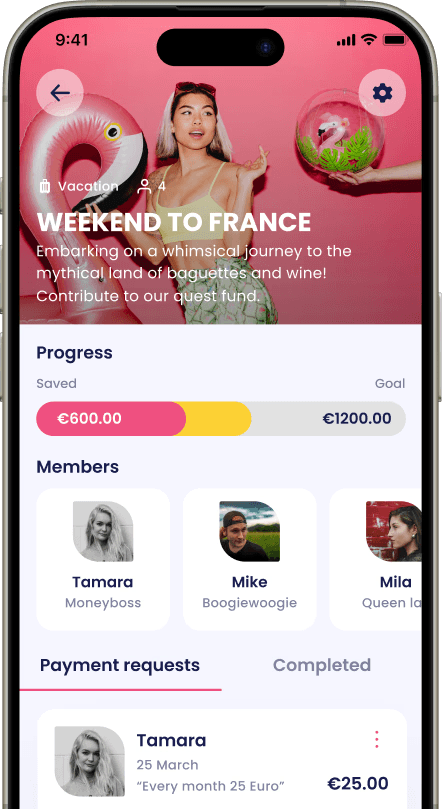
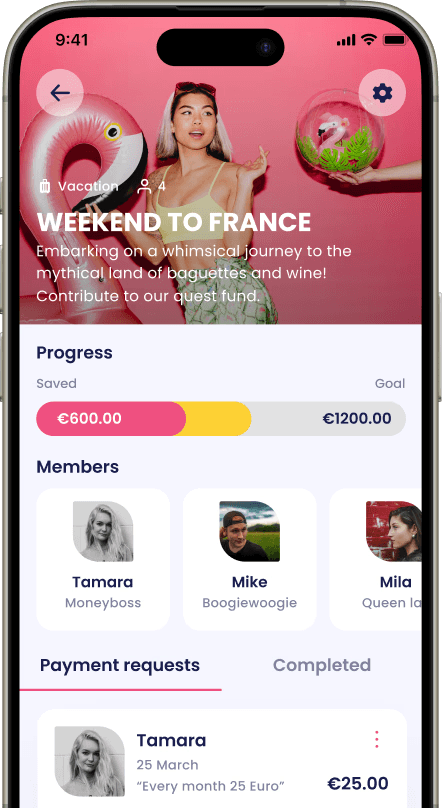
Create a dedicated money pot for a specific goal
Invite contributors via a simple link
Collect money gradually over weeks or months
Track visual progress toward the target budget
Organise shared expenses collaboratively
This changes the group chat conversation completely.
Instead of the dreaded: "Can everyone please send me their share for the Airbnb?" The conversation confidently becomes: "We already have the budget ready in the pot. Let's book it."
For trips, gifts, festivals, sports teams, and other shared group expenses, this structure entirely removes the financial pressure and anxiety from the organiser.
Real Situations Where Upfront Group Budgets Make a Difference
When you stop fronting the money and start collecting upfront, the benefits are immediately obvious across multiple scenarios:
Group Holidays: Rather than one friend paying thousands of euros upfront on their credit card, everyone contributes weekly or monthly toward the trip long before any flights or hotels are booked.
Birthday Gifts: Instead of one organiser buying the expensive gift and chasing dozen of small payments, contributors add money into the shared goal first, dictating exactly how much can be spent.
Festivals: Accommodation, transport, and festival tickets can all be planned securely around a shared, pre-funded budget rather than relying on one person's available personal funds.
Sports Teams: Team captains and organisers can actually focus on playing the sport instead of managing dozens of separate, chaotic bank transfers for pitch fees and referee costs.
In every single scenario, the exact same principle applies: Shared plans work exponentially better when the money is organised together from day one.
Common Misconceptions About Group Money
"It's easier if one person just pays for everything." It only feels easier initially at the checkout screen. But somebody always ends up doing hours of extra work later. That work usually involves sending reminders, tracking bank statements, and reconciling debts. It is never actually "easier" for the person paying.
"My friends always pay me back eventually." Eventually is the most important word in that sentence. The problem isn't always whether your friends are trustworthy enough to pay you back. The real problem is how long the organiser is forced to carry the heavy cash flow burden before they actually do.
"This proactive approach only matters for massive expenses." Small expenses that are repeated regularly (like weekly team drinks or monthly roommate supplies) often create even more profound frustration than one-off large expenses. The issue is rarely the size of the payment; it is the exhausting repetition of the broken repayment process.
Coming Soon: Spend Together With Apple Pay
To make group spending even more seamless, Potje is currently developing virtual VISA debit cards connected directly to your shared money pots. These highly anticipated cards will fully support Apple Pay and Google Pay, and can be used globally anywhere VISA is accepted.
This massive feature upgrade will allow groups to:
Collect money together securely
Organise budgets together transparently
Spend directly from shared balances without transferring back to a personal account
Track group spending easily and automatically
The feature has not launched just yet, but it represents the ultimate way to stop fronting the money forever. Join the waitlist here: https://www.potje.app
FAQ Section
Why am I always the friend who fronts the money?
Usually, it is because you are the most responsible and organised person in the group. Friends naturally rely on the person who is willing to take the initiative to make bookings, buy tickets, or handle the complex planning. Over time, this becomes deeply frustrating because you end up carrying both the financial risk and the administrative burden. The solution is changing the financial process, rather than trying to change your friends' personalities.
Is Splitwise enough to solve this problem?
Splitwise is fantastic for tracking complex repayments and calculating exact balances, which is extremely useful for figuring out the math. However, it does not eliminate the core problem: someone still has to pay upfront. For larger group expenses, you need a system that organises contributions before the spending occurs to protect your cash flow.
What's the best way to avoid chasing repayments?
The most effective approach is collecting the money before the expenses are actually incurred. When friend groups contribute toward a shared digital money pot in advance, there is absolutely no need for repayment tracking, awkward reminders, and stressful follow-up messages later.
What is Potje?
Potje is a modern joint money account designed specifically for groups. It allows people to seamlessly create shared money pots, invite contributors, collect money toward common goals, and organise group spending collaboratively. This entirely eliminates the financial pressure that typically falls on one organiser.
Will Potje support Apple Pay?
Yes. Potje's upcoming virtual VISA debit cards are expected to fully support both Apple Pay and Google Pay. This will allow groups to securely spend directly from their shared balances while maintaining complete visibility over all shared spending activity.
Key Takeaways
Being the friend who always fronts the money usually starts with great intentions.
But over time, it creates unnecessary pressure, heavy administration, and unfair financial responsibility.
The problem is rarely your friends; the problem is the outdated "spend first, collect later" process.
When groups organise money before spending happens, responsibility becomes shared, budgeting becomes far easier, and everyone contributes fairly.
The absolute best group experiences happen when one person isn't carrying the entire financial cost of making them happen.

Social Accountability and Saving: The Missing Link to Financial Freedom
Ondersteuning voor verschillende inhoudstypes zoals artikelen, blogs, video's en meer. Rijke tekstverwerker met opmaakopties voor verbeterde.
17 november, 2025

Group Saving Apps Compared: What's Easiest, Safest, and Most Transparent?
Ondersteuning voor verschillende inhoudstypes zoals artikelen, blogs, video's en meer. Rijke tekstverwerker met opmaakopties voor verbeterde.
17 november, 2025

Group Money Platforms Compared: What’s Safe, Regulated, and Fair?
Ondersteuning voor verschillende inhoudstypes zoals artikelen, blogs, video's en meer. Rijke tekstverwerker met opmaakopties voor verbeterde.
17 november, 2025
