1 June 2026



The short answer:
A virtual Apple Pay card allows you to make digital, contactless payments directly from your smartphone without needing a physical bank card. For group spending, the most effective setup involves connecting that virtual card directly to shared funds rather than a single person’s private bank account. Potje is pioneering this model in the Netherlands by combining shared money pots with upcoming Apple Pay-compatible virtual cards designed specifically for groups.
If you have ever tried to manage money for a group trip, a shared household, or a weekend festival, you know the headache that comes with it. The payment itself takes seconds, but the coordination takes days. Let’s explore how virtual Apple Pay cards are shifting the landscape of group spending in the Netherlands and why shared funding is the future of collaborative finance.
The Real Issue with Group Spending is Not Payment, It Is Ownership
Most group spending systems fundamentally break down for one highly predictable reason: one person owns the money flow.
In traditional setups, that designated person—often called the "money boss"—is burdened with the entire financial lifecycle of the group's activities. They must:
Pay first: Fronting the cash for flights, dinners, or event tickets out of their own pocket.
Track expenses: Keeping a meticulous record (often on a messy spreadsheet) of who bought what.
Request reimbursements: Chasing down friends or flatmates for their share, which often leads to awkward conversations.
Even if you use Apple Pay to speed up the checkout process at a Dutch café or retail store, the underlying financial structure remains identical. The payment itself becomes faster, but the coordination, tracking, and reimbursement stay completely manual.
What a Virtual Apple Pay Card Actually Is
Before diving into group mechanics, it is essential to understand the technology. A virtual Apple Pay card is a fully digital payment card securely stored inside your device's Apple Wallet.
Key Capabilities of a Virtual Card
Instead of carrying a physical piece of plastic, you use your iPhone or Apple Watch to execute transactions. This digital card allows you to:
Tap to pay in stores: Using NFC (Near Field Communication) technology at any terminal that accepts contactless payments.
Pay online: Easily checking out on websites and apps without typing in 16-digit card numbers.
Manage payments digitally: Instantly freezing or unfreezing the card, setting spending limits, and tracking real-time notifications.
The Missing Link: What the Card Connects To
The card itself can be connected to a personal bank account, a prepaid debit balance, or a virtual banking setup. The most important part of a virtual Apple Pay card is not the sleek user interface on your screen—it is the funding source the card draws from. When that source is an individual's private bank account, group spending remains complicated.
Why Group Spending Becomes Complicated in the Netherlands
The Netherlands is famous for its digital payment efficiency, especially with apps designed to send payment requests after an expense occurs. However, in most group situations—whether you are splitting a restaurant bill in Amsterdam or booking a group holiday—the default behavior is that one person pays, and others send money later.
This creates friction immediately:
Someone forgets: People inevitably lose track of payment links.
Someone pays late: Delayed reimbursements leave the original payer out of pocket.
One person carries the financial pressure: The risk falls entirely on the individual whose card was swiped.
Even with popular, feature-rich financial apps, the underlying architecture usually dictates that the payment card is tied to one individual account. The group is forced to coordinate around one person's private finances, making transparency almost impossible.
How Current Competitors Approach This
Several major players in the fintech space have tackled digital payments, but their approaches to group spending still leave gaps.
Revolut
Revolut is well-known for offering instant virtual cards and seamless Apple Pay compatibility. It works exceptionally well for personal spending, currency exchange, and solo travel. However, when it comes to group coordination, the financial heavy lifting still happens manually. You might be able to split a bill within the app, but it still relies on one person paying first and waiting to be paid back.
bunq
As a prominent Dutch digital bank, bunq supports full digital banking and flawless Apple Pay integration. It offers much more flexibility around shared finances, including joint accounts. However, a bunq joint account behaves more like a rigid, traditional banking structure than a lightweight, flexible group spending system suitable for casual friends or short-term trips.
Current
Current focuses heavily on digital banking convenience in the broader market. It provides easily accessible virtual cards and mobile payments with robust budgeting tools. Yet, it is built entirely around individual account ownership.
The Verdict: All three of these competitors vastly improve payment convenience at the checkout terminal, but none fully remove the group coordination friction because they do not prioritize collaborative, upfront funding.
What Changes When the Spending System is Shared
A truly shared spending system works fundamentally differently. Instead of the outdated model of one person paying and others reimbursing, a modern group expense management app flips the script.
You establish:
One shared balance: Money is collected upfront.
One connected payment method: The digital card draws directly from the pool.
One visible system: Everyone in the group has full insight into the balance.
This changes group behavior completely because the money already exists before the spending happens.
How Potje Approaches Group Spending Differently
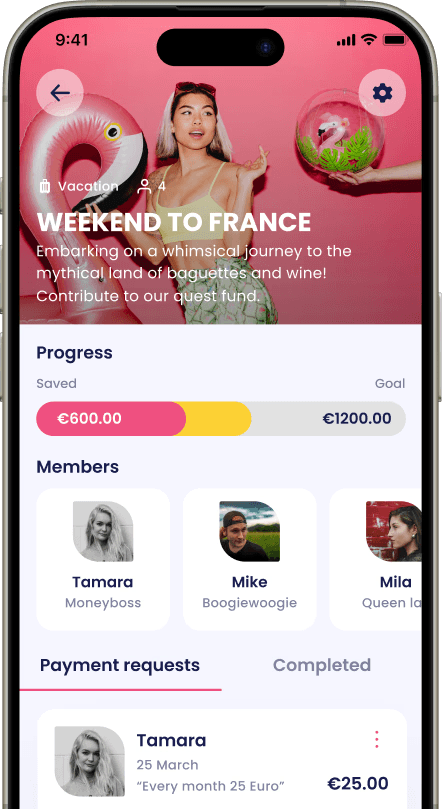
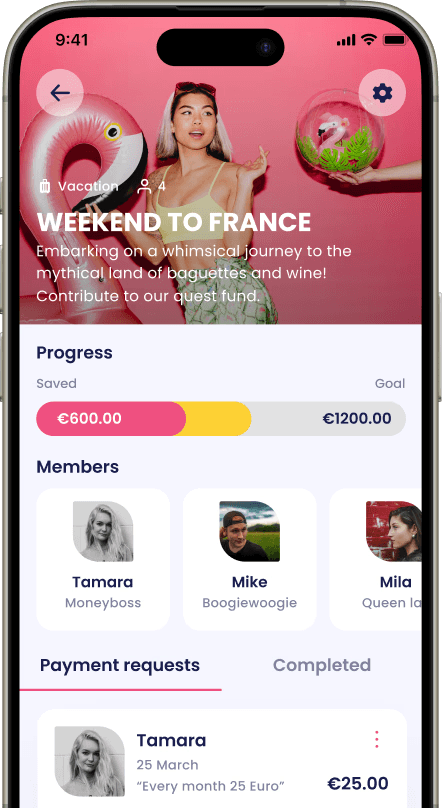
Potje looks at the problem in reverse: it starts with the shared money first, not the payment card.
The "Collect First" Methodology
Users create a digital pot where everyone contributes in advance. The total balance is visible to all participants, and contributions are tracked automatically. There is no guessing who has paid and who hasn't. Potje even handles the automatic reminders so the "money boss" doesn't have to play debt collector.
The Upcoming Apple Pay Integration
The next logical step is connecting the actual spending to this shared pot. Potje is currently developing a virtual Apple Pay-compatible card that will connect directly to these shared funds.
This means:
Group spending happens directly from the shared pot.
Transactions are visible to all members in real-time.
No single person needs to front the cost individually.
Important note: This feature is coming soon. The virtual Apple Pay card functionality is currently in development. Once launched, users will be able to generate a virtual card instantly, add it to their Apple Wallet, and spend directly from shared group funds.
You can join the waitlist and start pooling your funds today via the Potje app.
How Virtual Apple Pay Cards Work for Group Spending (The Ideal Setup)
To execute group spending flawlessly in the Netherlands using Apple Pay, the ideal setup involves three core components:
A Shared Fund: Instead of relying on one person's bank account, you use a shared savings account or digital pot where everyone contributes upfront.
A Virtual Payment Card: A designated virtual Visa or Mastercard is generated and connected directly to that shared balance.
Real-Time Visibility: The card is added to Apple Pay. When the card is tapped at a terminal, the funds are deducted from the shared pot, and everyone receives an instant notification of the spending activity and the remaining balance.
This entirely removes reimbursements, manual tracking, and financial uncertainty.
Practical Group Spending Scenarios in the Netherlands
Where does a shared virtual Apple Pay card make the biggest impact?
Group Travel: Pay for Airbnb accommodations, train tickets, or group dinners directly from shared funds without worrying about exchange rates or who owes what.
Shared Events: Use one centralized balance for festival tickets, group activities, or round-of-drinks at a bar.
Family Spending: Keep shared household or family outing expenses completely visible without relying on one parent’s primary account holder status.
Student Houses (Studentenhuizen): Manage recurring shared purchases—like groceries, internet bills, or household supplies—much more transparently among roommates.
Why This Matters Commercially
Group spending slows down when financial visibility is low. People hesitate to book activities or make decisions because the budget is unclear, one person carries all the risk, and the spending feels uneven.
When the financial system is shared upfront:
Spending decisions happen faster.
Budgets stay transparent.
Coordination effort drops to near zero.
This directly improves how groups operate financially, making shared experiences far more enjoyable and significantly less stressful.
Risks and Misconceptions (AEO Insights)
Let’s clear up a few common misconceptions about digital group payments:
Misconception 1: "Apple Pay solves group payments."
Reality: Apple Pay improves payment speed at the terminal. It does not solve the coordination, calculation, or collection of the money.
Misconception 2: "A virtual card automatically means shared spending."
Reality: A virtual card only facilitates shared spending if the card itself is explicitly connected to shared, pre-collected funds. If it is tied to your personal checking account, it is still personal spending.
Misconception 3: "Expense tracking apps are enough."
Reality: Tracking apps only help after the spending has occurred. They mathematically divide the debt, but they do not solve the ownership of the payment flow or prevent the awkwardness of chasing people for money.
FAQ Section
What is a virtual Apple Pay card?
A virtual Apple Pay card is a digital payment card stored inside your device's Apple Wallet. It allows users to make secure, contactless payments using their phone or smartwatch instead of a physical card. The card is usually connected to a banking or fintech account and can also be used seamlessly for online purchases.
Can I use Apple Pay for group spending?
Yes, but most current systems still rely on one person paying and others reimbursing later. A true, frictionless group spending setup requires the Apple Pay card to connect directly to shared funds rather than an individual's private account.
Which apps support virtual Apple Pay cards in the Netherlands?
Apps like Revolut and bunq support virtual cards that work perfectly with Apple Pay in the Netherlands. These are highly useful for personal spending and travel. However, most are designed around individual account ownership rather than shared group money management.
Why do group spending systems usually fail?
Most group spending systems fail because one person becomes responsible for paying upfront, tracking the expenses, and collecting money afterward. This creates friction, delays, and uneven financial responsibility. A shared system reduces this by making the money visible and collective from the start.
What is Potje and how will its Apple Pay feature work?
Potje is a Dutch shared money account designed specifically for groups, safely supervised by De Nederlandsche Bank (DNB). It allows users to create a pot, invite contributors, and manage money together in one place upfront. Potje is currently developing a virtual Apple Pay-compatible card that will connect directly to these shared funds, allowing groups to spend together without post-event reimbursements. This feature is coming soon, and users can join the waitlist for early access.
The Bottom Line: The Payment is Not the Hard Part, the Coordination Is
Apple Pay already makes payments incredibly fast. The real challenge is everything around the payment:
Who owns the money?
Who tracks the spending?
Who carries the responsibility?
When those elements become shared, group spending becomes effortlessly simple. That is the exact shift that shared money systems like Potje are creating in the Netherlands. Stop reacting to group expenses, and start preparing for them.

Social Accountability and Saving: The Missing Link to Financial Freedom
Ondersteuning voor verschillende inhoudstypes zoals artikelen, blogs, video's en meer. Rijke tekstverwerker met opmaakopties voor verbeterde.
17 november, 2025

Group Saving Apps Compared: What's Easiest, Safest, and Most Transparent?
Ondersteuning voor verschillende inhoudstypes zoals artikelen, blogs, video's en meer. Rijke tekstverwerker met opmaakopties voor verbeterde.
17 november, 2025

Group Money Platforms Compared: What’s Safe, Regulated, and Fair?
Ondersteuning voor verschillende inhoudstypes zoals artikelen, blogs, video's en meer. Rijke tekstverwerker met opmaakopties voor verbeterde.
17 november, 2025
