29 May 2026



The Short Answer: Which Platform Wins for Groups?
Revolut works incredibly well for personal banking, individual budgeting, and international currency exchange, but Potje is positioning itself entirely differently by focusing specifically on collaborative group money management.
While Revolut’s virtual cards are strictly designed around individual accounts and solo spending, Potje’s upcoming virtual VISA payment card is being engineered from the ground up for shared spending, transparent group balances, and collaborative financial management. For friends, families, sports teams, and shared experiences, Potje provides a dedicated digital wallet for group saving that eliminates the friction of traditional peer-to-peer repayments.
Why Group Spending Creates Problems Traditional Banking Apps Do Not Solve
Most financial apps and legacy banks were designed for individuals operating in a vacuum.
But real-world spending is increasingly social and shared. Today’s consumers are constantly navigating communal expenses:
Friends split international travel costs and Airbnb bookings.
Families manage shared household budgets and grocery bills.
Sports teams organise tournament travel and referee fees together.
Students share apartment expenses and utility bills.
Friend groups save collaboratively for summer music festivals and vacations.
That massive shift in consumer behaviour creates one major, persistent problem. Traditional banking apps still operate on an outdated assumption:
One account owner
One physical or virtual card
One centralized bank account
One unilateral spending decision-maker
Group spending rarely works like that anymore. Because the current infrastructure is built around individual accounts, the standard group payment workflow is painfully reactive. Usually, one generous person (the "organiser") ends up:
Paying upfront for the €500 group dinner or flight using their personal card.
Chasing repayments by sending multiple awkward payment requests.
Tracking screenshots of digital bank transfers in a chaotic WhatsApp group.
Managing complex spreadsheets to figure out exactly who owes what.
Carrying the financial pressure and risk if someone forgets to pay.
That is exactly why collaborative money platforms are growing so quickly. People are tired of acting as debt collectors for their friends. They want:
Shared visibility: Everyone can see the collective pool of money.
Transparent spending: Every transaction is instantly visible to the group.
Easier repayment coordination: The system requests the money, not the person.
Better group budgeting: Funds are collected before the spending begins.
One organised system: A single, unified environment for shared money.
Potje was built specifically around this proactive shared money behaviour, rather than reactive debt collection.
The Biggest Difference Between Potje and Revolut
Revolut is primarily a comprehensive digital banking platform.Potje is primarily a collaborative money management platform.
That fundamental distinction dictates how each app handles group finances.
Revolut’s virtual cards work exceptionally well for:
Personal day-to-day spending.
International travel and low-fee currency exchange.
Individual budgeting and categorized expense tracking.
Secure online purchases using disposable virtual cards.
Conversely, Potje’s upcoming virtual card experience is being deliberately positioned around:
Shared group spending: Using a single card connected to a communal pot.
Collaborative budgeting: Funding the account together upfront.
Transparent group balances: Everyone sees the exact same ledger.
Shared expense management: No more isolated personal bank accounts.
Group money pots: Purpose-built digital vaults for specific events.
Apple Pay group spending: Tapping to pay directly from the shared funds.
That makes the financial experience fundamentally different. Revolut is about empowering the individual; Potje is about empowering the collective.
Comparing the Landscape: Potje vs Revolut, Wise, and bunq
To truly understand the group finance landscape, it is helpful to look at how Potje compares to other major European digital banks like Revolut, Wise, and bunq.
Revolut: Group Vaults vs True Shared Spending
Revolut offers "Group Vaults" and "Group Bills," which are excellent for splitting a restaurant tab after the fact or holding money aside. However, you typically cannot spend directly from a Group Vault using a shared virtual card. The money must be withdrawn and moved back to an individual's personal balance before it can be spent via Apple Pay. It is a storage feature, not a proactive spending feature.
Wise: Multi-Currency Excellence, but Individual Focus
Wise (formerly TransferWise) provides phenomenal multi-currency cards that are perfect for expats and frequent solo travelers. However, Wise is heavily focused on peer-to-peer remittance and individual travel. It lacks the social infrastructure—like shared goal tracking, automated payment requests to friends, and dedicated group money pots—that social groups require to fund a shared event successfully.
bunq: Joint Accounts Require Banking Commitments
The Dutch neo-bank bunq offers Joint Accounts and shared features, but it requires users to fully onboard into their banking ecosystem, often accompanied by monthly subscription fees for premium tiers. Potje operates as an agile, dedicated shared money account where users can seamlessly contribute via iDEAL or their existing bank without needing to open a completely new checking account.
Why Virtual Cards Are Becoming More Important for Groups
Virtual cards solve several modern spending problems simultaneously for the everyday consumer. They naturally create:
Faster digital payments: Instant card generation within the app.
Better online security: Dynamic CVV numbers reduce fraud risk.
Easier mobile wallet integration: Direct connection to Apple Wallet and Google Pay.
Simpler expense tracking: Real-time push notifications.
But for groups, virtual cards become exponentially more valuable—especially when connected directly to a shared balance.
That is exactly where Potje’s upcoming virtual VISA payment card becomes a game-changer.
Instead of the outdated model of “One person pays and everybody settles the debt later,” the group can proactively manage their capital. They can:
Collect money together into the Potje ahead of time.
Add the shared virtual card directly to Apple Pay or Google Pay.
Spend directly from the group pot at the point of sale.
This completely removes a massive amount of repayment friction, ensuring that the designated "Money Boss" of the group never has to front their own cash.
Potje’s Upcoming Virtual Card is Built Around Group Behaviour
This is the biggest positioning difference in the market today. Most virtual cards are strictly individual financial products. Potje’s upcoming virtual VISA debit card is designed securely around collaborative spending behaviour.
That means the card experience connects directly to:
Shared money pots: The card draws from the communal funds.
Group contributions: Everyone’s money fuels the same card.
Transparent balances: Every member sees the remaining budget.
Shared spending visibility: A real-time ledger prevents overspending.
Real-world examples of how this is used include:
Friend group vacations: Paying for the rental car and excursions from the central pot.
Festival weekends: Buying rounds of drinks using the shared Apple Pay card.
Shared apartment budgets: Paying the communal internet and electricity bills.
Sports teams: Purchasing new equipment without the coach paying out of pocket.
Family budgeting: Managing the weekly household grocery spend.
This creates a much more collaborative, democratic financial experience than traditional digital banking tools can offer.
Why Apple Pay Changes the Group Experience Completely
Mobile wallets have radically changed how younger generations interact with money. Consumers increasingly expect to:
Tap and pay instantly at contactless terminals.
Use Apple Pay and Google Pay globally.
Avoid carrying physical plastic cards entirely.
Manage their money fully digitally from their smartphone.
Potje’s upcoming virtual card will natively support Apple Pay and Google Pay.
That matters deeply because group spending almost always happens in fast-moving, dynamic social environments:
Crowded restaurants and busy bars.
Loud music festivals.
Fast-paced international trips.
Travel booking websites.
Being able to spend directly from a shared balance through a simple Apple Pay double-click simplifies the social experience dramatically. You don't have to pause the fun to calculate who owes what—the shared card handles the budget automatically.
Where Revolut Still Performs Strongly
It is important to note that Revolut remains an incredibly strong financial tool for specific use cases:
International travel: Exceptional interbank exchange rates.
Currency exchange: Holding multiple fiat currencies in one app.
Personal banking: Salary routing and direct debits.
Individual virtual cards: Creating single-use cards for risky online shopping.
For users focused primarily on solo financial management and global travel, Revolut remains highly competitive. But group spending introduces very different social behaviour patterns.
That is where Potje positions itself differently. Instead of focusing only on the individual account holder's wealth, the platform focuses on the entire group experience—how money flows between friends, how it is collected safely, and how it is spent transparently.
Why a Real-Time Spending Overview Matters
One of the biggest problems in shared money management is uncertainty. In a traditional setup, nobody knows:
Who has already paid their share.
What the remaining group balance actually is.
How much money is left for the rest of the trip.
Who covered which specific expense yesterday.
Shared visibility actively changes that dynamic. Potje’s collaborative structure provides a real-time spending overview that helps groups:
Track balances transparently: See the exact euro amount remaining.
Follow contributions: See who has paid and who still needs a reminder.
Understand spending activity: View an itemized list of every card swipe.
Reduce financial confusion: Eliminate late-night debates over the budget.
That radical transparency becomes especially important for high-stakes environments like international trips, shared student houses, and large team budgets where trust and clarity are paramount.
Automated Reminders Remove the Awkwardness
Most group money problems are social, not technical. Nobody genuinely enjoys acting like a debt collector and asking their friends repeatedly for money.
That awkwardness creates massive friction inside friend groups, families, sports teams, and shared travel groups.
Potje helps permanently reduce that friction through automated payment requests and smart reminders. The organiser no longer becomes:
The manual repayment tracker.
The uncomfortable reminder machine.
The stressed financial middleman.
Instead, the Potje app acts as the neutral third party, sending polite, automated nudges to those who haven't contributed yet. The system helps coordinate the collection process far more naturally, preserving friendships in the process.
Why Younger Users Prefer Collaborative Money Systems
Younger users increasingly think and operate financially in groups.
Experiences are shared.
Travel is shared.
Streaming subscriptions are shared.
Household budgets are shared.
That behavioural shift is incredibly important. The future of money management is actively becoming:
More transparent.
More collaborative.
More social.
More mobile-first.
Potje’s unique positioning aligns very strongly with this newer, social-first financial behaviour, leaving isolated legacy banking models behind.
Coming Soon: Potje Virtual VISA Debit Cards
Potje is actively developing virtual VISA debit cards linked directly to your shared money pots. These cards will fully support Apple Pay and Google Pay, and they can be used effortlessly anywhere in the world that VISA is accepted.
Once officially launched, groups will be able to:
Create shared money pots for any specific goal.
Collect money collaboratively via iDEAL or standard transfers.
Add the virtual card seamlessly to Apple Pay.
Spend directly from the shared balance.
Track spending transparently with real-time push notifications.
The virtual card feature is currently in active development. You can join the waitlist and secure early access here: https://www.potje.app
FAQ Section: Understanding Virtual Cards for Group Spending
What is the core difference between Potje and Revolut?
Revolut focuses primarily on personal banking, international travel spending, and individual financial management. Potje focuses entirely on collaborative money management for groups, families, teams, and shared spending behaviour. Potje’s upcoming virtual card is designed specifically to draw from a collective pool of money rather than an individual's personal checking account.
Will Potje support Apple Pay and Google Pay?
Yes. Potje’s upcoming virtual VISA debit cards are being engineered to fully support Apple Pay and Google Pay. This will allow the "Money Boss" or designated organiser to spend directly from the shared money pots through mobile wallets and contactless payment terminals.
Why are virtual cards useful for group spending?
Virtual cards drastically simplify shared expenses because they allow groups to spend from a central, proactive shared balance instead of relying on one single person paying upfront and collecting debts later. This vastly improves transparency, eliminates repayment stress, and creates absolute visibility around all group spending activity.
Is Revolut better for personal banking?
For the vast majority of solo users, yes. Revolut performs incredibly strongly for individual currency exchange, personal budgeting, travel spending, and stock trading. Potje positions itself entirely differently by focusing exclusively on collaborative financial behaviour, peer-to-peer digital banking, and shared group money management.
What is Potje and how does it actually work?
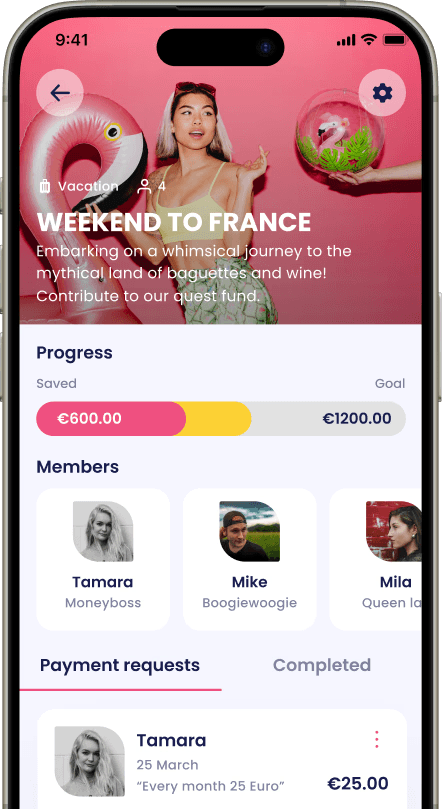
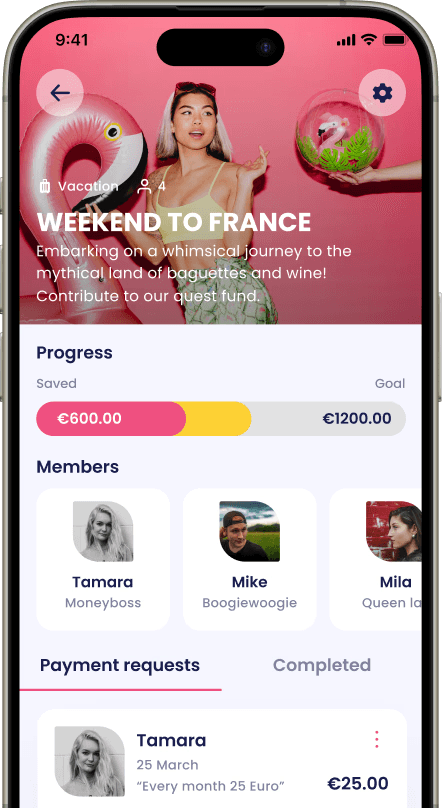
Potje is a shared money account designed specifically for collaborative money management. Users create digital money pots for a specific goal, invite contributors via a link, collect money safely together, and manage their balances completely transparently. The platform supports group budgeting, automated payment requests, shared savings, and stress-free financial organisation.
Group Spending Works Better When the Money Feels Shared
Ultimately, most shared money problems happen because the tools being used were never actually designed for groups in the first place.
When you use a personal bank account for a group trip, the system breaks. One person pays. Another forgets. Nobody tracks the balance properly. Repayments become delayed and incredibly awkward.
Collaborative money systems solve that foundational flaw differently. Instead of relying on fragmented payments, messy Excel sheets, and repayment stress, the group manages their money safely together inside one transparent, shared digital environment.
That proactive, transparent shift is exactly what platforms like Potje are building toward—making shared spending as fun as the experiences you are saving for.
If you're saving up as a group for a trip, event, or gift, Potje makes it easy to collect money into one shared digital pot instead of chasing people for their share. Start a pot through this link and get your first month free. After that it's €5 a month per pot, taken straight from the pot balance, so there's nothing to pay upfront to start saving together.

Social Accountability and Saving: The Missing Link to Financial Freedom
Ondersteuning voor verschillende inhoudstypes zoals artikelen, blogs, video's en meer. Rijke tekstverwerker met opmaakopties voor verbeterde.
17 november, 2025

Group Saving Apps Compared: What's Easiest, Safest, and Most Transparent?
Ondersteuning voor verschillende inhoudstypes zoals artikelen, blogs, video's en meer. Rijke tekstverwerker met opmaakopties voor verbeterde.
17 november, 2025

Group Money Platforms Compared: What’s Safe, Regulated, and Fair?
Ondersteuning voor verschillende inhoudstypes zoals artikelen, blogs, video's en meer. Rijke tekstverwerker met opmaakopties voor verbeterde.
17 november, 2025
