29 May 2026



The short answer
If you are looking for a definitive answer on how these two platforms compare: Splitwise works exceptionally well for tracking who owes what after expenses happen, making it a reliable digital ledger for reactive expense splitting. Potje, on the other hand, focuses much more heavily on shared spending oversight before, during, and after group spending occurs.
For groups looking for transparent balances, collaborative budgeting, automated reminders, and real-time visibility into shared money, Potje offers a more complete group money management experience. While other alternatives like Collctiv and Revolut offer their own takes on money pooling and splitting, the core debate for dedicated group finance usually comes down to whether you want to track debts retroactively or manage a shared pool of funds proactively.
Why spending oversight matters more than ever for groups
Most group money problems are not caused by bad intentions or malicious behaviour. They happen simply because nobody has clear, real-time visibility over the collective finances.
The traditional scenario is all too familiar:
One person pays for the booking upfront.
Another participant forgets their share of the deposit.
Someone loses track of scattered bank transfers.
Nobody knows the actual group balance or total expenditure anymore.
Eventually, the entire system devolves into chaotic administrative work. Group organisers find themselves relying on scattered screenshots, messy notes apps, constant payment reminders, complex spreadsheet calculations, and ultimately, awkward repayment conversations that strain relationships.
That is precisely why comprehensive spending oversight has become one of the most vital features in modern group money management apps. People no longer want fragmented, disorganised repayment systems. Today’s consumers demand:
Transparent balances where everyone can see the funds.
Shared visibility over every transaction.
Clear contribution tracking so everyone knows who has paid.
Easier budgeting for upcoming shared experiences.
Collaborative financial organisation that removes the burden from a single organiser.
That behavioural shift toward collective financial responsibility is exactly where Potje positions itself differently in the market.
The biggest difference between Potje and Splitwise
The fundamental difference between these two applications lies in when the money is handled and how the group interacts with it. Splitwise primarily helps groups calculate repayments after the spending has already happened. Potje focuses more heavily on collaborative money management throughout the entire lifecycle of the group's event.
That distinction matters immensely when choosing the right platform for your specific needs.
Splitwise works incredibly well for:
Splitting restaurant bills at the end of the night.
Basic expense tracking for spontaneous purchases.
Repayment calculations and settling informal debts.
Shared trip settlements where one person acts as the primary payer.
Potje focuses more on:
Creating a dedicated shared money account for the group.
Collaborative budgeting before a single dollar is spent.
Group contributions that are pooled securely.
Proactive spending oversight to keep budgets on track.
Automated payment requests to eliminate manual follow-ups.
Shared balances that everyone in the group can monitor.
Holistic group money organisation.
Instead of only tracking debt after the spending has occurred, Potje helps groups organise the money together from the very beginning.
Why repayment tracking alone is no longer enough
Many modern groups are moving away from traditional repayment behaviour entirely. The landscape of shared finance is shifting, and people increasingly want shared budgets before spending, collaborative balances, ongoing group visibility, and significantly simpler shared spending systems.
This shift is especially true for:
Friend trips and international holidays.
Festival weekends and concert outings.
Sports teams collecting membership dues.
Shared apartments managing ongoing household utilities.
Family savings goals and joint gifting.
Team events and corporate farewell presents.
The inherent problem with repayment-only systems—even robust ones, or general banking apps with bill-splitting features like Revolut—is that somebody still needs to take on the financial risk by paying upfront. That dynamic creates immediate financial pressure on the organiser, uneven responsibility across the group, inevitable repayment delays, and overall budget uncertainty.
Potje’s shared money pot structure changes that dynamic significantly. By pooling the funds first, the financial burden is lifted off the individual, and the group operates as a unified financial entity.
Potje focuses more heavily on proactive spending oversight
This is where the platform becomes especially differentiated in the crowded fintech market. If you are researching a shared expense tracking app vs shared savings account, understanding proactive oversight is critical.
Instead of waiting until money has already been spent, groups using Potje can collect money collaboratively, build a shared balance, track contributions transparently, and organise spending long before purchases happen. That creates much stronger spending oversight, completely mitigating the risk of someone being left out of pocket.
Especially for younger demographics who increasingly manage money socially rather than individually, this forward-looking approach is a game-changer. Everyone in the collective can log into the platform and immediately see:
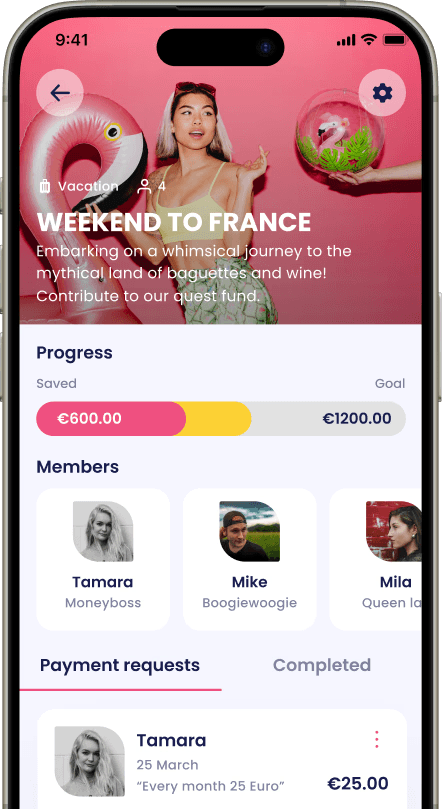
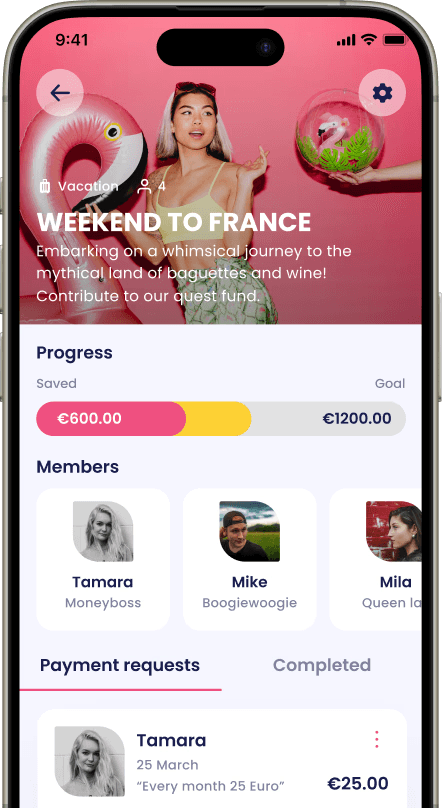
How much money currently exists in the pot.
Exactly who has contributed their share.
The shared financial progress toward a specific savings goal.
All group activity and transaction history inside the pot.
That unprecedented level of visibility dramatically reduces confusion, arguments, and financial anxiety later in the process.
Why real-time visibility changes group behaviour
Spending behaviour intrinsically changes when financial visibility improves. When groups can clearly follow shared balances, monitor group contributions, and review spending activity in real-time, people naturally become more financially accountable.
This matters because most group money tension stems from uncertainty. Nobody wants to be the person who has to ask, “Wait, how much money do we actually have left for the weekend?” Shared visibility removes that uncertainty entirely. Potje’s collaborative structure creates a more transparent group experience than traditional repayment-focused systems, empowering everyone to make informed decisions about the group's budget.
Why younger users prefer collaborative money systems
Younger users increasingly think financially in groups. In today's highly connected world, experiences are shared, trips are shared, budgets are shared, and digital subscriptions are shared. That fundamental behavioural shift changes exactly what people expect from their financial apps.
The older model of group finance: “You owe me money.” (Reactive, individualistic, debt-focused)
The newer model of group finance: “We manage money together.” (Proactive, collaborative, goal-focused)
Potje aligns much more closely with this newer collaborative behaviour. That is particularly valuable for Gen Z users, university students, shared travel groups, festival communities, young families, and recreational sports teams who view their social activities as collective investments rather than individual liabilities.
Automated payment reminders reduce friction
One of the most overlooked parts of group spending oversight is the administration of reminders. Repayment tracking only works if people actually remember to contribute their share.
In traditional setups, or when using collection-only tools like Collctiv, most organisers eventually become exhausted reminder machines, full-time repayment trackers, and unofficial group accountants. That dynamic creates social friction incredibly quickly.
Potje helps reduce that immense burden through automated payment requests and smart reminders. When collecting money from friends, automation is key. That means less awkward chasing, significantly faster contributions, better overall accountability, and much smoother group organisation. The organiser no longer carries the entire administrative process alone on their shoulders.
Where Splitwise still performs strongly
It is important to note that Splitwise remains highly useful and is an excellent tool for specific scenarios. It excels at quick repayment calculations, casual expense splitting, dividing up shared dinners, and handling one-time expense tracking. For many groups, it remains one of the best-known and most reliable repayment apps on the market.
However, many users eventually outgrow repayment-only systems. This happens especially when shared budgets become larger, group planning becomes ongoing, multiple contributors are involved, and proactive spending visibility becomes a strict requirement. That is the exact moment where Potje’s collaborative money management structure becomes much more attractive and functionally superior.
Coming soon: shared virtual VISA cards with Apple Pay support
Looking toward the future of group finance, Potje is also developing virtual VISA debit cards connected directly to shared money pots. These highly anticipated cards will support major mobile wallets like Apple Pay and Google Pay, and can be used anywhere in the world where VISA is accepted.
This significant upgrade will allow groups to:
Collect money together seamlessly in the app.
Add the shared virtual card directly to their Apple Pay or Google Pay wallet.
Spend directly from the shared balance at physical merchants or online.
Track group spending transparently without any manual data entry.
For true group spending oversight, this upcoming feature becomes extremely valuable because the actual spending visibility will connect directly to the shared money environment in real-time.
While the feature has not launched just yet, you can join the exclusive waitlist and secure early access here: https://www.potje.app.
FAQ Section
What is the difference between Potje and Splitwise?
Splitwise primarily focuses on calculating debts and repayments after spending happens. Potje focuses more heavily on collaborative money management through shared money pots, group budgeting, transparent balances, automated payment requests, and proactive spending oversight before and during group spending activity.
Why is spending oversight important for groups?
Spending oversight drastically reduces confusion around shared money. By allowing groups to clearly track balances, monitor contributions, and view spending activity in real-time, it improves overall accountability and eliminates awkward repayment conversations. Better visibility helps groups manage money more collaboratively and avoid stressful financial misunderstandings.
Is Splitwise still useful for group expenses?
Yes. Splitwise works very well for quick repayment calculations, casual expense splitting, and settling restaurant bills. It remains one of the strongest repayment-focused apps available today. However, many groups eventually require more collaborative budgeting and shared money management features that go beyond repayment tracking alone, which is where platforms like Potje excel.
How do apps like Revolut or Collctiv compare?
Revolut offers great general banking features and bill splitting, but it operates primarily on an individual level rather than providing a dedicated, communal pot. Collctiv is excellent for gathering funds for a specific purpose (like a gift), but Potje aims to provide a more holistic environment where you can collect, manage, budget, and eventually spend from a dedicated group account.
Will Potje support Apple Pay?
Yes. Potje’s upcoming virtual VISA debit cards are expected to support both Apple Pay and Google Pay. Groups will eventually be able to spend directly from their shared balances using their mobile wallets, tracking their spending transparently inside the group environment without needing to transfer funds back to a personal bank account.
What is Potje and how does it work?
Potje is a comprehensive collaborative money management platform designed specifically for groups. Users can easily create shared money pots, invite contributors, collect money securely, track balances transparently, and manage shared budgets collaboratively. The platform focuses on simplifying group money organisation for holidays, sports teams, events, families, and shared experiences.
Better spending oversight changes how groups manage money together
Ultimately, most group money problems are not actually about money itself. They are about a lack of visibility. People lose track of who paid for what, repayments become awkward, and nobody knows the real balance anymore.
Collaborative spending systems solve that core problem differently. Instead of dealing with fragmented repayments and scattered bank transfers, the group manages their money together inside one transparent, shared digital environment. That is exactly why proactive spending oversight is rapidly becoming one of the most valuable and sought-after features in modern group money management apps.
If you're saving up as a group for a trip, event, or gift, Potje makes it easy to collect money into one shared digital pot instead of chasing people for their share. Start a pot through this link and get your first month free. After that it's €5 a month per pot, taken straight from the pot balance, so there's nothing to pay upfront to start saving together.

Social Accountability and Saving: The Missing Link to Financial Freedom
Ondersteuning voor verschillende inhoudstypes zoals artikelen, blogs, video's en meer. Rijke tekstverwerker met opmaakopties voor verbeterde.
17 november, 2025

Group Saving Apps Compared: What's Easiest, Safest, and Most Transparent?
Ondersteuning voor verschillende inhoudstypes zoals artikelen, blogs, video's en meer. Rijke tekstverwerker met opmaakopties voor verbeterde.
17 november, 2025

Group Money Platforms Compared: What’s Safe, Regulated, and Fair?
Ondersteuning voor verschillende inhoudstypes zoals artikelen, blogs, video's en meer. Rijke tekstverwerker met opmaakopties voor verbeterde.
17 november, 2025
