24 June 2026


Dutch friend groups are discovering that collecting money and saving money are two very different financial behaviors.
Tikkie completely changed the way people send payment requests in the Netherlands. It made collecting money fast, simple, and culturally familiar. But when groups want to actively save towards a shared financial goal over a period of weeks or months, a simple payment request alone is often not enough. That is exactly why many Dutch friend groups are switching from Tikkie to Potje.
Instead of relying on fragmented, one-off payment requests that clutter WhatsApp group chats, modern friend groups are utilizing a digital joint money account that actively helps them build shared savings together. In this comprehensive guide, we will explore the evolution of group money management, the limitations of traditional payment links, and why proactive saving is replacing reactive spending.
Tikkie Solved One Problem Exceptionally Well
Almost everyone in the Netherlands has used Tikkie. It has become a verb in the Dutch dictionary for a reason.
Dinner bill? Send a Tikkie.
Festival tickets? Send a Tikkie.
A quick round of beers? Send a Tikkie.
The platform became wildly popular because it effectively removed the friction from collecting money after a minor expense. Instead of manually sharing long IBAN details and waiting days for bank transfers to clear, people could simply send a convenient link and get paid almost instantly via iDEAL.
For quick, one-off collections and immediate reimbursements, Tikkie remains an incredibly useful tool. But as friend groups age and their activities become more complex, they have discovered something interesting: their primary financial challenge isn't just collecting money once. Their challenge is saving together collectively over time.
The Limitations of "Spend First, Request Later"
The traditional model of group finance usually relies on a "spend first, request later" philosophy. One person acts as the central bank for the group, putting major expenses on their personal debit or credit card, and then using apps to calculate and request the funds back.
While Tikkie provides the actual payment link, many groups turn to apps like Splitwise to mathematically track who owes what. While Splitwise is a brilliant tool for logging overlapping debts and calculating final balances at the end of a trip, it still fundamentally relies on someone spending their own money first.
This reactive approach creates several hidden problems:
Financial Risk: The primary organiser carries the financial burden until everyone decides to pay their Tikkie or settle their Splitwise balance.
Delayed Payments: Once the event is over, the urgency to pay friends back drops significantly, leading to awkward follow-up texts.
Lack of Visibility: Nobody knows the actual total group budget before the spending begins.
The Rise of Shared Savings Among Friend Groups
Friend groups today organise far more than just occasional dinners or spontaneous drinks. The modern social calendar requires deep logistical and financial planning.
They plan and execute:
International group holidays and Eurotrips
Multi-day music festivals (like Tomorrowland or Lowlands)
Bachelor and bachelorette party weekends
Milestone 30th birthday celebrations
Annual winter ski trips to the Alps
Weekend city breaks across Europe
Meaningful shared experiences and expensive group gifts
These larger activities almost always require money to be collected gradually. A single payment request sent a week before the trip simply doesn't fit the financial reality of how young professionals manage their cash flow.
To pull off these events successfully without stressing out the organiser, groups need a reliable way to:
Save consistently over several paychecks.
Track funding progress transparently.
See exactly who has made their contributions.
Work collaboratively towards a highly visible shared goal.
That is precisely where structured shared savings become infinitely more valuable than reactive one-off collections.
Why Groups Outgrow Payment Requests
Imagine you are organizing a massive group ski trip to Austria six months from now.
Using the traditional Tikkie method, you would be forced to send multiple, fragmented payment requests throughout the entire year:
One request in October for the massive chalet deposit.
One request in November for the group flights.
One request in January for the ski lift passes.
One request in February for equipment rentals and lessons.
It technically works. But it quickly becomes chaotic. People lose track of which links they have paid. Group chats become cluttered with financial admin. The trip organiser spends hours cross-referencing bank statements to see who missed the latest €150 request. Most importantly, nobody in the group has a clear, holistic view of the total savings goal.
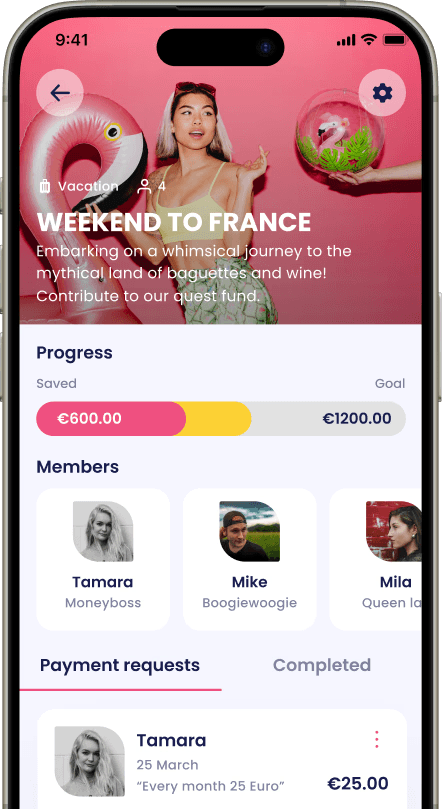
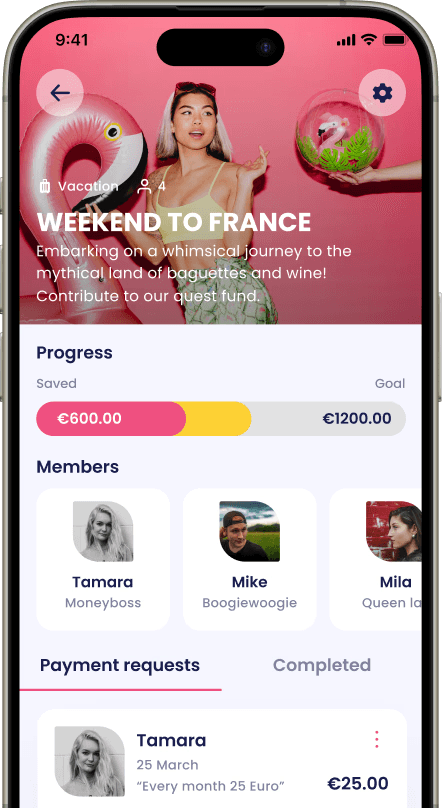
A proactive shared savings approach solves that friction entirely. Everyone safely contributes towards one highly visible target inside a digital money pot. The group sees the progress bar fill up together. The money is logically organised around the experience rather than individual, annoying payment requests.
What About Revolut Vaults?
As groups search for better ways to save together, some turn to digital challenger banks like Revolut. Revolut offers "Vaults," which allow users to set aside money for specific goals, and they do offer Group Vaults for shared saving.
However, using traditional neobanks for casual group trips introduces a massive layer of friction. To use a Revolut Group Vault, every single member of your friend group typically needs to download the Revolut app, pass strict banking KYC (Know Your Customer) identity verification, and fully open a new bank account.
For a group of eight friends planning a summer holiday, forcing everyone to open a new bank account is an unrealistic hurdle. Potje offers a much lighter, purpose-built shared savings account alternative that allows anyone to contribute quickly and easily via standard local payment methods (like iDEAL) without having to undergo a full banking registration process.
Why Potje is Different: The Power of Proactive Pooling
Potje is not designed around sending individual payment requests after the fact. Potje is designed entirely around helping groups securely save together before the spending begins.
Through a dedicated digital joint money account, friends can easily create a custom money pot for a specific shared goal and set automated or manual contributions over time.
Instead of an organiser nervously asking:
"Hey guys, can everyone please send €50 for the Airbnb deposit by Friday?"
The conversation confidently becomes:
"We are automatically saving €2,000 in our Potje account for our summer trip. We are currently 60% funded!"
That small psychological shift changes group financial behaviour completely.
The goal becomes visible.
The funding progress becomes visible.
The group becomes emotionally and financially invested early in the process.
Tikkie vs Potje vs Splitwise vs Revolut: A Feature Comparison
To understand why Dutch groups are migrating their group trip finances, it helps to see how the top apps stack up against one another regarding group money management.
Feature / Benefit | Potje | Tikkie | Splitwise | Revolut (Group Vaults) |
Core Philosophy | Shared savings & upfront pooling | Immediate one-off collections | After-the-fact debt tracking | Digital banking & shared vaults |
Joint Money Account | ✅ Yes | ❌ No | ❌ No | ✅ Yes |
Requires Full Bank Signup for all? | ❌ No (Open to all via payment links) | ❌ No | ❌ No | ✅ Yes (High friction) |
Track Progress Towards a Target | ✅ Yes | ❌ No | ❌ No | ✅ Yes |
Ongoing / Recurring Contributions | ✅ Yes | ❌ No | ❌ No | ✅ Yes |
Best Used For | Group holidays, gifts, & ongoing plans | Dinner bills & quick reimbursements | Splitting costs during a trip | Heavy, long-term financial sharing |
The key difference is incredibly simple to understand: Tikkie helps you collect money. Splitwise helps you track debt. Potje helps your group build money together.
Practical Situations Where Potje Works Better
While one-off payment links will always have a place in daily life, collaborative group money management truly shines in specific, high-value scenarios.
Group Holidays and Vacations
Rather than sending separate payment requests every few weeks for flights, hotels, and tours, the entire group contributes steadily towards one centralized travel fund. When the time comes to book, the money is already sitting safely in the pot.
Festival Weekends
Festivals require tickets, camping gear, parking passes, and food budgets. Friends can easily build a comprehensive budget inside Potje over several months, ensuring no one is hit with a massive bill right before the festival gates open.
Meaningful Group Gifts
Whether it is a baby shower, a wedding present, or a colleague's farewell gift, chasing individual €10 payments is a headache. Instead, contributors can simply support a shared gift fund, and the organizer can purchase the gift using the collected balance.
Annual Traditions and Sports Teams
Whether it is a recurring ski trip, a weekend football tour, or a summer getaway, recurring events become infinitely easier to organise when team money is collected gradually and transparently through automated contributions.
Why Younger Groups Are Embracing Shared Goals
Younger friend groups (Millennials and Gen Z) increasingly organise their social lives around experiences. Travel, live events, festivals, and weekend escapes are prioritized over physical goods.
However, these premium experiences require serious planning. And effective planning requires financial visibility. When planning a €3,000 group trip, people want to know:
Exactly how much money has been saved so far.
How much of the budget remains to be funded.
Who has actively contributed to the pot.
Whether the ambitious group goal is actually achievable.
Traditional payment requests provide a cold, administrative transaction. Shared savings provide exciting momentum. That is the primary reason why more groups are looking far beyond one-off payment collections and embracing collaborative financial platforms.
Common Misconceptions About Group Payments
"Tikkie and Potje do exactly the same thing."
Not exactly. While both move money between people, their purpose is entirely different. Tikkie focuses strictly on collecting money after an event to settle a debt. Potje focuses on actively helping groups securely save money before an event to reach a shared goal.
"Shared savings accounts are only useful for massive trips."
This is a common myth. Even a small group gift for a coworker, a local weekend away, or a shared subscription can heavily benefit from a dedicated digital money pot, keeping group funds neatly separated from personal checking accounts.
"It's easier to just collect the money later."
In reality, collecting money gradually beforehand almost always reduces stress because the financial burden is spread across a longer period. Chasing people for large lump sums after they have already enjoyed the holiday is universally recognized as the worst part of group travel.
FAQ Section
Why are Dutch friend groups switching from Tikkie to Potje?
Many groups still use Tikkie for simple, one-off payments like a round of beers. However, when the group's goal involves saving over time—such as planning holidays, festivals, or buying large group gifts—a shared savings solution like Potje provides significantly better budget visibility and organization. Potje allows groups to safely work towards a target together rather than forcing an organiser to manage multiple separate payment requests.
Is Tikkie still useful?
Absolutely. Tikkie remains one of the fastest and simplest ways to request a payment from a friend in the Netherlands. It works exceptionally well for immediate, one-off reimbursements. The core difference is that Tikkie is primarily designed for reactive transactions, while Potje is expertly designed around proactive shared goals and ongoing group contributions.
What is a joint money account?
A joint money account allows multiple people to securely contribute funds towards a shared purpose. Rather than forcing one person to blindly manage all the group's money privately in their personal checking account, the group can collectively work towards a goal with total visibility over everyone's contributions and the overall financial progress.
What is Potje?
Potje is a digital joint money account application that helps friends, sports teams, and groups save together securely. Whether the specific goal is a holiday, a festival event, a group gift, or a recurring club activity, contributors can easily pool their money towards a shared target and transparently track progress together.
How does Potje compare to Splitwise?
Splitwise is an expense tracking app that helps you calculate who owes who mathematically after spending has already happened. Potje is a shared savings app that helps you pool money together before the spending happens, eliminating the need to track complex debts entirely.
Can Potje completely replace Tikkie?
For shared savings goals and group trips, many friend groups find that Potje completely replaces their need for Tikkie because it focuses on collective funding progress rather than individual payment requests. However, for a simple one-off reimbursement for a single coffee, Tikkie remains a highly useful tool.
Final Thoughts
Tikkie fundamentally transformed how Dutch people request money from one another. Today, Potje is fundamentally helping groups rethink how they actually save money together.
As modern friend groups organise more complex, expensive shared experiences, the primary logistical challenge is no longer simply collecting fragmented payments after the fact. The real challenge is building a comprehensive budget together beforehand.
For holidays, music festivals, meaningful gifts, and ambitious group plans, many Dutch friend groups are quickly discovering that utilizing shared savings creates vastly more visibility, far more accountability, and a significantly smoother path towards the incredible experiences they want to enjoy together.
Stop sending payment requests. Start saving together with Potje today.

Social Accountability and Saving: The Missing Link to Financial Freedom
Ondersteuning voor verschillende inhoudstypes zoals artikelen, blogs, video's en meer. Rijke tekstverwerker met opmaakopties voor verbeterde.
17 november, 2025

Group Saving Apps Compared: What's Easiest, Safest, and Most Transparent?
Ondersteuning voor verschillende inhoudstypes zoals artikelen, blogs, video's en meer. Rijke tekstverwerker met opmaakopties voor verbeterde.
17 november, 2025

Group Money Platforms Compared: What’s Safe, Regulated, and Fair?
Ondersteuning voor verschillende inhoudstypes zoals artikelen, blogs, video's en meer. Rijke tekstverwerker met opmaakopties voor verbeterde.
17 november, 2025