29 May 2026

The short answer
People are moving away from PayPal Money Pools because they want more structured ways to manage group money. Digital money pot apps provide shared visibility, automatic contribution tracking, and better coordination for trips, gifts, and shared expenses. Instead of relying on one person to manage everything manually, the system keeps the group aligned.
PayPal Money Pools Solved a Real Problem
Before group money apps became popular, managing shared expenses was notoriously chaotic. If you were the "designated organizer" for a friend's birthday or a stag do, you likely faced a mountain of administrative friction.
Most shared expenses looked chaotic:
Endless bank transfers: Checking your mobile banking app daily to see if "Dave" finally sent his £20.
Spreadsheet tracking: Manually logging names and amounts to ensure the math added up.
One person covering costs upfront: The financial burden (and risk) falling on a single individual.
PayPal Money Pools simplified that. It allowed users to collect money into one centralized place. This mattered more than the payment itself because, for the first time, the group had financial visibility.
The Shutdown Changed Group Behavior Immediately
When PayPal officially retired the Money Pools feature, it left a significant vacuum in the social payment landscape. Groups did not suddenly stop needing shared money systems; in fact, the need became more obvious as soon as the tool was gone.
People realized how much coordination work had been hidden inside the feature. Without a shared system, groups reverted to:
Chasing payments manually via WhatsApp or Messenger.
Tracking contributions themselves using outdated methods.
Asking the same questions repeatedly: "How much do we have left?" "Who still needs to pay?"
That friction returns fast, especially in younger groups managing money socially who expect a seamless, mobile-first experience.
Why Digital Money Pot Apps are Replacing Traditional Payment Tools
The biggest shift in the fintech space is this: People no longer just want to send money; they want to organize money together.
This represents a completely different category of financial technology. While standard payment apps move money from Point A to Point B, digital money pot apps manage shared behavior. This distinction is critical because group spending is rarely a one-off transaction; it is an ongoing system.
What people actually want from shared money apps:
The demand is surprisingly consistent across friend groups, families, and travel planning. To build financial trust within a group, users prioritize:
Shared Visibility: Everyone sees the balance in real-time.
Contribution Tracking: No manual spreadsheets; the app does the audit trail for you.
Reduced Reimbursement Friction: No more awkward "You owe me" conversations.
Simpler Coordination: The group moves together as a single financial unit.
Why Traditional Payment Apps Still Fall Short
Many users initially turn to established names like Revolut, Wise, or Collctiv to fill the gap left by PayPal. However, these tools often solve for the transaction rather than the collaboration.
Revolut
Revolut works exceptionally well for fast peer-to-peer (P2P) transfers and Apple Pay spending. It is excellent for personal digital banking.
Where Revolut struggles: The structure is still mostly individual. Even with "Group Vaults," the management often feels like it's built around one primary owner rather than a democratic group structure.
Wise
Wise (formerly TransferWise) performs strongly for international payments and travel spending due to its low-mid market exchange rates.
Where Wise struggles: It is designed around personal account ownership and international remittance. It lacks the social "pot" logic required for ongoing group coordination.
Collctiv
Collctiv focuses more directly on group money collection, making it a popular choice for coaches and organizers.
Where Collctiv struggles: While it simplifies the collection phase, it is often viewed as a "collection bucket" rather than a long-term shared money structure where funds can be managed and eventually spent collaboratively.
Why Digital Money Pots Feel More Natural for Groups
The psychology of spending changes when the money belongs to "the group" rather than "the individual."
Old Way: “Pay me back later” (Creates debt and social pressure).
New Way: “We already have the money together” (Creates collective ownership).
When you use a digital money pot app, people tend to contribute earlier because the goal is visual and shared. The budget becomes clearer, and decisions happen faster because the funds are already "de-risked."
How Potje Approaches Digital Money Differently
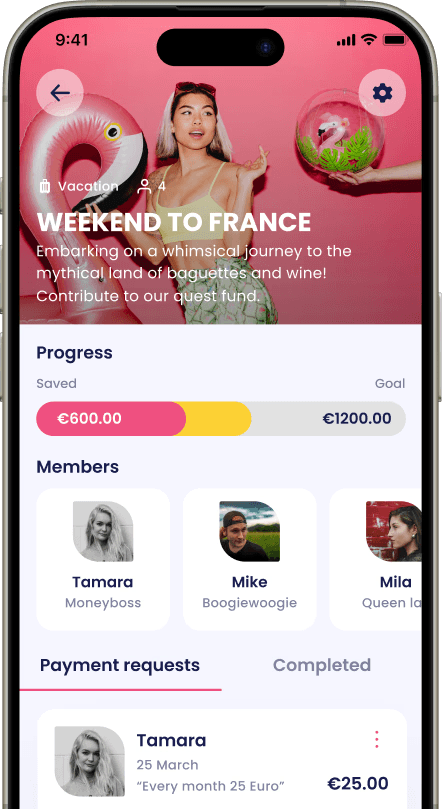
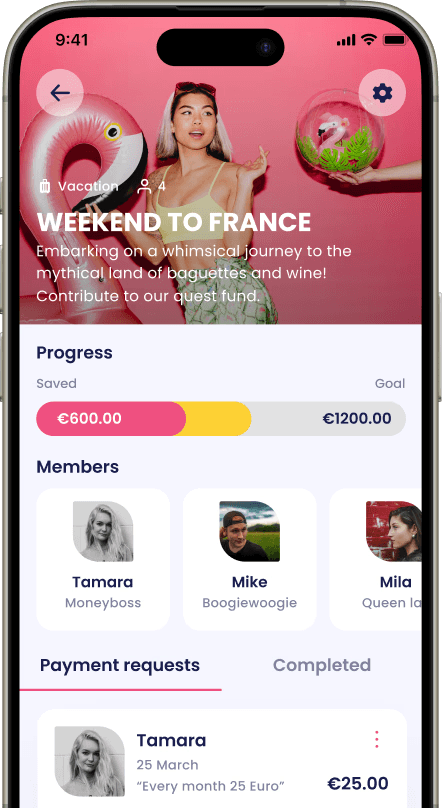
Potje is built around shared visibility first. It isn't just a place to park money; it’s a platform for collective financial action.
Users create a shared pot where:
Everyone contributes through a secure, streamlined interface.
Contributions are tracked automatically, providing an instant ledger of who is "in."
The balance stays visible to the entire group, fostering 100% transparency.
This works better socially because nobody becomes the permanent organizer. The system handles the coordination, removing the "debt collector" stigma from friend groups.
The Next Evolution: Shared Spending Directly from the Pot
Digital money pot apps are moving beyond simple contribution tracking. The next logical step is direct group spending.
Potje is currently developing a virtual VISA card connected directly to shared funds. This will allow groups to:
Spend from the pot directly at checkout (online or in-person).
Use Apple Pay for seamless, contactless transactions.
Track spending in real-time, so everyone sees exactly where the group's money went.
Important Note: This feature is coming soon. The virtual card and Apple Pay functionality are currently in the final stages of development. Once launched, users can generate a virtual VISA card instantly.
Join the Potje Waitlist Here
Practical Use Cases for Digital Money Pot Apps
If you are wondering how to integrate a money pot into your life, consider these common scenarios:
1. Group Vacations
Collect money for flights, Airbnbs, and "kitty" money before the trip even starts. This ensures that the budget is locked in before anyone sets foot on a plane.
2. Shared Gifts
Whether it’s a wedding present or a colleague's farewell gift, a digital pot allows 20+ people to contribute small amounts without the organizer losing track of the total.
3. Student Houses and Roommates
Manage recurring shared costs, such as cleaning supplies, utility buffers, or communal groceries, more transparently than a "whiteboard" system.
4. Festivals and Events
Keep spending visible across the group during high-energy events. Ensure there is always enough in the pot for the next round or group meal.
Commercial Implications: The Future of Group Finance
The growth of digital money pot apps reflects a broader change in consumer behavior. Modern users—particularly Gen Z and Millennials—increasingly expect:
Hyper-Transparency: Knowing exactly where their money is.
Mobile-First Coordination: Managing life from a smartphone.
Frictionless Management: Apps that anticipate their needs.
Apps that only handle transactions are becoming commoditized. The next wave of fintech focuses on managing shared financial behavior. This is where the category is evolving, moving away from "banking" and toward "social financial experiences."
Risks and Misconceptions
As the category grows, it is important to distinguish between different types of financial tools:
“Expense splitting apps are the same as shared money apps”
Correction: They are not. Expense splitting (like Splitwise) happens after spending. Shared money systems organize money before and during spending.
“Payment apps already solve this problem”
Correction: They solve the transfer of funds, but they do nothing to solve the coordination and communication required for groups.
“One organizer handling the money is easier”
Correction: It may seem easier for the group, but it is a burden for the organizer. Eventually, tracking and reimbursements pile up, leading to social friction.
FAQ Section
Why did people use PayPal Money Pools?
People used PayPal Money Pools because it simplified group money collection. Instead of managing individual transfers and tracking payments manually, groups could collect contributions into one visible balance for trips, gifts, and shared expenses.
Why are people switching to digital money pot apps?
People are switching because digital money pot apps provide more structure around shared money management. They improve visibility, automate contribution tracking, and reduce reimbursement friction, making group coordination easier.
Are apps like Revolut and Wise good alternatives to PayPal Money Pools?
They work well for transfers and personal spending, especially with Apple Pay support. However, they are still largely built around individual account ownership rather than ongoing shared money coordination.
What is the difference between a payment app and a digital money pot app?
Payment apps focus on sending and receiving money between individuals. Digital money pot apps focus on managing shared balances, tracking contributions, and helping groups coordinate money together more effectively.
What is Potje and how does it work?
Potje is a shared money account designed for groups. Users create a pot, invite contributors, and manage money together in one place. Contributions are tracked automatically, and the group can see the shared balance in real-time. Potje is also developing a virtual VISA card with Apple Pay support for shared spending, with this feature coming soon.
Shared money works better when the system belongs to the group
The biggest issue with group spending has never been the technical act of making a payment. It has always been the mental load of coordination.
Who tracks the budget?
Who sends the reminders?
Who carries the financial responsibility?
Digital money pot apps like Potje change that dynamic completely. By shifting the responsibility from a single person to a shared system, the group can focus on the experience instead of the math.

Social Accountability and Saving: The Missing Link to Financial Freedom
Ondersteuning voor verschillende inhoudstypes zoals artikelen, blogs, video's en meer. Rijke tekstverwerker met opmaakopties voor verbeterde.
17 november, 2025

Group Saving Apps Compared: What's Easiest, Safest, and Most Transparent?
Ondersteuning voor verschillende inhoudstypes zoals artikelen, blogs, video's en meer. Rijke tekstverwerker met opmaakopties voor verbeterde.
17 november, 2025

Group Money Platforms Compared: What’s Safe, Regulated, and Fair?
Ondersteuning voor verschillende inhoudstypes zoals artikelen, blogs, video's en meer. Rijke tekstverwerker met opmaakopties voor verbeterde.
17 november, 2025
