26 October 2026



Carpooling makes perfect sense on paper. Four colleagues. One car. Fuel costs split four ways. Everyone saves money and the roads get a little quieter.
The problem is what happens in practice.
Someone has to be the driver. And the driver pays for fuel. And parking. And sometimes a toll. Then they spend the rest of the week quietly hoping everyone remembers to pay them back. Sometimes they do. Sometimes it takes a nudge. Sometimes it gets awkward enough that nobody mentions it at all.
The real issue is not the money itself. It is the timing. The costs go out before the contributions come in. That gap is where the awkwardness lives.
This is exactly the kind of problem Potje was built to fix. Instead of the driver paying first and chasing later, the group builds a shared pot before the month begins. The money is already there when the fuel pump runs. No IOUs. No uncomfortable reminders. Just a group of colleagues sharing costs the way carpooling was always meant to work.
Key stat: Two thirds of all commuting kilometres in the Netherlands are driven by car drivers, according to CBS. Every one of those cars is a chance to share the cost, and a shared money pot means the savings reach everyone, not just the passengers.
Why the Driver Always Ends Up Out of Pocket
Fuel is not a one-off cost. It is a recurring one. And recurring costs need a system.
Without a system, this is what usually happens. The driver fills up on a Monday morning, pays €60 at the pump, and sends a message to the group chat. Two people transfer their share that afternoon. One person says they will do it tomorrow. The fourth person does not reply at all. By Friday, the driver is €30 short and has already decided it is not worth bringing up again.
This is not a character flaw. It is simply what happens when money flows in the wrong direction.
The three costs that land on the driver
Most carpooling arrangements involve more than just fuel. The full picture often includes:
Fuel: The biggest and most visible cost. Petrol now costs around €2.35 per litre at Dutch pumps, according to the ANWB, and the national advised price for Euro95 hit a record €2.73 per litre in October 2026.
Parking: If the group uses a paid car park near the office, whoever reaches the machine first covers the cost for everyone.
Wear and tear: Not always discussed, but worth acknowledging. The driver's car is doing all the kilometres.
Why it creates awkwardness between colleagues
Chasing money from friends is uncomfortable. Chasing it from colleagues is worse, because you see them every day.
Most drivers eventually stop asking. They absorb the shortfall themselves, or they quietly start resenting the arrangement. Neither outcome is fair. And neither is good for a working relationship.
The fix is not to chase more aggressively. The fix is to collect the money upfront, before the costs arrive.
How to Agree a Fair Monthly Amount
Before you set up the pot, you need a number everyone agrees on. This conversation is easier than most people expect, as long as you approach it practically.
The four variables to agree on
1. Distance and fuel cost
Start with the round-trip distance from the pick-up point to the office. Multiply by the number of carpooling days per month and by the car's average fuel consumption. Apply the current fuel price to get a monthly total. Then divide by the number of people in the car.
A simple formula:
Monthly fuel cost per person = (km per day x days per month x fuel price per litre x litres per 100 km) / 100 / number of people in the car
2. Days per week
Three days a week gives you roughly 13 carpooling days per month. Five days a week gives around 22. Agree on your working pattern and use it as the base.
3. Parking costs
If you pay for parking, add the monthly parking cost and split it equally. The driver should not bear this alone.
4. Does the driver pay in too?
This is the question most groups avoid. The answer is usually yes. The driver is sharing the cost of their own commute, not running a taxi service. Including the driver in the contribution keeps things fair and removes any suggestion that the arrangement is a commercial transaction.
Compliance note: Carpooling should always be about sharing costs, not generating income for the driver. Keep the monthly contribution at cost price only. This keeps the arrangement straightforward and avoids complications with employment rules or tax. We recommend seeking independent advice if you are unsure about your specific situation.
What a fair monthly contribution looks like
Variable | Example value |
Round-trip distance | 40 km |
Carpooling days per month | 13 (3 days/week) |
Fuel consumption | 7 litres per 100 km |
Fuel price | €2.35 per litre |
Monthly parking | €40 |
People in the car (incl. driver) | 4 |
Monthly contribution per person | approx. €31 |
This is a realistic figure for a commute in the Netherlands. Fuel and parking prices vary across Europe, so plug in your local numbers. The calculation is the same.
Takeaway: If you are unsure how to structure the conversation, frame it simply: "Let us work out what the car actually costs per month and split it equally." That framing removes any awkwardness about who is paying whom.
Setting Up Your Carpooling Pot With Potje
Once you have agreed on a monthly amount, setting up the pot takes about five minutes.
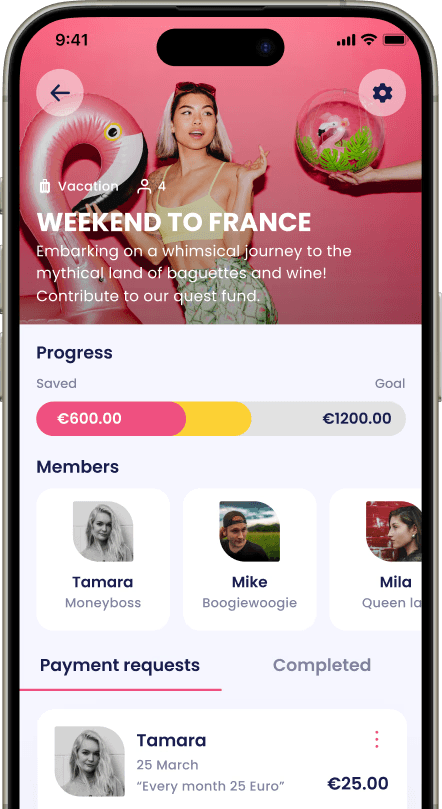
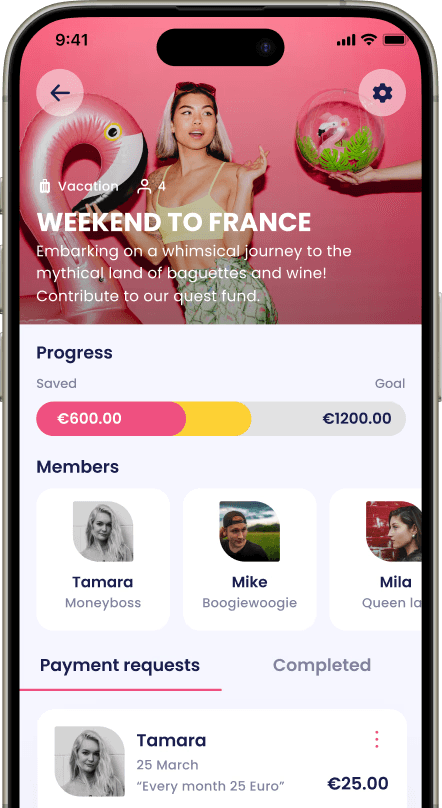
Potje is a shared money account built for groups. Instead of one person holding the group's money in their personal bank account, everyone contributes into a shared pot that is only spent on the agreed purpose. The driver becomes the Money Boss of the pot, which means they control the spending side. Everyone else contributes their monthly share.
Step 1: Create the pot
Open Potje and create a new pot. Give it a clear name, something like "Carpool Fuel Fund" or "Office Commute Pot." Set the monthly contribution amount based on your calculation. Read our step-by-step guide to setting up a group money pot if you want a full walkthrough.
Step 2: Invite your colleagues
Share the pot link with your carpooling group. Each person joins and sets up their recurring monthly contribution. Potje supports Pay by Bank, Bancontact, iDEAL | Wero and SEPA bank transfer, so everyone can pay in the way that suits them.
Step 3: Set contributions to recur automatically
Recurring contributions are the key feature here. Instead of chasing people every month, the pot refills itself. Everyone contributes on the same date each month, and the driver always has a balance to draw from.
Step 4: The driver pays from the pot
The driver withdraws from the pot to cover fuel and parking costs. No personal money involved longer than necessary. No chasing reimbursements afterwards.
This is the shift that changes everything. The money is already there before the cost arrives. The driver is not lending the group anything. They are simply drawing from the group's shared fund.
Potje pricing
The pot costs €5 per month in total, shared automatically across the whole group.
Group size | Cost per person per month |
2 people | €2.50 |
4 people | €1.25 |
5 people | €1.00 |
10 people | €0.50 |
Your first month is free. There are no fees on partial payouts, and you can make instant payouts of any amount whenever you need to. It is one of the most cost-effective ways to manage recurring group costs.
A Worked Example: Four Colleagues, Three Days a Week
Let us put the numbers together with a realistic scenario.
The group: Sarah, Tom, Priya and Marcus. They all work at the same office, 20 km from the shared pick-up point. They carpool three days a week.
The monthly budget
Cost item | Monthly total | Per person (4 people) |
Fuel (40 km/day x 13 days x 7L/100km x €2.35/L) | €85.54 | €21.39 |
Parking (€3/day x 13 days) | €39.00 | €9.75 |
Potje pot fee | €5.00 | €1.25 |
Total | €129.54 | €32.39 |
Each person contributes roughly €32 per month. That is less than a single tank of fuel for a solo commuter doing the same route five days a week.
How the pot works month to month
On the 1st of each month, all four contributions hit the pot automatically. By the time Sarah (the driver) fills up on Monday morning, the balance is already sitting there. She withdraws from the pot to cover the cost, and the shared fund absorbs it.
No message in the group chat. No "can you transfer me your share?" No one pretending they forgot.
At the end of the month, if there is leftover money in the pot, the group decides together whether to roll it over or pay it out. With instant payouts and no fee on partial withdrawals, there is no friction either way.
What this saves compared to driving alone
A solo commuter doing the same 40 km round trip, three days a week, would spend roughly:
Fuel: €85 per month
Parking: €39 per month
Total: approximately €125 per month
With carpooling three days a week and Potje managing the shared fund, each person's contribution drops to around €32. That is roughly a quarter of what each of them would pay driving alone.
The scale of this is real. According to the European Urban Mobility Observatory, corporate carpooling in Italy alone generated €2 million in combined savings on fuel, tolls and parking in 2024. The money is there. The system just needs to be organised properly.
Simple Rules to Agree Before You Start
The pot handles the money. The group still needs to handle the edge cases. Agreeing on these upfront prevents any awkwardness later.
Missed days
What happens if someone is off sick or works from home on a carpool day?
The simplest approach is to keep contributions fixed regardless of attendance. The cost of running the car does not drop because one person stayed home. If someone misses a significant number of days in a month, the group can agree to adjust their next contribution manually.
Holidays and longer absences
If someone is away for a full week or more, it is reasonable to reduce their contribution for that month. Agree on a minimum notice period (two or three days works well) and decide in advance whether the driver tops up the pot from their own contribution or the group simply runs a smaller pot that month.
Someone joining the group
When a new colleague joins the carpool, they start contributing from the beginning of the following month. They do not owe anything for the current month, but they also do not ride for free. Clear from day one.
Someone leaving the group
If someone leaves, the pot is adjusted at the end of their last month. The group agrees how to settle their share of any remaining balance, which can be paid out instantly with no fee on the withdrawal. The remaining members recalculate their monthly contributions based on the new headcount.
A quick reference for the group
Situation | Recommended approach |
Sick day or WFH | Contribution stays the same |
Holiday (1 week+) | Reduce contribution for that month |
New member joining | Starts contributing from next month |
Member leaving | Final month settled, pot adjusted |
Fuel price spike | Review contributions quarterly |
Having these rules written down somewhere, even just pinned in the group chat, removes the need for difficult conversations later. The pot is the tool. The rules are what make the arrangement fair.
For a broader look at how to collect and manage group money without the usual hassle, our guide covers everything from setup to payout.
Frequently Asked Questions
What is a carpooling money pot?
A carpooling money pot is a shared digital fund where everyone in the carpool contributes a fixed monthly amount. The driver withdraws from the pot to cover fuel and parking costs, rather than paying from their own account and waiting for reimbursement. With Potje, contributions are automated and the driver draws from the shared balance. A virtual card for direct payments at the pump is currently in development.
Can the driver make money from a carpooling arrangement?
No. Carpooling is about sharing costs, not generating income. The driver's contribution should be set so the total pot covers actual costs only, with no profit margin for the driver. Keeping it at cost price avoids complications with employment rules or tax. If you are unsure about your specific situation, seek independent advice.
How much does Potje cost for a carpooling group?
The pot costs €5 per month in total, shared automatically across the group. For four people, that is €1.25 each per month. Your first month is completely free, so you can try it before committing.
What payment methods does Potje support?
Potje supports Pay by Bank, Bancontact, iDEAL | Wero and SEPA bank transfer. Every member of the group can contribute in the way that suits them.
What happens to leftover money at the end of the month?
The group decides. You can roll it over to the following month as a buffer, or pay it out instantly. Potje allows instant payouts of any amount with no fee on partial withdrawals.
What if someone does not pay their contribution?
Potje sends automatic reminders, so you do not have to chase manually. If someone consistently fails to contribute, the group can discuss adjusting the arrangement. The driver always has full visibility of who has paid and who has not.
Is carpooling growing across Europe?
Yes, significantly. Corporate carpooling trips in Italy increased by 71.6% in 2024, reaching over 641,000 shared journeys. With fuel prices at record highs in countries like the Netherlands, more commuters across Europe are looking for ways to share the cost.
Can I use Potje for other shared expenses beyond carpooling?
Absolutely. Potje works for any recurring group cost: shared office lunches, sports club fees, holiday funds, group gifts and more. Take a look at how Potje compares to traditional banking for group expenses to see the full picture.
Start Your Carpooling Pot Today
Carpooling already makes financial sense. The only thing stopping it from running smoothly is the money organisation.
A shared Potje pot removes the awkwardness entirely. Everyone contributes before the costs arrive. The driver spends from a shared balance, not their own pocket. And the group has a transparent, automatic system that runs itself month after month.
Your first month is free. No fees on partial payouts. Instant withdrawals whenever you need them.
If you already carpool, this is the system you have been missing. If you have been thinking about starting a carpool with colleagues, this is the easiest way to make it fair from day one.
Create your carpooling pot now and see how much simpler shared commuting can be.

Social Accountability and Saving: The Missing Link to Financial Freedom
Ondersteuning voor verschillende inhoudstypes zoals artikelen, blogs, video's en meer. Rijke tekstverwerker met opmaakopties voor verbeterde.
17 november, 2025

Group Saving Apps Compared: What's Easiest, Safest, and Most Transparent?
Ondersteuning voor verschillende inhoudstypes zoals artikelen, blogs, video's en meer. Rijke tekstverwerker met opmaakopties voor verbeterde.
17 november, 2025

Group Money Platforms Compared: What’s Safe, Regulated, and Fair?
Ondersteuning voor verschillende inhoudstypes zoals artikelen, blogs, video's en meer. Rijke tekstverwerker met opmaakopties voor verbeterde.
17 november, 2025