19 October 2026



Living with housemates is great, right up until someone suggests replacing the knackered sofa, fixing the leaking bathroom tap, or giving the garden a proper makeover. What starts as a simple group conversation quickly turns into a financial negotiation nobody signed up for.
Someone volunteers to pay upfront. Everyone else promises to transfer their share later. A month passes. The money never arrives. The sofa stays broken.
Sound familiar?
The problem is not that housemates are unwilling to contribute. The problem is that there is no system in place before the spending starts.
This guide walks through exactly how to budget together as a house for shared projects, from a new dining table to a full garden overhaul. And it shows you a smarter way to collect contributions before anyone spends a cent.
Key takeaway: Shared house projects fail not because of bad intentions, but because money is collected after the fact instead of before. Flip that order and everything changes.
What This Guide Covers
Why shared house projects always get complicated
How to set a fair budget everyone agrees on
The collect-first approach that removes all the awkwardness
How Potje makes group budgeting simple
Practical tips for running a smooth house project
Frequently asked questions
Why Shared House Projects Always Get Complicated
Shared homes are full of shared decisions. But money is where things get uncomfortable, fast.
The classic pattern plays out like this:
One housemate spots a problem or an opportunity (broken washing machine, sad-looking garden, bare living room).
Everyone agrees something needs to be done.
Someone offers to pay first and collect later.
Contributions trickle in slowly, or not at all.
Resentment builds. The project stalls or falls apart entirely.
This is not a people problem. It is a process problem.
Key insight: In shared houses, money is one of the most common causes of friction, especially the gap between who pays upfront and who pays back.
The Three Most Common Shared House Spending Scenarios
Understanding which type of project you are dealing with helps you plan the right approach from the start.
Project Type | Examples | Typical Cost Range |
Furniture and furnishings | Sofa, dining table, curtains, shelving | €100 to €800 |
Repairs and maintenance | Leaking tap, broken appliance, cracked tiles | €50 to €500 |
Improvements and makeovers | Garden redesign, painting, new kitchen accessories | €150 to €1,500+ |
Each of these requires the group to agree on a budget, collect contributions, and then spend. The order matters enormously.
Collect first. Spend second.
That one change removes almost every source of tension that shared house projects typically create.
How to Set a Fair Budget for a Shared House Project
Getting everyone to agree on a number before anything is purchased is the single most important step. It sounds obvious. Most housemates skip it entirely.
Here is a straightforward process that actually works.
Step 1: Define the Project Clearly
Vague goals create vague budgets. Instead of "let's sort the garden," say "we want two outdoor chairs, a small table, and some planters, total budget €250."
The more specific the project, the easier it is for everyone to commit to a fair share. Write it down, even if it is just a message in the group chat.
Step 2: Research Costs Together
Spend 15 minutes as a group looking at actual prices. Check IKEA, local hardware stores, or second-hand marketplaces. This grounds the conversation in reality and stops anyone feeling like the budget was invented by one person.
Tip: Add a 10 to 15% buffer for unexpected costs. Repairs especially tend to run over.
Step 3: Agree on How to Split the Contribution
For most shared house projects, an equal split is the simplest and fairest approach. Everyone uses the living room sofa. Everyone benefits from a working boiler. Everyone enjoys a tidy garden.
In houses where room sizes differ significantly, some housemates prefer a proportional split.
Step 4: Set a Collection Deadline
This is the step most groups miss entirely. Agree that everyone contributes by a specific date, before any purchasing happens. No contributions, no project.
This is not about distrust. It is about fairness. Nobody should be left covering costs that belong to the whole house.
Why deadlines matter: A two-week window is usually enough. Long deadlines invite procrastination. Short, clear deadlines get results.
The Old Way vs the Better Way
Most housemates default to one of two broken systems.
System A: One person pays, everyone promises to transfer later.
Result: the person who paid becomes an unpaid debt collector. Friendships get strained. The money often never arrives in full. The organiser ends up quietly absorbing the shortfall rather than making things awkward.
System B: Everyone waits for someone else to take the initiative.
Result: the project never happens. The broken chair stays broken. The garden stays neglected. The house collectively agrees it is a problem and collectively does nothing about it.
There is a third option that changes the dynamic completely.
Collect Before You Spend
The smarter approach is to create a shared money pot specifically for the project. Everyone contributes their share upfront. Once the pot reaches the target, whoever is buying the furniture or paying the contractor draws the money out and makes the purchase.
Nobody is out of pocket. Nobody is chasing anyone. The project happens because the money is already there.
The difference feels small. The impact on group dynamics is enormous.
Think about it from the perspective of the person who usually ends up paying first. They take on financial risk. They take on the emotional labour of chasing contributions. They carry the stress of not knowing whether they will be reimbursed in full.
With a shared pot, none of that happens. Everyone is equal from day one.
This is the core idea behind Potje, and it is why the collect-first approach works so much better than any after-the-fact repayment system. For a deeper look at why groups struggle with money after the event, read how to collect money without the awkward chasing.
How Potje Makes Shared House Budgeting Simple
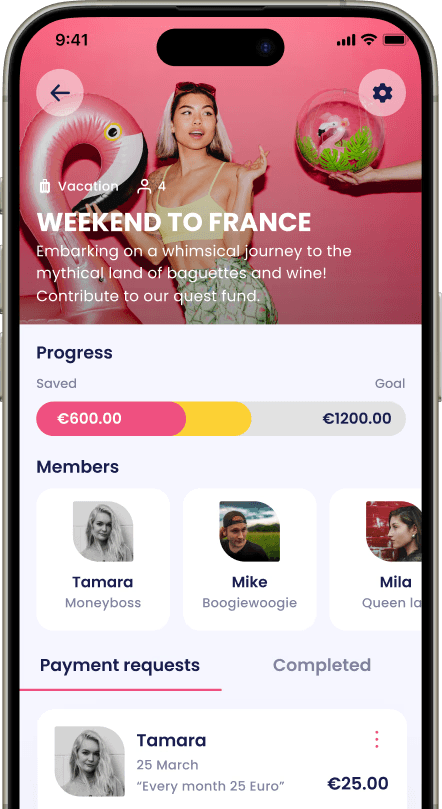
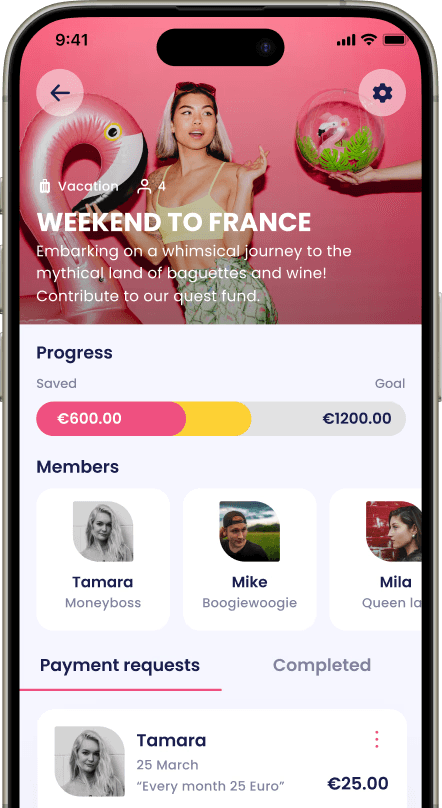
Potje is a shared money pot built for groups. It is not a bank account, a debt-tracking app, or a payment request tool. It is a dedicated space where everyone contributes towards a shared goal, and the money sits safely until the group is ready to spend it. Here is how a typical shared house project works with Potje:
One housemate creates a pot and sets a goal, for example "New living room sofa, €400."
A payment link is shared with all housemates via WhatsApp, Signal, or any messaging app.
Each person contributes their share using their preferred payment method. Potje supports Pay by Bank, Bancontact, iDEAL | Wero, SEPA bank transfer so everyone can pay the way that suits them.
Everyone sees the live balance, and Potje sends automatic payment requests to anyone who hasn't paid yet. No spreadsheets.
When the goal is reached, the organiser requests an instant payout for any amount, and the money is ready to use.
What Makes Potje Different for Housemates
First month completely free. No cost to get started and test it out for your first shared project.
Instant payouts of any amount. No waiting around once the money is collected.
No fee on partial payouts. If the pot is not yet full but you need to move forward with an urgent repair, you can withdraw what has been collected without any penalty.
The cost is shared by the group. After the free month, Potje costs €5 per month in total, deducted from the pot balance, so the whole house shares it. In a house of four people, that is just €1.25 each per month.
No joint bank account needed. Setting up a shared bank account for a temporary project is overkill. Potje gives you the same transparency without the admin.
For a full comparison of how a shared money pot differs from a joint account or a split app, read Digital Money Pot vs Joint Bank Account: Which Should Your Group Use?
Real-World Example: The Garden Makeover
Four housemates in Amsterdam decide to give their neglected back garden a proper overhaul. They want outdoor furniture, some planters, gravel, and a string of lights. Total estimated budget: €480.
Each person's share: €120
They create a Potje pot, share the link in their house WhatsApp group, and set a two-week contribution deadline.
All four contribute within a week.
The organiser requests an instant payout and heads to the garden centre.
The garden gets sorted. Nobody chased anyone. Nobody felt awkward.
That is the whole point.
Tips for Running a Smooth Shared House Project
Even with the right tools, a bit of upfront organisation goes a long way. These are the habits that separate houses that get things done from those that argue about it for months.
Agree Everything Before the Pot Goes Live
Before you even share the payment link, make sure everyone has agreed on:
The exact project and what it includes
The total budget and each person's share
Who will manage the purchasing once the money is collected
What happens if the project comes in under budget (refunds, or roll into the next project)
Getting this in writing, even just a quick message in the group chat, prevents misunderstandings later.
Keep the Contribution Window Short
Long deadlines invite procrastination. A two-week window is usually enough. If someone has not contributed after Potje's automatic reminder, that is far less awkward than asking for a bank transfer.
The money is already in the pot. That removes the social friction.
Start Small to Build Trust
If your house has never done this before, start with a smaller project. A set of new kitchen towels. A replacement shower curtain. Something that costs €20 to €40 in total.
Once everyone has experienced how easy it is to contribute and see the results, they are far more likely to commit to bigger projects. Trust is built in small moments.
Keep a Running List of House Projects
Most shared houses have a backlog of things that need fixing or improving. Keeping a shared list, even a simple note in a group chat, means you can prioritise and tackle them one by one rather than letting everything pile up.
Some houses create a single ongoing Potje pot labelled "House Fund" and top it up monthly. Others create a fresh pot for each project. Both approaches work. The key is having a system everyone understands and trusts.
For more on how groups manage money effectively together, read How to Recognise If a Group Money App Really Gives You Control Over Your Money
What to Do If Someone Keeps Forgetting to Pay
This happens in every house at some point. A couple of practical approaches:
Set a firm deadline in writing. "Everyone contributes by Sunday" is harder to ignore than a vague request.
Let Potje do the reminding. Potje sends automatic payment requests to anyone who hasn't paid yet.
Make the pot progress visible. When everyone can see the pot is already three quarters full, the social dynamic does the work for you.
If someone consistently fails to contribute, that is a conversation worth having separately, away from the project itself.
Frequently Asked Questions
How do housemates split the cost of shared house improvements fairly?
The most common approach is an equal split, since everyone in the house benefits from shared improvements like furniture, repairs, and garden projects. For larger projects where room sizes or usage differ significantly, some groups use a proportional split based on room size. The important thing is to agree the split before collecting money, not after.
What is the best way to collect money from housemates for a shared project?
The best approach is to collect contributions upfront before any spending happens. A shared money pot like Potje lets everyone contribute their share via a payment link, using methods including Pay by Bank, Bancontact, iDEAL | Wero and SEPA bank transfer. The organiser can then payout instantly once the goal is reached, for any amount.
Can I start a Potje pot for free?
Yes. Potje offers your first month completely free. After that, the platform costs €5 per month in total, deducted from the pot balance, so the whole house shares it. There are no hidden fees and no fee on partial payouts.
What happens if the project costs less than we collected?
If the final cost comes in under budget, the money boss can pay out the leftover balance and transfer each person's share back, or the house can keep it in the pot for the next project.
Do all housemates need to download an app to contribute?
Not for a one-time contribution. The money boss can share a payment link outside the app, so people can pay without downloading anything. If you're saving together over a longer period, it's best if everyone gets the app for the reminders and the overview.
What is the difference between a shared money pot and a joint bank account?
A joint bank account requires everyone to go through a formal bank application process, share personal financial details, and closing it takes paperwork. A shared money pot like Potje is created in minutes, requires no bank application, and is purpose-built for temporary shared goals. For a full comparison, read Digital Money Pot vs Joint Bank Account: Which Should Your Group Use?
Is Potje suitable for one-off repairs as well as bigger projects?
Absolutely. Whether it is a €40 replacement shower head or a €600 sofa, Potje works for any shared house expense. The no-fee partial payout feature is particularly useful for urgent repairs where you need to access funds before the pot is completely full.
How do I set up a shared money pot for my house?
Create a pot, name it, set a goal amount, and share the payment link with your housemates. For a step-by-step walkthrough, read A Step-by-Step Guide to Setting Up a Group Money Pot with Potje.
Start Your House Fund Today
Shared living is better when the financial side is sorted.
The garden does not have to stay neglected. The sofa does not have to stay broken. The kitchen does not have to stay stuck in 2018.
All it takes is a clear budget, a fair split, and a place to collect the money before anyone spends it.
Your first month with Potje is completely free. Set up a shared money pot for your next house project in minutes, share the link with your housemates, and watch the contributions come in. No chasing. No awkward conversations. No one left out of pocket.

Social Accountability and Saving: The Missing Link to Financial Freedom
Ondersteuning voor verschillende inhoudstypes zoals artikelen, blogs, video's en meer. Rijke tekstverwerker met opmaakopties voor verbeterde.
17 november, 2025

Group Saving Apps Compared: What's Easiest, Safest, and Most Transparent?
Ondersteuning voor verschillende inhoudstypes zoals artikelen, blogs, video's en meer. Rijke tekstverwerker met opmaakopties voor verbeterde.
17 november, 2025

Group Money Platforms Compared: What’s Safe, Regulated, and Fair?
Ondersteuning voor verschillende inhoudstypes zoals artikelen, blogs, video's en meer. Rijke tekstverwerker met opmaakopties voor verbeterde.
17 november, 2025