16 July 2026



Both Tikkie and Potje help groups move money. But they solve completely different problems.
Tikkie answers the question: who owes me money right now?
Potje answers the question: how do we all save together before we spend?
That distinction sounds small. In practice, it changes everything about how group money feels to manage.
The short answer: Tikkie is the right tool for quick, one-off repayments. Potje is the right tool when your group has a shared goal, a shared budget, and a shared responsibility to contribute before the spending begins.
If you've ever been the person who paid for the Airbnb and spent three weeks chasing everyone back, you already understand why the difference matters.
What Is Tikkie and How Does It Work?
Tikkie is a payment request app, built by ABN AMRO, that lets you ask someone to pay you back via a WhatsApp link. The recipient clicks the link, pays through iDEAL, and the money lands in your account. No app download needed on their end.
It became a verb in the Netherlands for a reason. It is genuinely fast and frictionless for small, immediate costs.
When Tikkie works well
Splitting a dinner bill after the meal
Getting reimbursed for a round of drinks
Collecting your share from a single ticket purchase
Any one-off cost that already happened
The key word is after. Tikkie is built around the "spend first, collect later" model. One person covers the cost, then sends a request.
That works perfectly for a €12 pizza. It starts to break down when the cost is €1,200 for a group ski trip.
What Is a Money Pot and How Is It Different?
A money pot is a shared savings account that a group contributes to before the spending begins.
Rather than one person fronting the cost and chasing others afterward, everyone pays into a central pot first. The money builds up together. When the goal is reached, it gets spent.
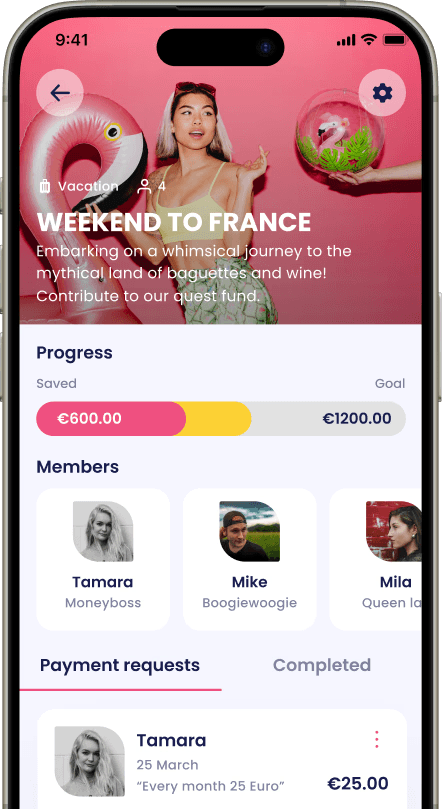
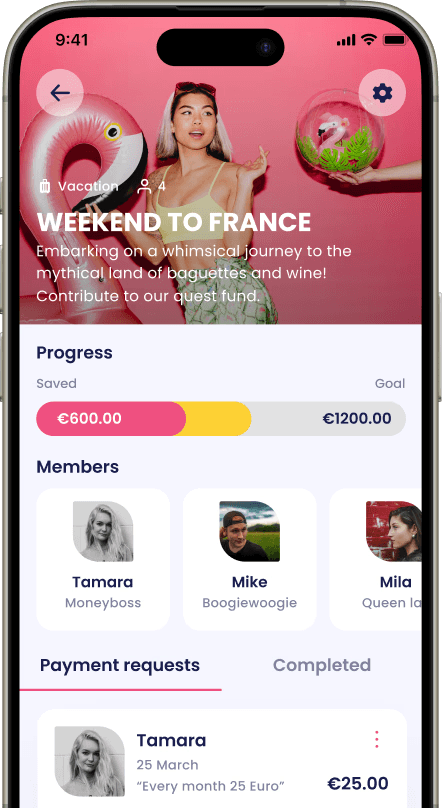
One platform taking a different approach is Potje. Groups can create dedicated money pots for holidays, group gifts, festivals, sports club fees, and any other shared goal. Everyone can see the progress toward the target. Nobody carries the financial burden alone.
What makes a money pot different from a payment request?
Tikkie (payment request) | Potje (money pot) | |
When money moves | After spending happens | Before spending happens |
Who carries the risk | The organiser | Nobody, it's shared |
Goal tracking | No | Yes, everyone sees progress |
Best for | One-off repayments | Planned group goals |
Group saving | No | Yes |
Automated reminders | No | Yes |
The organiser no longer needs to front hundreds of euros and hope everyone pays back in time. The group builds the money together, then spends it together.
When a Money Pot Beats a Payment Request
There are specific situations where sending a Tikkie simply creates more problems than it solves. These are the moments a money pot was built for.
Planning a group holiday or Airbnb
Someone has to book. That usually means one person puts €800 on their card and sends eight Tikkies into the group chat.
Then comes the waiting. One person pays immediately. Two pay after a reminder. One says they'll do it this weekend. One goes quiet.
With a money pot, the group contributes first. The booking only happens once the pot is full. Nobody fronts anything. No awkward reminders. No one-sided financial risk.
Collecting for a group gift
Birthdays, farewells, weddings. Everyone agrees to chip in €20. Someone volunteers to collect. They spend the next week messaging individually, keeping track in their head, and hoping they haven't miscounted.
A gift pot on Potje handles all of that automatically. Everyone contributes via a shared link. Progress is visible. The organiser doesn't have to chase a single person.
Sports club or recurring group costs
Monthly fees, kit orders, end-of-season events. These don't happen once. They happen every month.
Sending a Tikkie every month is manageable for two people. For a team of fifteen, it becomes a part-time job. A shared money pot keeps contributions organised in one place, with automated reminders doing the work.
Festival or trip planning with a budget
Planning Tomorrowland, a ski weekend, or a group city trip involves multiple costs over time: accommodation, transport, tickets, activities.
A dedicated holiday fund keeps all contributions in one place, tied to one shared goal. Everyone can see how close the group is to being able to book. That visibility alone removes most of the friction.
The rule of thumb: If the cost already happened, send a Tikkie. If the cost is still coming, create a pot.
How Potje Works in Practice
Getting started takes a few minutes. Only the organiser needs the app.
Create a pot with a name, a goal amount, and a deadline
Share the payment link with your group via WhatsApp, email, or any other channel
Everyone contributes via iDEAL, at their own pace, without needing to download anything
Track progress together as the pot fills up toward the goal
Spend when ready, knowing the money is already there
Contributors don't need an account. They click the link, pay via iDEAL, and that's it.
The organiser can see exactly who has contributed and how much is in the pot at any time. Automated reminders handle the chasing. No more awkward "hey, just a reminder..." messages in the group chat.
You can read a full step-by-step guide to setting up your first pot if you want to see the full process before you start.
Frequently Asked Questions
Is Potje better than Tikkie?
They serve different purposes. Tikkie is better for instant, one-off repayments after a cost has already occurred. Potje is better for planned group goals where everyone needs to contribute before the money gets spent. For a round of drinks, Tikkie is fine. For booking a group holiday, Potje removes the risk and the chasing entirely.
Can I use both Tikkie and Potje?
Yes. Many groups use Tikkie for small, spontaneous costs and Potje for planned savings goals. They complement each other rather than compete. The difference is the situation: reactive payment request versus proactive shared savings.
Do my friends need to download Potje to contribute?
No. Only the organiser needs the app. Contributors receive a payment link and pay directly via iDEAL. No account, no download, no friction.
What happens to the money in a Potje pot?
The money is held securely in a dedicated joint money account, separate from anyone's personal account. Everyone can see the balance and progress toward the goal. The organiser controls when and how the funds are used.
Is Potje free to use?
You can create a pot for free and start collecting straight away. Potje charges a small transaction fee on contributions, which is transparently shown before anyone pays.
Can Potje replace Tikkie for group trips?
For planned group trips, many groups find that Potje completely replaces their need for Tikkie. Rather than one person fronting the full cost and sending payment requests, the group saves together first. The money is ready before any booking is made.
Ready to Try a Different Approach?
Group money doesn't have to be the thing that creates friction between friends.
When you collect before you spend, the dynamic shifts completely. Nobody is owed anything. Nobody is chasing anyone. The group has a shared goal, a shared pot, and a shared sense of progress.
Tikkie changed how the Netherlands handles quick repayments. Potje is changing how groups save together before the spending begins.
If you have a group trip, a gift collection, or any shared goal coming up, create your first pot and see how different it feels when everyone contributes together from the start.
If you're saving up as a group for a trip, event, or gift, Potje makes it easy to collect money into one shared digital pot instead of chasing people for their share. Start a pot through this link and get your first month free. After that it's €5 a month per pot, taken straight from the pot balance, so there's nothing to pay upfront to start saving together.

Social Accountability and Saving: The Missing Link to Financial Freedom
Ondersteuning voor verschillende inhoudstypes zoals artikelen, blogs, video's en meer. Rijke tekstverwerker met opmaakopties voor verbeterde.
17 november, 2025

Group Saving Apps Compared: What's Easiest, Safest, and Most Transparent?
Ondersteuning voor verschillende inhoudstypes zoals artikelen, blogs, video's en meer. Rijke tekstverwerker met opmaakopties voor verbeterde.
17 november, 2025

Group Money Platforms Compared: What’s Safe, Regulated, and Fair?
Ondersteuning voor verschillende inhoudstypes zoals artikelen, blogs, video's en meer. Rijke tekstverwerker met opmaakopties voor verbeterde.
17 november, 2025