15 October 2026



Your group wants to save together. Simple enough. But then comes the question nobody thinks to ask until it causes problems: how should you actually structure it?
There are two fundamentally different models for group saving. One rotates the money around the group so each person gets a lump sum in turn. The other pools contributions toward one shared goal that everyone benefits from at the same time. Both work. But they work for very different groups, goals, and situations.
This guide breaks down exactly how each model operates, where each one falls short, and how to decide which suits your group.
Key takeaway: A savings circle (ROSCA) moves money through time so individuals get lump sums in rotation. A shared savings pot such as Potje pools contributions toward one collective goal. Most friend groups saving for a holiday, gift, or event will find the shared pot model far simpler and lower risk.
What Is a Savings Circle?
A savings circle, formally known as a Rotating Savings and Credit Association (ROSCA), is one of the oldest community finance systems in the world. According to the World Bank, around 25% of people in sub-Saharan Africa report having used a savings club. The model goes by different names depending on the culture: susu in West Africa, tontine in Senegal, Cameroon and other French-speaking African countries, chit fund in India, hui in China, and paluwagan in the Philippines.
The mechanics are straightforward.
How a Savings Circle Works
A fixed group of people agrees to contribute the same amount of money at regular intervals, typically monthly. Each round, the entire pooled amount goes to one member. The rotation continues until every member has received the pot once. Then the cycle ends or restarts.
A practical example:
10 friends each contribute €200 per month
Each month, one person receives the full €2,000 pot
After 10 months, every member has received €2,000 exactly once
Total in: €2,000 per person. Total out: €2,000 per person
Across the full cycle, nobody gains and nobody loses. The system simply moves money through time. The person who receives the pot in month one gets an interest-free advance. The person who receives it in month ten has been lending to the group for nearly a year.
How the Rotation Order Is Decided
Groups typically use one of four methods:
Method | How It Works | Best For |
Fixed rotation | Order is agreed at the start | Groups that want predictability |
Random draw | Names are drawn each round | Groups that want fairness without negotiation |
Bidding | Members bid to receive the pot sooner by accepting a smaller amount | Groups with varying urgency levels |
Need-based | The group decides collectively who needs funds most | Close-knit mutual aid groups |
The Real Risk Most People Miss
The savings circle model carries a significant structural risk that is easy to overlook.
Before your turn arrives, you are effectively lending money to the group. After your turn, you owe the group the equivalent of what you received minus what you have paid in. If someone receives the pot early and then stops contributing, the remaining members absorb that loss directly.
There is no regulation protecting you in an informal savings circle. No consumer protection scheme, no deposit guarantee, no legal recourse beyond whatever personal relationship you have with the defaulting member. A 2021 feasibility report by The Hague University of Applied Sciences on savings groups in five European countries, including the Netherlands, describes ROSCAs as informal arrangements built on trust.
This is why savings circles work best among people with very strong existing relationships, and why they tend to break down when group dynamics shift.
What Is a Shared Savings Pot?
A shared savings pot works on an entirely different principle. Instead of rotating a lump sum around the group, everyone contributes toward one collective goal. The money accumulates in a single shared account. When the group reaches its target, everyone benefits at the same time.
This is the model most European friend groups are actually looking for when they want to save together.
How a Shared Savings Pot Works
The group sets a shared goal: a holiday, a group gift, a festival, a team event
Each member contributes a fixed or flexible amount, regularly or as they can
The money sits in one shared account, visible to everyone
When the target is reached, the funds are used for the shared purpose
A practical example:
6 friends want to book an Airbnb for a weekend trip costing €900
Each person contributes €150 over two months
The pot reaches €900, the booking is made, and everyone goes
Nobody had to front the money. Nobody had to chase anyone afterwards.
That is the core difference. A savings circle moves money between individuals at different points in time. A shared savings pot moves money toward one shared moment.
Why This Model Works for Most Groups
The shared pot model is lower risk because the money stays pooled until the goal is reached. Nobody receives an advance. Nobody owes the group anything. The relationship between members stays clean.
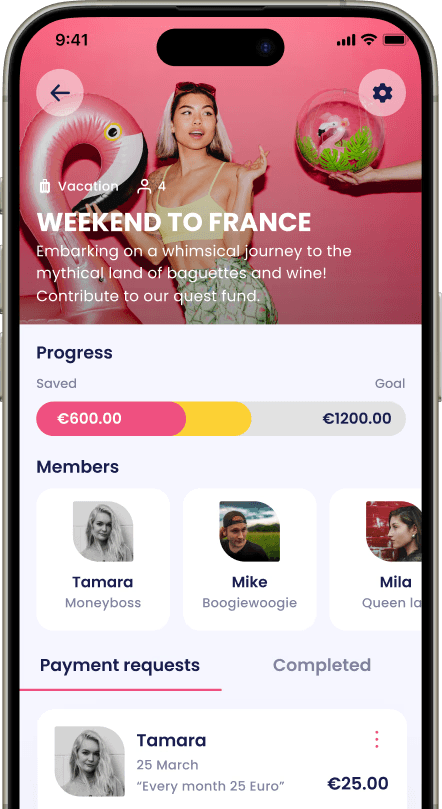
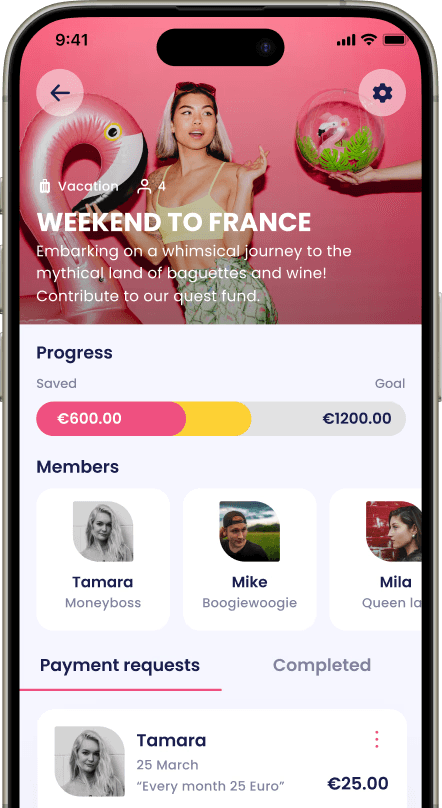
It is also far easier to manage digitally. Potje is built specifically for this model, with automated contribution reminders, real-time progress tracking, and instant payouts when the goal is reached.
Key advantages of the shared savings pot:
Everyone sees progress toward the goal in real time
No individual receives a lump sum before others have contributed
Lower trust requirement than a savings circle
Works for any group size, from 2 people upward, saving for a specific shared experience
Rather than asking one person to collect and hold the money, Potje creates a dedicated shared money pot where every member contributes directly. The organiser does not carry the financial burden. Everyone can see the balance. And when the group is ready, the money is paid out instantly, regardless of the amount.
Potje's first month is completely free. After that, the total cost is €5 per month, shared automatically across the entire group. For a group of five, that is €1 per person per month. For a group of ten, it is just €0.50 each.
You can pay into a Potje pot using Pay by Bank, Bancontact, iDEAL | Wero or SEPA bank transfer.
Savings Circle vs Shared Savings Pot: Side-by-Side Comparison
Here is how the two models compare across the decisions that matter most for a typical European group.
Feature | Savings Circle (ROSCA) | Shared Savings Pot (Potje) |
How it works | One member receives the full pot each round in rotation | All contributions accumulate until the shared goal is reached |
Best for | Individual financial needs at different points in time | One shared goal: holiday, gift, event, trip |
Trust requirement | Very high. Early recipients hold an advance on others' money | Moderate. Money stays pooled and visible to all |
Risk if someone leaves | Remaining members absorb the shortfall | Funds stay in the pot; no individual is owed money |
Transparency | Depends on the organiser's record-keeping | Real-time balance visible to all members |
Ideal group size | Often 5 to 20 members | Any size, from 2 people upward |
Timeline | Fixed: ends when all members have received a payout | Flexible: ends when the savings target is reached |
Payout | Individual lump sums, one per member per cycle | Collective payout when the goal is hit |
The bottom line: If your group has a shared goal everyone benefits from together, the shared savings pot is almost always the better choice. The savings circle model serves individual needs at different times, which is useful in specific cultural contexts but harder to manage for most modern European friend groups.
Which Model Suits Your Group?
The right answer depends on what your group is actually trying to achieve.
Choose a Savings Circle If...
Your group members have different individual financial goals that are not shared
You have a very high level of mutual trust built over years
You are comfortable with informal arrangements and do not need regulatory protection
Your group is culturally familiar with the ROSCA model (susu, tontine, etc.)
You want to help members access larger lump sums without taking out a loan
A savings circle can be a powerful tool in the right context. It is particularly effective for tight-knit communities where the social pressure to contribute is strong enough to replace formal enforcement.
Choose a Shared Savings Pot If...
Your group is saving for one shared experience: a holiday, a festival, a group gift, a birthday trip
You want full transparency so every member can see the balance at any time
You want the money held somewhere secure, not sitting in one person's own bank account
You want automated reminders so you are not the one chasing people for contributions
You want the flexibility to pay out any amount at any time, without waiting for a full cycle to complete
This is the model that works for planning a Tomorrowland trip with eight friends, collecting for a colleague's leaving gift, or building a shared fund for your sports team's annual weekend away.
The Old Way vs the Better Way
Old way: one person pays for the Airbnb on their credit card. Everyone promises to transfer their share. Someone forgets. Someone sends the wrong amount. The organiser spends three weeks chasing.
Better way: everyone contributes to a shared pot before the booking is made. The money is already there. The organiser pays out the pot and makes the booking. No chasing. No awkwardness. No one person carrying the financial burden.
That shift, from collecting after spending to collecting before spending, is what makes the shared savings pot model work so well for most groups. You can read more about how to collect money for a group trip without the awkward chasing and why group saving works better than everyone paying separately.
How to Set Up a Shared Savings Pot with Potje
Setting up a shared money pot with Potje takes a few minutes. Not everyone in the group needs to download the app, because the money boss can also share a payment link for one-time contributions.
Step-by-Step
Create your pot at app.potje.tech/store. Give it a name and set your savings goal.
Share the link with your group via WhatsApp, email, or any messaging app.
Everyone contributes using their preferred payment method: Pay by Bank, Bancontact, iDEAL | Wero or SEPA bank transfer.
Track progress in real time. Everyone can see how close the group is to the goal.
Pay out instantly whenever you are ready. There is no minimum payout amount, and there is no fee on partial payouts.
Your first month is completely free. After that, the €5 monthly fee is split automatically across all members.
No spreadsheets. No chasing. No one person holding everyone else's money.
Potje is built around the idea that group money should be organised before it becomes a problem. For a deeper look at how the platform works, read the step-by-step guide to setting up a group money pot with Potje.
You can also explore how Potje compares to other group saving approaches in our guide on digital money pot vs joint bank account vs split app.
Frequently Asked Questions
What is the difference between a savings circle and a shared savings pot?
A savings circle (ROSCA) rotates the pooled contributions so each member receives a lump sum at a different point in the cycle. A shared savings pot accumulates contributions toward one collective goal that all members benefit from at the same time. The key distinction is whether money flows to individuals in turns or toward one shared experience.
What happens if someone stops contributing to a savings circle?
If a member leaves or stops contributing after receiving their payout, the remaining members absorb the shortfall. There is no formal mechanism to recover the money in an informal ROSCA. This is the primary risk of the savings circle model.
How many people do you need for a savings circle?
Savings circles often have somewhere between 5 and 20 members. Fewer members means longer waits between payouts for those at the end of the rotation. More members increases the complexity and the risk of someone dropping out.
Can I do a partial payout from a shared savings pot?
Yes. With Potje, you can pay out any amount at any time. There is no minimum payout, and there is no fee on partial payouts. This gives your group flexibility to spend some of the pot while continuing to save the rest.
How much does Potje cost?
The total cost is €5 per month for the entire group, split automatically. For a group of five, that is €1 each per month. For a group of ten, it is €0.50 each. Your first month is completely free.
What payment methods does Potje accept?
Potje supports Pay by Bank, Bancontact, iDEAL | Wero and SEPA bank transfer. Members can contribute using whichever method works best for them.
Is a shared savings pot better than a savings circle for a group holiday?
For a group holiday, a shared savings pot is almost always the better choice. Everyone saves toward the same goal, the money is held securely, everyone can see progress, and the funds are available the moment the group is ready to book. There is no rotation, no waiting for your turn, and no risk that one person receives money and disappears. You can read more in our guide on how to save for a group trip without anyone dropping out.
What is a ROSCA?
ROSCA stands for Rotating Savings and Credit Association. It is the formal name for a savings circle: a group of people who contribute a fixed amount regularly, with the entire pool going to one member each round in rotation until everyone has received it once. According to research on ROSCAs, around 25% of people in sub-Saharan Africa have used a savings club, based on World Bank figures. The system goes by many different names around the world.
Start Your Group Savings Pot Today
Group money does not have to be complicated.
Whether you are planning a weekend away, collecting for a group gift, or building a shared fund for a festival, a shared savings pot gives your group a clear goal, full transparency, and zero awkwardness.
Your first month with Potje is completely free.
Create your shared savings pot now and invite your group in minutes.

Social Accountability and Saving: The Missing Link to Financial Freedom
Ondersteuning voor verschillende inhoudstypes zoals artikelen, blogs, video's en meer. Rijke tekstverwerker met opmaakopties voor verbeterde.
17 november, 2025

Group Saving Apps Compared: What's Easiest, Safest, and Most Transparent?
Ondersteuning voor verschillende inhoudstypes zoals artikelen, blogs, video's en meer. Rijke tekstverwerker met opmaakopties voor verbeterde.
17 november, 2025

Group Money Platforms Compared: What’s Safe, Regulated, and Fair?
Ondersteuning voor verschillende inhoudstypes zoals artikelen, blogs, video's en meer. Rijke tekstverwerker met opmaakopties voor verbeterde.
17 november, 2025