14 October 2026



You know how it goes.
Someone books the Airbnb. Someone else pays for the train tickets. A third person covers the first supermarket run. Three weeks later, you are sitting in a group chat with a spreadsheet nobody can agree on, two people who "definitely already paid" and one person who has gone suspiciously quiet.
Group money is simple in theory. In practice, it is one of the fastest ways to create friction between people who actually like each other.
This guide gives you a free group payment tracker template: a simple table in this article that you can copy into Google Sheets or Excel and use right now. It also explains when a tracker stops being enough, and when a shared money pot like Potje is the better option.
The short answer: a tracker tells you who owes what. A shared money pot like Potje means nobody owes anything, because everyone contributes before the spending starts.
Let's cover both.
Why Group Payments Go Wrong
Group money problems are rarely about bad intentions. Most people genuinely mean to pay. The problem is the system, or rather, the lack of one.
Here is what typically happens without a clear tracker in place:
One person fronts the money and becomes the unofficial debt collector for the group
Payments trickle in at different times, making it hard to know the current balance
Partial payments create confusion about whether someone has settled in full
No central record exists, so everyone has a different version of events
Reminders feel awkward, especially when it involves close friends or family
The result? The organiser ends up out of pocket, stressed, and quietly resentful. The group ends up with a weird atmosphere that nobody wants to name.
A group payment tracker does not fix the behaviour. But it removes the ambiguity. When everyone can see the same information, there is less room for misunderstanding.
In practice, the most common group money dispute is about whether a payment was made at all.
That is exactly what a good tracker solves.
The Free Group Payment Tracker Template
You do not need a paid app or a complicated spreadsheet to start tracking group payments. The template below works in Google Sheets, Excel, or any table-based tool. Copy it, add your group's names, and you are ready.
How to Set It Up
Create a spreadsheet with the following columns:
Name | Amount Owed (€) | Amount Paid (€) | Payment Date | Method | Status |
Sarah | €120 | €120 | 14/08/2026 | iDEAL | Wero | Paid |
Tom | €120 | €60 | 20/08/2026 | Bancontact | Partial |
Mia | €120 | €0 | Unpaid | ||
Lucas | €120 | €120 | 12/08/2026 | SEPA | Paid |
Column guide:
Name: Every person in the group gets a row
Amount Owed: The agreed contribution per person
Amount Paid: What they have actually transferred so far
Payment Date: When the payment arrived, not when they said they would pay
Method: How they paid. Common options include Visa, Bancontact, iDEAL | Wero, SEPA, and Revolut
Status: Paid / Partial / Unpaid. Update this as money comes in
Tips for Keeping the Tracker Accurate
Assign one person as the keeper. The tracker only works if one person updates it consistently. Decide this upfront.
Record partial payments separately. If Tom pays €60 now and €60 later, log both with dates. Do not overwrite the first entry.
Share view access with the whole group. When everyone can see the tracker, there are fewer disputes. Use Google Sheets and share a view-only link.
Set a payment deadline before the event. "Pay whenever" is not a deadline. "Pay by the 1st" is.
Note the payment method. If someone claims they paid via Revolut and you received nothing, you need to know where to look.
What the Tracker Cannot Do
A tracker is a passive record. It shows you the problem but does not prevent it.
It cannot send automatic reminders. It cannot chase the person who has been "about to pay" for three weeks. And it cannot stop one person from carrying the financial burden while waiting for everyone else to catch up.
That is where a shared money pot changes everything.
When to Switch from a Tracker to a Shared Pot
A tracker works well for simple, one-off situations. You split a dinner bill. You share a taxi. Someone covers the pizza and the others transfer back. Done.
But the moment the situation gets more complex, a tracker starts to show its limits. According to the European Consumer Payment Report, payment behaviour across Europe differs by income and age group, so in most groups some people will pay later than others. In our experience, unclear contribution records, not dishonesty, sit at the root of most group payment disputes.
Signs Your Group Has Outgrown a Spreadsheet
More than four people are involved. Beyond a certain size, the tracker becomes a full-time job for the organiser.
Money is being collected over several weeks or months. A holiday fund, a group gift, a sports club subscription. These are ongoing collections, not one-off splits.
Multiple expenses need to be covered before everyone has paid. Someone is fronting costs and hoping to be reimbursed. That is a risk.
People are paying at different times and in different amounts. Partial payments, late payments, top-ups. The tracker gets complicated fast.
The group has had a money disagreement before. If there was friction last time, a spreadsheet will not save you this time.
What a Shared Money Pot Does Differently
A shared money pot flips the model entirely.
Instead of one person paying first and chasing everyone afterwards, the group collects the money upfront into a shared pot. Everyone contributes before a single euro is spent.
This is the core difference. And it matters more than it sounds.
With a shared pot:
Nobody carries the financial burden alone
The organiser does not become the group's personal bank
Spending only happens when the money is actually there
Everyone can see the progress towards the goal
There is nothing to chase, because the money arrives before it is needed
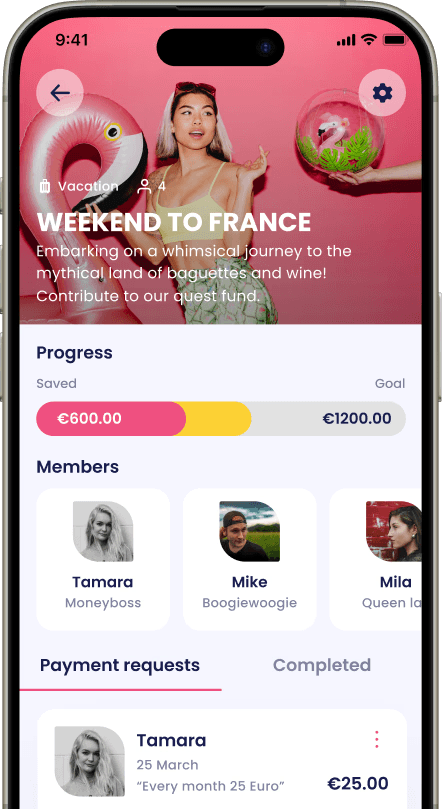
Potje is built specifically for this. You create a shared money pot, set a goal, and share a payment link with the group. Members contribute via Visa, Bancontact, iDEAL | Wero, SEPA, or Revolut. Everyone in the group sees the live balance, without anyone maintaining a spreadsheet.
For a deeper look at how this compares to traditional approaches, see our guide on group money management: shared expense tracker vs shared savings account.
How Potje Works for Group Collections
Potje is a joint money account built for groups. It is not a payment app. It is not a bank. It is a shared money pot that your group contributes to together, with a clear goal and full visibility for everyone involved.
Getting Started
Setting up a pot works like this:
Create a pot with a name and a goal amount (e.g. "Barcelona Trip 2027 - €800")
Share the payment link with your group via WhatsApp, email, or any messaging app
Group members contribute using Visa, Bancontact, iDEAL | Wero, SEPA, or Revolut
Track progress in real time without a spreadsheet or manual updates
Pay out instantly when the goal is reached, or at any point along the way
What Makes Potje Different
Your first month is free. There is no cost to try Potje and see if it works for your group.
Instant payouts of any amount. You do not have to wait until the pot is full. If you need to pay a deposit today, you can pay it out today. No minimum. No waiting period.
No fee on partial payouts. If you withdraw part of the pot to cover an early expense, you are not charged for it. The money is yours to use when you need it.
The cost is shared automatically. Active pots cost €5.00 per month in total, deducted from the pot balance, so the cost is split across the whole group. With five people, that is €1.00 each. With ten people, it is €0.50 each. The organiser does not carry the cost alone.
Full transparency. Everyone in the group sees the live balance of the pot. Potje also sends automatic payment requests and follows up with late payers, so the reminders a tracker cannot send are taken care of. No more "I definitely paid" conversations. The record is there.
For groups that have struggled with the pay-later model before, Potje removes the problem at the source. There is no debt to chase because the money is collected before it is spent. Read more about how to collect money for a group trip without the awkward chasing.
Who Uses Potje
Potje works for any group with a shared goal:
Friends saving for a holiday, festival, or weekend away
Families collecting for a birthday, anniversary, or Christmas gift
Colleagues running an office collection or farewell fund
Sports clubs gathering membership fees or kit contributions
Student groups splitting accommodation or event costs
If your group has a shared goal and more than two people, Potje is built for this. See a step-by-step guide to setting up a group money pot with Potje for a full walkthrough.
Tracker vs Shared Pot: Which Is Right for Your Group?
Not every situation calls for a shared pot. Here is a simple way to decide.
Situation | Best Approach |
Quick dinner split between 2-3 people | Payment tracker or direct transfer |
One-off group gift collected upfront | Shared pot (Potje) |
Holiday fund over several months | Shared pot (Potje) |
Ongoing club or team fees | Shared pot (Potje) |
Post-event repayment between close friends | Payment tracker |
Large group (5+ people) with multiple expenses | Shared pot (Potje) |
Any situation where someone has to front money | Shared pot (Potje) |
The rule of thumb: if money needs to be collected before it is spent, use a shared pot. If you are settling up after the fact, a tracker works fine.
The tracker is a useful tool. But it is a reactive tool. It records what has already happened. A shared pot is proactive. It organises the money before anyone needs to spend it.
For groups that regularly plan things together, the shared pot model is simply less work for everyone involved. There is no spreadsheet to maintain, no reminders to send, and no awkward conversations about who still owes what.
Explore how groups manage shared holiday costs to understand which approach suits your next trip or event.
Frequently Asked Questions
What is a group payment tracker?
A group payment tracker is a shared record that shows who owes money, how much they have paid, when they paid it, and whether they have settled in full. It is typically a spreadsheet or table that the organiser maintains and shares with the group.
How do I track who has paid in a group?
Create a simple table with each person's name, the amount they owe, the amount they have paid, the date of payment, and the payment method. Update it each time a payment arrives. Share it with the group via Google Sheets so everyone has visibility. For larger groups or ongoing collections, a shared money pot like Potje handles this automatically.
What is the best free group payment tracker template?
The simplest approach is a Google Sheet with six columns: Name, Amount Owed, Amount Paid, Payment Date, Payment Method, and Status. This covers the information you need without overcomplicating the process. The template in this article is a table you can copy into Google Sheets or Excel for free.
When should I use a shared pot instead of a tracker?
Use a shared pot when your group has more than four people, when money needs to be collected over several weeks or months, or when one person would otherwise have to front costs and wait for reimbursement. A shared pot like Potje collects contributions upfront so there is nothing to chase afterwards.
How does Potje handle partial payments?
With Potje, group members can contribute any amount at any time. Everyone in the group sees the live balance of the pot. There are no fees on partial payouts, meaning the organiser can withdraw money from the pot at any point, even before the full goal is reached, to cover early expenses like deposits or bookings.
What payment methods does Potje support?
Potje supports Visa, Bancontact, iDEAL | Wero, SEPA, and Revolut. This lets everyone pay into the pot from any bank, in 30+ countries across the EEA, making it straightforward for groups with members in different countries.
Is Potje free to use?
Your first month is completely free. After that, active pots cost €5.00 per month in total, deducted from the pot balance and shared automatically across the whole group. With five people, that is €1.00 each per month. With ten people, it is €0.50 each.
Can the whole group see who has paid?
Everyone in the group sees the live balance of the pot in real time, and Potje sends automatic payment requests and chases late payers for you. This removes the most common source of group money disputes: the question of whether someone has actually paid.
Stop Chasing. Start a Shared Pot.
The tracker in this article will help you today. It is practical, free, and better than nothing.
But if you are tired of being the one who keeps track, sends the reminders, and absorbs the cost while waiting for everyone else to pay, there is a better way to organise group money.
Collect before you spend. Contribute upfront. No chasing required.
Potje gives your group a shared money pot with full transparency, instant payouts, no fees on partial withdrawals, and your first month completely free.
Start your shared pot today and let the group see exactly where things stand, without a single spreadsheet.

Social Accountability and Saving: The Missing Link to Financial Freedom
Ondersteuning voor verschillende inhoudstypes zoals artikelen, blogs, video's en meer. Rijke tekstverwerker met opmaakopties voor verbeterde.
17 november, 2025

Group Saving Apps Compared: What's Easiest, Safest, and Most Transparent?
Ondersteuning voor verschillende inhoudstypes zoals artikelen, blogs, video's en meer. Rijke tekstverwerker met opmaakopties voor verbeterde.
17 november, 2025

Group Money Platforms Compared: What’s Safe, Regulated, and Fair?
Ondersteuning voor verschillende inhoudstypes zoals artikelen, blogs, video's en meer. Rijke tekstverwerker met opmaakopties voor verbeterde.
17 november, 2025