21 October 2026



Family reunions are wonderful in theory.
Everyone agrees it is overdue. Someone picks a weekend. A group chat is created. And then, almost immediately, the money conversation starts.
Who pays for the holiday home? What about food? Does the weekend include activities, or is everyone sorting themselves out? And who on earth is going to front the deposit?
The problem is not the money itself. It is the chaos of collecting it from multiple households at once.
When four, six or ten different families all need to contribute, the old approach falls apart quickly. Someone sends too little. Someone forgets entirely. The organiser ends up carrying the cost and chasing everyone for weeks afterwards. What was meant to be a joyful occasion becomes a spreadsheet nightmare.
There is a better way. Collect the money upfront, before anything gets booked, using a shared money pot like Potje that every household can pay into. This guide walks you through exactly how to do it, step by step.
Key takeaway: Collect by household, not by individual. Set a clear total, open a shared pot, and let everyone contribute before a single deposit is paid.
Step 1: Work Out the Total Cost Per Household Before You Do Anything Else
The biggest mistake reunion organisers make is announcing a weekend before the numbers are clear.
People say yes to the idea of a reunion. They say no when the invoice lands two weeks before the trip.
Avoid this by building a simple budget first. Think in households, not individuals. A family of four and a solo cousin are two separate paying units. Treating them the same creates resentment before the weekend even starts.
What to include in your shared budget
Split your costs into two clear categories.
Shared costs (split equally by household):
Holiday home or venue hire
Shared groceries and group meals
Group activities everyone joins
A contingency buffer of around 10 to 15% of the total
Individual costs (each household sorts their own):
Travel to the venue
Optional excursions or extras
Personal spending money
Once you have a realistic shared total, divide it by the number of households attending. Publish that number clearly, with a breakdown, before anyone commits. Families can then decide whether they are in for the full weekend or just part of it.
Practical tip: Planning 40 people across roughly 12 households? For example, if the shared total comes to €2,640 and 12 households attend, each household pays €220. Set the number early so no one is surprised.
For more on how to structure group costs fairly, see our guide on how to collect money for a group trip without the awkward chasing.
Step 2: Open a Shared Money Pot Before You Open Any Booking Pages
Here is where most groups go wrong.
Someone books the holiday home on their own card, planning to collect the money from everyone afterwards. Then the chasing begins. Some households pay quickly. Others take weeks. One family sends the wrong amount. The organiser is out of pocket for the entire deposit while the group chat goes quiet.
The fix is simple: collect the money first.
Open a shared money pot, set the target amount, and share the link with every household. Nobody books anything until the money is in the pot. This one change removes the awkward debt conversation entirely.
Why a dedicated money pot works better than a group chat and bank transfer
When you ask households to transfer money to a personal account, you create a record-keeping problem. Who has paid? How much? When did they send it? You end up managing a spreadsheet alongside the actual reunion planning.
A shared money pot keeps everything in one place:
Every household can see the running total
Contributions are tracked automatically
No one person carries the financial risk
The organiser does not need to chase manually
This is exactly the difference between a shared expense tracker and a shared savings account. A tracker tells you who owes what after the fact. A shared pot collects the money before anything gets spent.
Collect before you spend. That is the principle that makes group money work.
Step 3: How Potje Makes This Straightforward
Potje is built for exactly this.
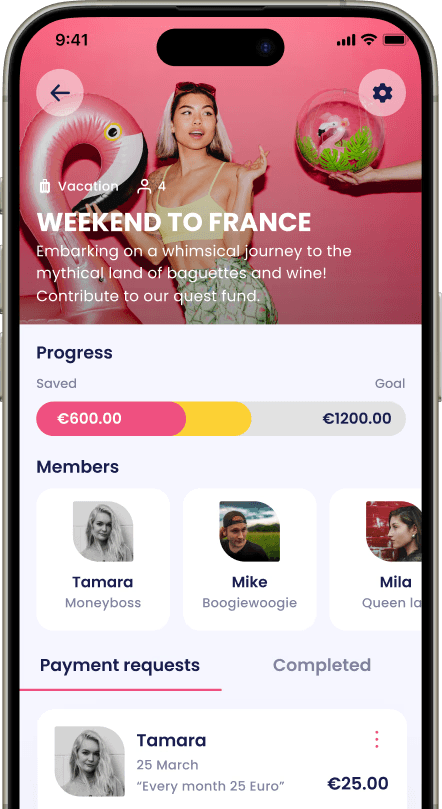
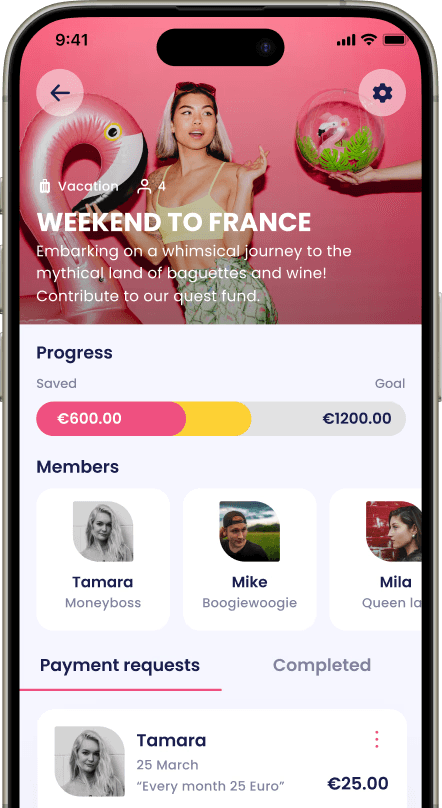
Rather than asking everyone to repay someone after the event, Potje helps groups collect contributions upfront into a shared money pot. Every household pays in before anything gets booked. The organiser sees progress in real time. When the target is reached, the money is there and ready.
What makes Potje suited to family reunion weekends
One pot, multiple households. Create a single pot for the whole weekend and share the payment link. Each household contributes their share directly, using their preferred payment method.
Supported payment methods. Households can pay via Pay by Bank, Bancontact, iDEAL | Wero or SEPA bank transfer, so every household can pay from its own bank.
Instant payouts of any amount. Once you are ready to pay the venue deposit or book activities, you can pay out immediately. There is no waiting period and no minimum withdrawal.
No fee on partial payouts. If you need to release part of the pot early, for example to secure a venue deposit, you can do so without any additional charge.
Your first month is free. After that, one small monthly fee is shared by the whole group (see below).
Automated payment reminders. If a household has not yet contributed, Potje sends reminders automatically. The organiser does not have to send awkward follow-up messages.
How the cost works: The €5 monthly fee is split across the whole group, not paid by one person. If each household joins with one member, five households pay €1.00 each per month and ten pay €0.50 each. The first month is free, so if you collect within that month, the full reunion budget costs you nothing extra.
This means the organiser is not fronting any money, not managing any spreadsheets, and not chasing anyone for their share. The pot does the work.
For a full walkthrough of getting started, see a step-by-step guide to setting up a group money pot with Potje.
Step 4: Set the Rules Before You Share the Link
A shared pot works best when everyone understands the rules from the start.
Before you share the payment link with the group, agree on three things.
The contribution amount per household
Be specific. "Around €200 per family" leaves room for interpretation and confusion. "€220 per household, covering the venue, shared meals and Saturday activities" is clear and defensible.
If households vary significantly in size, you can adjust. Some groups charge full price per adult and half price for children under twelve. Others keep it simple and charge a flat rate per household regardless of size. Either approach works, as long as you publish the logic before anyone pays.
The payment deadline
Set a firm date by which every household must have contributed. Make it at least two weeks before you need to pay the venue deposit. This gives you time to follow up with anyone who has not yet paid, without the pressure of an imminent booking.
What happens if someone drops out
Agree on a cancellation policy upfront. If a household confirms and then pulls out close to the date, are they entitled to a refund from the pot? Partial or full? Deciding this in advance avoids a very uncomfortable conversation later.
Write these three things down and share them with the group at the same time as the payment link. Transparency removes the awkwardness from money conversations before they start.
For practical advice on keeping the group aligned without arguments, see how to split holiday costs with friends without arguments.
Step 5: Manage the Weekend Budget as You Go
Once the pot is full and the venue is booked, the money management does not stop. It just becomes easier.
Use the shared pot as the weekend budget. Rather than one person paying for everything on their personal card and then requesting repayment, the money boss pays out from the pot as costs arise.
A simple approach to weekend spending
Cost category | How to handle it |
Venue deposit | Pay out from the pot as soon as it is due |
Shared groceries | Assign one household to buy, reimburse from pot |
Group activities | Pay out from the pot, then book |
Unexpected costs | Draw from the contingency buffer built into the total |
Individual extras | Each household covers their own |
This approach keeps the shared finances clean and separate from personal spending. Nobody needs to track who owes whom for the weekend shop. The pot covers what the group agreed to cover. Everything else is personal.
What to do with leftover money
If the weekend comes in under budget, you have options. The money boss can pay out the balance and transfer each household its proportional share, roll the balance into a pot for the next reunion, or use it for a final group dinner.
Agree on this before the weekend, not after. It avoids a situation where the organiser is left holding money that everyone has forgotten about but nobody wants to write off.
Good to know: With Potje, you can make instant payouts of any amount at any time during the weekend. No minimum. No fee for partial withdrawals. If you need to pay for something unexpected, the money is accessible immediately.
Why the Old Way Keeps Causing Problems
Most families still organise reunion money the way they always have.
One person volunteers to coordinate. They front the venue deposit from their own account. They send a message to the group asking everyone to transfer their share. A few people do it immediately. Several others mean to but forget. One household sends the wrong amount. The organiser spends the next three weeks following up.
By the time the weekend arrives, the organiser is exhausted before it has even started.
The three most common money problems at family reunions
1. One person carries the financial risk
When the organiser fronts the deposit, they are personally liable if anything goes wrong. If the venue cancels, if headcounts change, if someone drops out last minute, the organiser absorbs the uncertainty. That is not a fair position to put anyone in.
2. Contributions arrive at different times
Bank transfers trickle in over weeks. Some arrive before the deadline. Others arrive late. A few never arrive at all. The organiser has to track every payment manually and reconcile it against a list of households.
3. Disagreements about what was agreed
When money conversations happen over a group chat, things get lost. Someone claims they were never told the amount. Another household thought the weekend cost less than it did. Without a clear record, these conversations become disputes.
A shared money pot solves all three. Every household can see the target and the live balance. The record is automatic. The risk is shared. And the organiser can focus on planning a great weekend rather than managing a debt spreadsheet.
To understand more about why the upfront model works better than splitting after the fact, read our piece on digital money pots versus joint bank accounts versus split apps.
Frequently Asked Questions
How do we split the cost fairly when households are different sizes?
The most common approach is to charge per household rather than per person. A family of five and a couple both pay the same household contribution for shared costs like venue hire and group meals. For activities, you can charge per adult and half price for children under twelve. Publish the formula clearly before anyone pays.
What if a household cannot afford the full amount upfront?
Potje supports partial contributions. A household can pay in stages towards their total, and the pot tracks the running balance. Set a final deadline by which the full household contribution must be in, and let families manage their own timeline within that window.
Which payment methods can households use to contribute?
Potje supports Pay by Bank, Bancontact, iDEAL | Wero and SEPA bank transfer so every household can pay from its own bank.
Can we make partial payouts from the pot before the weekend?
Yes. Potje allows instant payouts of any amount, with no fee on partial withdrawals. If the venue asks for a deposit while contributions are still coming in, you can pay out the amount already collected straight away.
How much does Potje cost?
Potje costs €5 per month in total, shared automatically across the group. If each household joins with one member, five households pay €1.00 each per month and ten pay €0.50 each. Your first month is completely free.
Do all households need to download the Potje app?
Not for a one-time contribution. The money boss can share a payment link outside the app, so people can pay without downloading anything. If you're saving together over a longer period, it's best if everyone gets the app for the reminders and the overview.
What happens to leftover money after the weekend?
Agree on this before the weekend: refund each household its share, carry it over to the next reunion's pot, or spend it on a closing dinner. Potje lets you pay out the full balance instantly whenever you are ready.
Start Your Family Reunion Pot Today
The reunion itself should be the part everyone looks forward to.
Not the money conversation. Not the chasing. Not the spreadsheet.
When you collect contributions upfront by household, set clear rules before the link goes out, and use a shared pot to hold and manage the budget, the financial side of a family reunion becomes simple. Everyone knows what they owe. Everyone can see progress. Nobody carries the risk alone.
Your first month with Potje is free. Create your family reunion pot, set your target, share the link, and start collecting contributions before you book a single thing.

Social Accountability and Saving: The Missing Link to Financial Freedom
Ondersteuning voor verschillende inhoudstypes zoals artikelen, blogs, video's en meer. Rijke tekstverwerker met opmaakopties voor verbeterde.
17 november, 2025

Group Saving Apps Compared: What's Easiest, Safest, and Most Transparent?
Ondersteuning voor verschillende inhoudstypes zoals artikelen, blogs, video's en meer. Rijke tekstverwerker met opmaakopties voor verbeterde.
17 november, 2025

Group Money Platforms Compared: What’s Safe, Regulated, and Fair?
Ondersteuning voor verschillende inhoudstypes zoals artikelen, blogs, video's en meer. Rijke tekstverwerker met opmaakopties voor verbeterde.
17 november, 2025